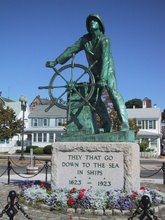
Far more significant than the exit of the undistinguished Larry Craig (R-ID) is the announcement by John Warner (R-VA) that he will not seek another term in the Senate in 2008. Warner, who is a terrific advertisement for old age (he's a VERY healthy looking 80) made headlines last week when he, albeit belatedly, told the White House publicly that the time has come to start pulling troops out of Iraq. Warner is also one of the more-or-less true conservatives, as distinguished from the reactionaries of Deadeye Dick's ilk, who has maintained at least a semblance of civility in Washington during the Bush administration.
Warner's departure puts the Virginia senate seat even more in play than it would have been had he run. The Old Dominion has been trending Democratic in recent years, as a swelling Hispanic population and a shift of gravity toward the Washington suburbs have reduced--and even eliminated--the state's traditional conservative tilt. Virginia has elected two consecutive Democratic governors and last year Jim Webb knocked George "Macacawitz" Allen out of the Senate. (We New Englanders might say that Virginia is the southern New Hampshire). Will Mark Warner, the former Democratic governor and no relation to the retiring senator, declare for the Senate? He was overwhelmingly popular as governor; he could be a very strong candidate next year. (For one thing, voters could keep their "Warner for Senate" bumper stickers). Stay tuned.
Friday, August 31, 2007


So long, Larry
Larry Craig will slink out of Washington by announcing his resignation from the Senate on the Saturday of Labor Day weekend. Apparently, he thinks no one will notice.
More outrage
Hard to believe that this administration could engage in even more outrageous conduct, but The Washington Post reports that American authorities in Baghdad's Green Zone have been handing out "tip sheets" on Democratic lawmakers who have come to Iraq as part of their congressional oversight responsibilities (and to help their credibility back home, let's admit). These sheets, which talkingpointsmemo.com aptly notes "read like they were written by the RNC," represent the latest effort to politicize every aspect of United States government policy. If politics no longer stops at the water's edge, we might at least have expected it to stop in the war zone. But no.
Even after all this time, we need to remind ourselves that they truly have NO shame.
Even after all this time, we need to remind ourselves that they truly have NO shame.
Thursday, August 30, 2007
Curiouser and curiouser
Even as someone who's expressed sympathy for Larry Craig (R-ID), I must confess to amusement at the way that his fellow (no, I don't mean it THAT way) Repubs are leading the pack calling for him to resign from Congress. The wonderful Gail Collins explains it all for us in today's New York Times.
I particularly liked this gem: "Mitt Romney absolutely raced to condemn his former campaign committee luminary. Really, it was a good thing that when word about Craig first came out there weren’t any small children or elderly people between him and the nearest microphone. Romney not only wanted to distance himself from anything involving the term 'he said-he said,' he was also fighting the whole school of thought that discounts the importance of a candidate’s private behavior. As the only leading Republican candidate for president who is still on his first wife, Romney wants private behavior way, way up there at the top of the list."
The more I see of Mitt, the harder it is for me to tell whose hypocritical moralizing I like less, his or Larry Craig's.
I particularly liked this gem: "Mitt Romney absolutely raced to condemn his former campaign committee luminary. Really, it was a good thing that when word about Craig first came out there weren’t any small children or elderly people between him and the nearest microphone. Romney not only wanted to distance himself from anything involving the term 'he said-he said,' he was also fighting the whole school of thought that discounts the importance of a candidate’s private behavior. As the only leading Republican candidate for president who is still on his first wife, Romney wants private behavior way, way up there at the top of the list."
The more I see of Mitt, the harder it is for me to tell whose hypocritical moralizing I like less, his or Larry Craig's.
Wednesday, August 29, 2007
Different strokes
Yesterday, I gave you my take on what is looking more and more like the downfall of Sen. Larry Craig (D-ID). Other folks are less charitable.
Hillary Rosen: "Larry Craig isn't gay. Thank god cuz we don't really want him to be. Ick. Now that he has told the country that he isn't gay in a press conference, I am so relieved."
Katie Halper: "Today is a terrible day for America, public bathrooms, a cappella music everywhere. The arrest of Senator Larry Craig by an undercover police officer for lewd conduct in a public men's bathroom is the final nail in the coffin in which rots the once vibrant barbershop quartet known as the Singing Senators."
As they say, that's what makes horse races. And political scandals.
Hillary Rosen: "Larry Craig isn't gay. Thank god cuz we don't really want him to be. Ick. Now that he has told the country that he isn't gay in a press conference, I am so relieved."
Katie Halper: "Today is a terrible day for America, public bathrooms, a cappella music everywhere. The arrest of Senator Larry Craig by an undercover police officer for lewd conduct in a public men's bathroom is the final nail in the coffin in which rots the once vibrant barbershop quartet known as the Singing Senators."
As they say, that's what makes horse races. And political scandals.
Tuesday, August 28, 2007
A turning point?
From a regular reader who wishes to remain anonymous:
American journalism? Yes, I think it is. No, the bloggers have
NOT replaced traditional journalism, they've augmented it in,
I think, a much needed way.
I like to think we do our part
If it weren't for the bloggers, Alberto Gonzales would still
have a job as the head of the DOJ. Is this a turning point inAmerican journalism? Yes, I think it is. No, the bloggers have
NOT replaced traditional journalism, they've augmented it in,
I think, a much needed way.
I like to think we do our part
Hypocrisy claims another victim
Sen. Larry Craig (R-ID) says that he now regrets pleading guilty to a disorderly-conduct charge stemming from his arrest at the Minneapolis-St. Paul airport in June. I'm sure he does, now that the story has made the national news. The arrest was made by an undercover police officer, who alleged that the Senator propositioned him for sex in a men's room at the airport.
This is not the first such incident for Craig; allegations of homosexuality have dogged him for many years. (The Senator, who is married and has children, has consistently denied all of such charges, and in May told the Idaho Statesman that has never engaged in a homosexual act. However, in 1982, he had to deny that he had sexual relations with underage Capitol pages.)
News of the arrest and plea led Craig to sever his ties to Mitt Romney's presidential campaign; he had been the co-liaison (whatever that means) from the campaign to the Senate. Craig is only the latest in a line of highly-placed Republican whose personal peccadilloes have been revealed this year. Rudy Giuliani's South Carolina chairman had to leave the campaign to defend himself against drug-trafficking charges, the co-chair of John McCain's Florida campaign was charged with soliciting homosexual sex from an undercover police officer, and Sen. David Vitter (R-LA) has admitted that his name appeared in the little black book of a Washington D.C. madam.
My purpose here is not to gloat or poke fun at the problems Republicans are having. (It is hard not to point out, however, that Sen. Craig's connection to the Romney campaign may be poetic justice for the Mitt-man's holier-than-thou attitude toward Giuliani and McCain.) What is more significant is the hypocrisy that has led to so many of these scandals. Well, not the drug-trafficking charge, but the others.
The intolerant attitude toward sex exhibited by most--not all--of those who style themselves conservative has caused untold (in both senses of the word) misery among so many who espouse the same political cause and, through the enactment of draconian laws, among millions who do not. If the charges about Larry Craig are true, think of the agony that he must have experienced over the decades as he tried to reconcile his feelings with his public persona. Hypocrisy? Yes. And it is all too easy for us to scorn the hypocrites (that's my first impulse). But let's take a moment to consider what it costs the hypocrite to straddle the barrier between truth and appearance. Let us have sympathy for people who feel forced to divide their public and private selves, and then let us consider what needs to be changed so that fewer of them--those who are not engaged in truly criminal or anti-social behavior, that is--need do so.
This is not the first such incident for Craig; allegations of homosexuality have dogged him for many years. (The Senator, who is married and has children, has consistently denied all of such charges, and in May told the Idaho Statesman that has never engaged in a homosexual act. However, in 1982, he had to deny that he had sexual relations with underage Capitol pages.)
News of the arrest and plea led Craig to sever his ties to Mitt Romney's presidential campaign; he had been the co-liaison (whatever that means) from the campaign to the Senate. Craig is only the latest in a line of highly-placed Republican whose personal peccadilloes have been revealed this year. Rudy Giuliani's South Carolina chairman had to leave the campaign to defend himself against drug-trafficking charges, the co-chair of John McCain's Florida campaign was charged with soliciting homosexual sex from an undercover police officer, and Sen. David Vitter (R-LA) has admitted that his name appeared in the little black book of a Washington D.C. madam.
My purpose here is not to gloat or poke fun at the problems Republicans are having. (It is hard not to point out, however, that Sen. Craig's connection to the Romney campaign may be poetic justice for the Mitt-man's holier-than-thou attitude toward Giuliani and McCain.) What is more significant is the hypocrisy that has led to so many of these scandals. Well, not the drug-trafficking charge, but the others.
The intolerant attitude toward sex exhibited by most--not all--of those who style themselves conservative has caused untold (in both senses of the word) misery among so many who espouse the same political cause and, through the enactment of draconian laws, among millions who do not. If the charges about Larry Craig are true, think of the agony that he must have experienced over the decades as he tried to reconcile his feelings with his public persona. Hypocrisy? Yes. And it is all too easy for us to scorn the hypocrites (that's my first impulse). But let's take a moment to consider what it costs the hypocrite to straddle the barrier between truth and appearance. Let us have sympathy for people who feel forced to divide their public and private selves, and then let us consider what needs to be changed so that fewer of them--those who are not engaged in truly criminal or anti-social behavior, that is--need do so.
Parting words
In announcing his departure yesterday, Alberto Gonzales (misspelled "Gonzalez" in an earlier post, for which I apologize) said that his worst day as Attorney-General was better than his father's best day; his father has been described as a construction worker.
My wife, the lovely Diane, was repelled by this comment, which to her seemed to show disrespect for the man who brought him into the world and brought him up. I take a somewhat more tolerant view, that the soon-to-be former A-G was trying to express, albeit clumsily, his gratitude at being given the chance to serve as the nation's highest-ranking lawyer. I also think, however, that the attitude underlying his words reveal how the son of immigrants became a Republican, and was happy to consort with Bush, Cheney and the rest of the imperial-presidency crowd.
My wife, the lovely Diane, was repelled by this comment, which to her seemed to show disrespect for the man who brought him into the world and brought him up. I take a somewhat more tolerant view, that the soon-to-be former A-G was trying to express, albeit clumsily, his gratitude at being given the chance to serve as the nation's highest-ranking lawyer. I also think, however, that the attitude underlying his words reveal how the son of immigrants became a Republican, and was happy to consort with Bush, Cheney and the rest of the imperial-presidency crowd.
Monday, August 27, 2007
The Electoral College
Last week, The New York Times editorialized in favor of abolishing the Electoral College. That is a popular position among progressives.
Let's be honest: the Electoral College is going to be with us for a long time to come. Amending the Constitution to abolish it would require the consent of too many small states that benefit from its undemocratic distribution of electoral votes. (The mal-distribution of votes comes in part from the fact that they are handed out only after every decennial census, but more from the allocation of electoral votes by the total number of senators and congressmen that each state has; a state like Wyoming gets one vote for its single congressman, but two for its senators. Thus Wyoming, though not a significant source of electoral votes, has proportionately much more influence than New York, California or Florida. Why would Wyoming, Alaska, Rhode Island, Maine, Vermont or other small (in population) states give up that power? They won't.)
Actually, the Electoral College has good features. What if we had had to recount the entire nation's vote in 2000? If you think the shenanigans surrounding the hanging chads in Florida were bad, imagine what would have happened in reviewing 100 million ballots. We might not have a winner yet. (I know what you're thinking: we still don't know--and probably never will--who actually won that election.)
This does not mean that the electoral college should not be reformed. It should be. However, as The Times pointed out in the editorial mentioned above, there are good ways and bad ways to make changes. Repubs in California are hoping to sneak through a change that would allocate the state's electoral votes based on who wins each congressional district, with the winner of the most electoral votes getting the two additional ones allocated for the state's senators. That's a palpable attempt to give the GOP perhaps 20 more electoral votes than it would now get, under the winner-take-all system. (The proposal would be voted on in a referendum. As argued in a letter in today's Times, that would be patently unconstitutional.)
The present system, where all of a state's electoral votes go to the winner of the popular vote by even the smallest margin, is plainly undemocratic, and leads to crises such as we had in 2000. The idea of allocating electoral votes by congressional district is equally unfair, however; should a candidate win an overwhelming majority in, say, two of eight districts, and lose the other six by small margins, he or she might have the most votes in the state as a whole, but get only two of ten electoral votes under the system proposed for California.
A practical, and fair, change would be to allocate electoral votes for each state in proportion to the popular vote. Take that state mentioned above, with ten electoral votes. If candidate A got 52 percent of the vote, he or she would get 5 of those votes. Candidate B, with 48 percent (assuming there are no significant third parties) would also get 5. That is not perfectly democratic, true, but it is far more fair than the system we now have. (Because there are ten votes, one is allocated for each 10 percent of the popular tally. To get one, a candidate would have to obtain more than half of that ten percent. Thus, the winner of 5 to just under 15 percent would get one vote, the winner of just over 15 to just under 25 percent two votes, and so on.)
Proportional allocation has a particular value when the vote in one or more states is very close. Take the example above, but let's assume that one candidate has 54.9 percent of the vote and one 45.1 percent. A recount might swing candidate A from 5 to 6 electoral votes, and candidate B from 5 to 4, but there would not be a wholesale change. In other words, the likelihood of an election turning on a recount would be much diminished. Had such a system been in place in 2000, Florida and its hanging chads would not have been an issue.
(For any who might be wondering, I have not gone through the state-by-state results to calculate who would have won in 2000, had the system I've described been in place. I'll try to find the time to do that, and if I do, I'll post the results, even if they show that W would have won.)
Let's be honest: the Electoral College is going to be with us for a long time to come. Amending the Constitution to abolish it would require the consent of too many small states that benefit from its undemocratic distribution of electoral votes. (The mal-distribution of votes comes in part from the fact that they are handed out only after every decennial census, but more from the allocation of electoral votes by the total number of senators and congressmen that each state has; a state like Wyoming gets one vote for its single congressman, but two for its senators. Thus Wyoming, though not a significant source of electoral votes, has proportionately much more influence than New York, California or Florida. Why would Wyoming, Alaska, Rhode Island, Maine, Vermont or other small (in population) states give up that power? They won't.)
Actually, the Electoral College has good features. What if we had had to recount the entire nation's vote in 2000? If you think the shenanigans surrounding the hanging chads in Florida were bad, imagine what would have happened in reviewing 100 million ballots. We might not have a winner yet. (I know what you're thinking: we still don't know--and probably never will--who actually won that election.)
This does not mean that the electoral college should not be reformed. It should be. However, as The Times pointed out in the editorial mentioned above, there are good ways and bad ways to make changes. Repubs in California are hoping to sneak through a change that would allocate the state's electoral votes based on who wins each congressional district, with the winner of the most electoral votes getting the two additional ones allocated for the state's senators. That's a palpable attempt to give the GOP perhaps 20 more electoral votes than it would now get, under the winner-take-all system. (The proposal would be voted on in a referendum. As argued in a letter in today's Times, that would be patently unconstitutional.)
The present system, where all of a state's electoral votes go to the winner of the popular vote by even the smallest margin, is plainly undemocratic, and leads to crises such as we had in 2000. The idea of allocating electoral votes by congressional district is equally unfair, however; should a candidate win an overwhelming majority in, say, two of eight districts, and lose the other six by small margins, he or she might have the most votes in the state as a whole, but get only two of ten electoral votes under the system proposed for California.
A practical, and fair, change would be to allocate electoral votes for each state in proportion to the popular vote. Take that state mentioned above, with ten electoral votes. If candidate A got 52 percent of the vote, he or she would get 5 of those votes. Candidate B, with 48 percent (assuming there are no significant third parties) would also get 5. That is not perfectly democratic, true, but it is far more fair than the system we now have. (Because there are ten votes, one is allocated for each 10 percent of the popular tally. To get one, a candidate would have to obtain more than half of that ten percent. Thus, the winner of 5 to just under 15 percent would get one vote, the winner of just over 15 to just under 25 percent two votes, and so on.)
Proportional allocation has a particular value when the vote in one or more states is very close. Take the example above, but let's assume that one candidate has 54.9 percent of the vote and one 45.1 percent. A recount might swing candidate A from 5 to 6 electoral votes, and candidate B from 5 to 4, but there would not be a wholesale change. In other words, the likelihood of an election turning on a recount would be much diminished. Had such a system been in place in 2000, Florida and its hanging chads would not have been an issue.
(For any who might be wondering, I have not gone through the state-by-state results to calculate who would have won in 2000, had the system I've described been in place. I'll try to find the time to do that, and if I do, I'll post the results, even if they show that W would have won.)
Recess?
Josh Marshal suggests that W will fill the AG's position with a recess appointment. Maybe that explains why they let Gonzalez's resignation out of the bag on Monday morning, instead of late on Friday afternoon, on the eve of the Labor Day weekend. But I suspect that even Bush realizes that using a recess appointment to get in someone Congress would not approve would only prolong the uproar over the way that he has treated the Justice Dept. and the law generally.
A clue to his intentions may be found in his statement on the resignation this morning (if you can bear to watch his self-pitying distortion (to be kind) of reality). At the end, he says that he has asked Paul Clement, the Solicitor-General, to be acting AG until a new nominee is confirmed by the Senate. You can see the statement here:
My theory about the timing is that too many people knew what was going on: the story would have broken long before Friday and they'd have looked even worse if they tried to hold it that long.
A clue to his intentions may be found in his statement on the resignation this morning (if you can bear to watch his self-pitying distortion (to be kind) of reality). At the end, he says that he has asked Paul Clement, the Solicitor-General, to be acting AG until a new nominee is confirmed by the Senate. You can see the statement here:
My theory about the timing is that too many people knew what was going on: the story would have broken long before Friday and they'd have looked even worse if they tried to hold it that long.
Damn!
We're not going to have Alberto Gonzalez to kick around any more.
Well, actually, we will. He's still going to be fair game for congressional committees, not to mention Democratic candidates. In fact, I'd say we're going to hear Gonzalez's name from Democrats almost as many times as we'll hear Bush and Cheney mentioned.
(I must admit to being surprised that this came out on Monday morning. It's the kind of thing this administration announces late on a Friday afternoon, and Labor Day weekend is coming up. Was there some new revelation that prompted Gonzalez to resign now? Stay tuned.)
Well, actually, we will. He's still going to be fair game for congressional committees, not to mention Democratic candidates. In fact, I'd say we're going to hear Gonzalez's name from Democrats almost as many times as we'll hear Bush and Cheney mentioned.
(I must admit to being surprised that this came out on Monday morning. It's the kind of thing this administration announces late on a Friday afternoon, and Labor Day weekend is coming up. Was there some new revelation that prompted Gonzalez to resign now? Stay tuned.)
Thursday, August 23, 2007
Just what amendments is he against?
I heard Fred Thompson on NPR last weekend, then saw him on PBS. Fred ("I'm not really a law-enforcement official, I just play one on TV") was at the Iowa State Fair, "testing the waters." He made a point of telling the crowd that he was "pro-Second Amendment."
That's interesting, because it implies that there are amendments that he's against. I think that's something we should know about, because if he were elected President, he would have to swear to uphold the entire Constitution.
So tell us, Fred, how do you feel about the other amendments? Are you against the Third, which forbids quartering troops in private homes except in times of war? (That might not go over well with the Repub right.) We wouldn't be surprised to find that you've got your doubts about the Fourth, Fifth and Sixth Amendments, which tend to stand in the way of law-enforcement agencies' desire to do whatever they please.
But how do you feel about the Eleventh Amendment, which forbids citizens of one state from suing another in federal court (an Amendment that has been misinterpreted by the courts since it was enacted)? Or the twelfth, which provides for election of the President and Vice-President on one ticket? (The Amendment that gave us Deadeye-Dick Cheney.) Do you favor the Thirteenth, Fourteenth and Fifteenth Amendments, which ended slavery, enshrined equality before the law without regard to race and extended voting rights to all Americans? (Being as you are from the Old South, this seems a fair question to ask.)
Now, Fred could be against the Eighteenth Amendment--the one that inaugurated Prohibition--because it was repealed by the Twentieth. But he'd better be pro-Nineteenth, because that was women's suffrage, and more than half of the voters are women.
So, Fred, let us know--how do you feel about all the Amendments to the Constitution you want to uphold, protect and defend?
That's interesting, because it implies that there are amendments that he's against. I think that's something we should know about, because if he were elected President, he would have to swear to uphold the entire Constitution.
So tell us, Fred, how do you feel about the other amendments? Are you against the Third, which forbids quartering troops in private homes except in times of war? (That might not go over well with the Repub right.) We wouldn't be surprised to find that you've got your doubts about the Fourth, Fifth and Sixth Amendments, which tend to stand in the way of law-enforcement agencies' desire to do whatever they please.
But how do you feel about the Eleventh Amendment, which forbids citizens of one state from suing another in federal court (an Amendment that has been misinterpreted by the courts since it was enacted)? Or the twelfth, which provides for election of the President and Vice-President on one ticket? (The Amendment that gave us Deadeye-Dick Cheney.) Do you favor the Thirteenth, Fourteenth and Fifteenth Amendments, which ended slavery, enshrined equality before the law without regard to race and extended voting rights to all Americans? (Being as you are from the Old South, this seems a fair question to ask.)
Now, Fred could be against the Eighteenth Amendment--the one that inaugurated Prohibition--because it was repealed by the Twentieth. But he'd better be pro-Nineteenth, because that was women's suffrage, and more than half of the voters are women.
So, Fred, let us know--how do you feel about all the Amendments to the Constitution you want to uphold, protect and defend?
The if-onlys
Get ready to hear from the if-onlys. We're going to hear a lot from them, for a long time. The if-only's are the ones who are going to say "if only we'd stayed in Iraq longer," "if only we hadn't drawn down our troops," "if only we'd been more patient."
They will be Repubs of course. And Joe Lieberman.
They are building the case for this already. Yesterday, the President addressed the VFW and compared Iraq to Vietnam. That is a little bit like the Prime Minister of France in 1940 recalling the Franco-Prussian War of 1870, but Bush's real point was to lay the groundwork for the "who lost Iraq" argument that the Repubs will use to cover their tracks.
Let's be honest: American participation in the Iraq (civil) war is ending. The only question is how soon, and with what human and material cost. Surge, splurge, there's no doubt that we are going to be "drawing down" our troop strength, if only because DOD admits that after April there won't be enough troops to sustain it.
And there's no doubt that the Iraq we leave behind will be neither stable nor democratic. That "success" we're having in al Anbar province is not the birth of a multi-sectarian Iraq; its the Sunnis girding themselves for the war with the Shia after we leave their country.
When the if-onlys make their argument, it's important to remember that the Iraq misadventure was a fiasco in conception as well as execution. It was the wrong war at the wrong time against the wrong foe. Even if it had been well-handled, it would have been a distraction from the struggle against our real enemies--people like bin Laden--and a strategic mistake. With that kind of a start, it was never going to go well. The fact that it has become a total disaster is almost secondary--although we need to remember that as well, so that we make sure to point out to the if-onlys that their monumental incompetence should disqualify them from any role in carrying out American policy in the future.
They will be Repubs of course. And Joe Lieberman.
They are building the case for this already. Yesterday, the President addressed the VFW and compared Iraq to Vietnam. That is a little bit like the Prime Minister of France in 1940 recalling the Franco-Prussian War of 1870, but Bush's real point was to lay the groundwork for the "who lost Iraq" argument that the Repubs will use to cover their tracks.
Let's be honest: American participation in the Iraq (civil) war is ending. The only question is how soon, and with what human and material cost. Surge, splurge, there's no doubt that we are going to be "drawing down" our troop strength, if only because DOD admits that after April there won't be enough troops to sustain it.
And there's no doubt that the Iraq we leave behind will be neither stable nor democratic. That "success" we're having in al Anbar province is not the birth of a multi-sectarian Iraq; its the Sunnis girding themselves for the war with the Shia after we leave their country.
When the if-onlys make their argument, it's important to remember that the Iraq misadventure was a fiasco in conception as well as execution. It was the wrong war at the wrong time against the wrong foe. Even if it had been well-handled, it would have been a distraction from the struggle against our real enemies--people like bin Laden--and a strategic mistake. With that kind of a start, it was never going to go well. The fact that it has become a total disaster is almost secondary--although we need to remember that as well, so that we make sure to point out to the if-onlys that their monumental incompetence should disqualify them from any role in carrying out American policy in the future.
Monday, August 20, 2007
The debate on Iraq is over
or should be.
If you don't think so, read these two pieces from the NYT:
In "The War as We Saw it," seven enlisted members of the 82nd Airborne provide much more than an account of their time in the war zone; they are far more perceptive than all most all of the experts and certainly all of the commentators and pundits. (It's not giving away too much to say that one of the authors was shot in the head while they were writing the piece.)
"Elegies from and Iraqi Notebook," is extracts from the reports of an unnamed (presumably to protect him or her with anonymity) Iraqi correspondent in Diyala Province.
Read these and you'll realize that the only question is the path to be taken to get American troops out of Iraq with the least cost to everyone involved.
If you don't think so, read these two pieces from the NYT:
In "The War as We Saw it," seven enlisted members of the 82nd Airborne provide much more than an account of their time in the war zone; they are far more perceptive than all most all of the experts and certainly all of the commentators and pundits. (It's not giving away too much to say that one of the authors was shot in the head while they were writing the piece.)
"Elegies from and Iraqi Notebook," is extracts from the reports of an unnamed (presumably to protect him or her with anonymity) Iraqi correspondent in Diyala Province.
Read these and you'll realize that the only question is the path to be taken to get American troops out of Iraq with the least cost to everyone involved.
Tom Friedman catches up
There’s only one thing at this stage that would truly impress me, and it is this: proof that there is an Iraq, proof that there is a coalition of Iraqi Shiites, Sunnis and Kurds who share our vision of a unified, multiparty, power-sharing, democratizing Iraq and who are willing to forge a social contract that will allow them to maintain such an Iraq — without U.S. troops.
When I say that there are too few Iraqis I mean that--from all appearances--there is no substantial number of people in that country who identify themselves as Iraqis first. If you asked Iraqis "what are you?" a clear, perhaps overwhelming majority would answer, "I am a
Shi'ite," of "I am Kurdish," or "I am a Sunni." Few--and fewer each day--would say, "I am Iraqi."
(I couldn't resist the urge to blow my own horn. The chance comes along so infrequently.)
When I say that there are too few Iraqis I mean that--from all appearances--there is no substantial number of people in that country who identify themselves as Iraqis first. If you asked Iraqis "what are you?" a clear, perhaps overwhelming majority would answer, "I am a
Shi'ite," of "I am Kurdish," or "I am a Sunni." Few--and fewer each day--would say, "I am Iraqi."
The Old New Englander, 11/29/06
(I couldn't resist the urge to blow my own horn. The chance comes along so infrequently.)
Saturday, August 18, 2007
The question
One question that should be asked of every presidential candidate, Democrat, Repub or other:
What specific steps will you take to ensure that the unwarranted, and even unlawful expansion of executive power by George W. Bush is not continued in your administration?
And a follow up that should be asked of all:
When you say that, do you intend to cut back executive power to where it was before Mr. Bush, or are you merely saying that you will not seek to expand that power further?
What specific steps will you take to ensure that the unwarranted, and even unlawful expansion of executive power by George W. Bush is not continued in your administration?
And a follow up that should be asked of all:
When you say that, do you intend to cut back executive power to where it was before Mr. Bush, or are you merely saying that you will not seek to expand that power further?
Friday, August 17, 2007
Patritot-ism
On The Huffington Post, Peter Chase discusses what it's like to be caught up in the Kafka-esque world of the new "national security." Chilling.
As a library trustee, I have said that if we are served with an order under the Patriot Act, I'll hold a news conference on the library steps to announce it, then see if the government can get a jury to convict me. But it's easier said than done. (I can't tell you, for reasons of national security, whether I've been afraid to keep my promise, or haven't had to.)
As a library trustee, I have said that if we are served with an order under the Patriot Act, I'll hold a news conference on the library steps to announce it, then see if the government can get a jury to convict me. But it's easier said than done. (I can't tell you, for reasons of national security, whether I've been afraid to keep my promise, or haven't had to.)
So, what's new?
Notes taken by the director of the F.B.I. say Attorney General John Ashcroft was "barely articulate" shortly after a hospital-room meeting in March 2004 in which two White House aides tried to persuade him to sign an extension for domestic eavesdropping
Teaser on the front page of the NY Times 8/17/07
Thursday, August 16, 2007
Hillary stalling?
A new poll done for NBC in Iowa has John Edwards continuing to lead, with 30% of likely Democratic caucus voters backing him. Hillary Clinton (D-NY) is second at 21%, with Barack Obama (D-IL) just behind at 18%.
Edwards, who has been finishing third and well back in most national polls, has to be gratified with the results, but has to worry, too, that his Iowa backers are hearing about those surveys and will begin to believe that he can't win. Clinton, meanwhile, should be concerned that she's only slightly ahead of Obama.
Should Edwards' support dip in Iowa, who would pick up more of his voters, Clinton or Obama? My bet is on the Senator from the Land of Lincoln. (Remember, he's a neighbor from just across the Mississippi; that won't hurt him in Iowa.)
Edwards, who has been finishing third and well back in most national polls, has to be gratified with the results, but has to worry, too, that his Iowa backers are hearing about those surveys and will begin to believe that he can't win. Clinton, meanwhile, should be concerned that she's only slightly ahead of Obama.
Should Edwards' support dip in Iowa, who would pick up more of his voters, Clinton or Obama? My bet is on the Senator from the Land of Lincoln. (Remember, he's a neighbor from just across the Mississippi; that won't hurt him in Iowa.)
Mitt--exposed again
The redoubtable Josh Marshal, of Talkingpointsmemo.com, shows more absurd verbiage from Mitt Romney. Take a look--it's worth it.
Opportunity knocks
Deborah Pryce (R-OH), an 8-term congressperson from the Columbus area, announced her retirement today. Pryce--who was the 4th ranking member of the Repub majority in the House in the last Congress--barely squeaked out re-election last year, and her opponent had already announced plans to run again. As if that were not bad enough, the district has been trending (as they say) Democratic for years.
This news comes on the heels of former Speaker Dennis Hastert's (R-IL) announcement yesterday that he, too is hanging them up. Hastert followed fellow Illinois Republican Ray LaHood in announcing his retirement.
All three of these seats present opportunities for the Democrats to pick up seats. Even if the GOP is able to hold on to them with rookie candidates, it will have to use valuable resources to do so--and in an age when, mirable dictu, the Democrats have far more congressional campaign money.
Over on the Senate side, Wayne Allard (R-CO) has announced his retirement in a state that has been turning more blue. In Minnesota, smarmy Democratic turncoat Norm Coleman faces a challenge from comedian Al Franken. Some commentators wrote Franken off early, but he has a national fund-raising operation (and profile), he's genuinely funny--a skill too little found in politics today--and Coleman is going to be in trouble for backing George W so often. The bridge collapse in Minneapolis is also going to present a tough obstacle to all Minnesota Republicans. (Remember when the phrase "Minnesota Republican" could have been used to describe a group barely big enough to fill a phone booth?) Finally, in Maine--another state that has been turning more blue--Cong. Tom Allen is taking on Susan Collins (R-ME), whose recent votes on the war show how nervous she is.
With a little good fortune and a lot of hard work, Democrats will substantially expand their congressional majorities in 2008.
This news comes on the heels of former Speaker Dennis Hastert's (R-IL) announcement yesterday that he, too is hanging them up. Hastert followed fellow Illinois Republican Ray LaHood in announcing his retirement.
All three of these seats present opportunities for the Democrats to pick up seats. Even if the GOP is able to hold on to them with rookie candidates, it will have to use valuable resources to do so--and in an age when, mirable dictu, the Democrats have far more congressional campaign money.
Over on the Senate side, Wayne Allard (R-CO) has announced his retirement in a state that has been turning more blue. In Minnesota, smarmy Democratic turncoat Norm Coleman faces a challenge from comedian Al Franken. Some commentators wrote Franken off early, but he has a national fund-raising operation (and profile), he's genuinely funny--a skill too little found in politics today--and Coleman is going to be in trouble for backing George W so often. The bridge collapse in Minneapolis is also going to present a tough obstacle to all Minnesota Republicans. (Remember when the phrase "Minnesota Republican" could have been used to describe a group barely big enough to fill a phone booth?) Finally, in Maine--another state that has been turning more blue--Cong. Tom Allen is taking on Susan Collins (R-ME), whose recent votes on the war show how nervous she is.
With a little good fortune and a lot of hard work, Democrats will substantially expand their congressional majorities in 2008.
The Padilla verdict
A Miami jury convicted Jose Padilla and two co-defendants today.
It may be that one, two or all three of the defendants are guilty as charged. But I despise this administration--and what it has done to our Constitution--so much that I really wanted the jury to acquit them.
I confess that I did not follow the trial--which took three months--in great detail. However, based on what I know, it seems that a large part of the prosecution's case, especially against the co-defendants, was based on interpretation of wiretapped conversations that were, in the government's version, in code. This was not the kind of code that can be broken through mathematical means or letter-substitution. What the government was really talking about was interpreting slang. And, apparently, the prosecution was unable to show that the slang at issue was so widely used in the defendants' community that its interpretation could be clear. Indeed, the defense called witnesses who said that the government investigators--who knew what the prosecution wanted, after all--had it all wrong. They gave innocent interpretations to the conversations in question.
If you think about it, we all speak in code much of the time. I used to say that if you wanted to find out whether a suspected spy was really an American in the '50's, 60's or '70's, you'd ask him to interpret this sentence: "The Bosox return to friendly Fenway to face the Tribe under the arcs as they continue their pursuit of the gonfalon in the junior circuit." (Translation below.) No Russian, now matter how well-trained in American mores and customs, would get it.
Against Padilla, the government's main piece of evidence was an alleged application for admission to an al Qaeda terrorist training camp. Forget the very improbability of that idea. (Does bin Laden put "Terrorist" down as his occupation on his income-tax return?) Padilla's fingerprints were on the document, but from what I have seen, the government was not able to show that he had not left them when he handled it during his lengthy (to say the least) "interrogation." (Some of us call it torture.)
So, did Padilla and the others get a fair trial? Given the culture of fear that has pervaded the nation these last six years, the nature of the charges, the locale of the trial (Miami) and the jury-selection process, could the jury be impartial? Remember that originally, Padilla was charged by the highest law-enforcement official in the land (John, "Too Dumb To Beat A Dead Guy" Ashcroft) with planning to set off a "dirty" nuclear device. Could Padilla assist in his own defense--a requisite of fair, or even legal, trials, after 3 1/2 years of solitary confinement interrupted by interrogation and abuse (some of us call it torture)? I doubt it. I doubt it very much. Could the trial have been fair? Let's just say that the defense faced substantial obstacles.
A prediction: Padilla will get a long sentence. His conviction will be upheld by a Republican-dominated Court of Appeals, and the Supreme Court will refuse to hear the case. He will be pardoned by a future President, but not until he has served a lengthy period in jail.
(For those who are baseball-challenged, the test sentence translates as follows: The Red Sox come home after a road-trip, to play a night game against the Cleveland Indians in the American League pennant race.)
It may be that one, two or all three of the defendants are guilty as charged. But I despise this administration--and what it has done to our Constitution--so much that I really wanted the jury to acquit them.
I confess that I did not follow the trial--which took three months--in great detail. However, based on what I know, it seems that a large part of the prosecution's case, especially against the co-defendants, was based on interpretation of wiretapped conversations that were, in the government's version, in code. This was not the kind of code that can be broken through mathematical means or letter-substitution. What the government was really talking about was interpreting slang. And, apparently, the prosecution was unable to show that the slang at issue was so widely used in the defendants' community that its interpretation could be clear. Indeed, the defense called witnesses who said that the government investigators--who knew what the prosecution wanted, after all--had it all wrong. They gave innocent interpretations to the conversations in question.
If you think about it, we all speak in code much of the time. I used to say that if you wanted to find out whether a suspected spy was really an American in the '50's, 60's or '70's, you'd ask him to interpret this sentence: "The Bosox return to friendly Fenway to face the Tribe under the arcs as they continue their pursuit of the gonfalon in the junior circuit." (Translation below.) No Russian, now matter how well-trained in American mores and customs, would get it.
Against Padilla, the government's main piece of evidence was an alleged application for admission to an al Qaeda terrorist training camp. Forget the very improbability of that idea. (Does bin Laden put "Terrorist" down as his occupation on his income-tax return?) Padilla's fingerprints were on the document, but from what I have seen, the government was not able to show that he had not left them when he handled it during his lengthy (to say the least) "interrogation." (Some of us call it torture.)
So, did Padilla and the others get a fair trial? Given the culture of fear that has pervaded the nation these last six years, the nature of the charges, the locale of the trial (Miami) and the jury-selection process, could the jury be impartial? Remember that originally, Padilla was charged by the highest law-enforcement official in the land (John, "Too Dumb To Beat A Dead Guy" Ashcroft) with planning to set off a "dirty" nuclear device. Could Padilla assist in his own defense--a requisite of fair, or even legal, trials, after 3 1/2 years of solitary confinement interrupted by interrogation and abuse (some of us call it torture)? I doubt it. I doubt it very much. Could the trial have been fair? Let's just say that the defense faced substantial obstacles.
A prediction: Padilla will get a long sentence. His conviction will be upheld by a Republican-dominated Court of Appeals, and the Supreme Court will refuse to hear the case. He will be pardoned by a future President, but not until he has served a lengthy period in jail.
(For those who are baseball-challenged, the test sentence translates as follows: The Red Sox come home after a road-trip, to play a night game against the Cleveland Indians in the American League pennant race.)
Wednesday, August 15, 2007
The smart guys (and gals) are wrong
What should we learn from the newly-apparent problems with the mortgage markets, and the stock market's recent dive? That once again, the smart guys (and gals) were wrong.
The smart people were the ones who devised the "securitization" of mortgages. I don't claim to fully understand this process--I think that it was made supremely complex just so the smart guys could tell the rest of us that we don't understand it--but it involves taking a large number of mortgages and putting them into entities like mutual funds. You might think that all of the top-drawer mortgages would be put into one fund, the less-good ones into another and the low-quality mortgages into a third, to be sold at prices that reflect the risks and returns involved. But no, the smart guys mixed mortgages of different qualities together, then got rating companies (Moody's is perhaps the best-known, although not the only one) to rate them.
The rating was key to the deal: a high rating gave a fund the imprimatur it needed to be acceptable to the market. So, how did the rating agencies get to examine particular funds? They bid for the business from the issuers. In other words, they offered their services at a price. Were their opinions trimmed to help in getting the opportunities--and the fees--involved? They deny it, but human nature says that it would be difficult to keep the raters' conclusions from being affected by their self-interest.
It used to be that you got a mortgage from the bank around the corner or downtown, and for the next fifteen or twenty years you dealt with that bank. No more. Now your mortgage comes from a mortgage company or broker. Whether you know the issuer of the mortgage or not doesn't matter, because in most cases your mortgage is going to be sold to someone else shortly after you close.
In the old days, if you had a problem paying the mortgage, you dealt with a bank that at least knew about local conditions. Today, you are likely to have trouble finding out who, exactly, owns the mortgage. Your local bank might have put you out on the street--they were bankers, after all--but you could have tried to negotiate with people who had some idea of what you were dealing with. Now, you could be facing foreclosure before you find someone to talk to who has some authority to deal with your problem.
The thing about the smart guys is that they sold the market on the idea that they had created something new--and what they had created was a solid, secure investment out of individual assets (mortgages) that were not as high in quality as the rating of the overall fund. And other smart guys--mutual fund managers, the people who invest billions of pension dollars and the like--accepted what they were told and bought these mortgage-backed securities.
Did anyone really believe that the housing market would not turn down? Did the smart guys think that the no-money-down mortgages and the adjustable-rate mortgages would all be paid off? Didn't they know that the unqualified borrowers were going to default in large numbers? And didn't they know that when those mortgage-holders defaulted, the value of the funds holding their debts would be hammered?
The more realistic inquiry would be whether they failed to tell the true answers to these questions, or whether they failed to ask them--especially of themselves.
And what about the other smart guys and gals who told us, just a few months ago, that the downturn in the housing market would not have ripple effects on the rest of the economy? What were they thinking?
The exposure of the mortgage-marketeers would not be especially significant if it were not an example of a frequent phenomenon. Look at the dot.com bubble of the 1990's or the real-estate boom of the 1980's. Or look at Iraq, where the "experts" told us that we would be welcomed as liberators.
When should we expect that the smart guys will prove wrong? When they tell us that they have something new--not something technical or physical, but something that deals with human nature (such as the behavior of markets, or Iraqis). Human nature doesn't change and neither does the way that we behave--including our repeated tendency to deny history and to fail to ask questions that will bring answers we don't want.
The smart people were the ones who devised the "securitization" of mortgages. I don't claim to fully understand this process--I think that it was made supremely complex just so the smart guys could tell the rest of us that we don't understand it--but it involves taking a large number of mortgages and putting them into entities like mutual funds. You might think that all of the top-drawer mortgages would be put into one fund, the less-good ones into another and the low-quality mortgages into a third, to be sold at prices that reflect the risks and returns involved. But no, the smart guys mixed mortgages of different qualities together, then got rating companies (Moody's is perhaps the best-known, although not the only one) to rate them.
The rating was key to the deal: a high rating gave a fund the imprimatur it needed to be acceptable to the market. So, how did the rating agencies get to examine particular funds? They bid for the business from the issuers. In other words, they offered their services at a price. Were their opinions trimmed to help in getting the opportunities--and the fees--involved? They deny it, but human nature says that it would be difficult to keep the raters' conclusions from being affected by their self-interest.
It used to be that you got a mortgage from the bank around the corner or downtown, and for the next fifteen or twenty years you dealt with that bank. No more. Now your mortgage comes from a mortgage company or broker. Whether you know the issuer of the mortgage or not doesn't matter, because in most cases your mortgage is going to be sold to someone else shortly after you close.
In the old days, if you had a problem paying the mortgage, you dealt with a bank that at least knew about local conditions. Today, you are likely to have trouble finding out who, exactly, owns the mortgage. Your local bank might have put you out on the street--they were bankers, after all--but you could have tried to negotiate with people who had some idea of what you were dealing with. Now, you could be facing foreclosure before you find someone to talk to who has some authority to deal with your problem.
The thing about the smart guys is that they sold the market on the idea that they had created something new--and what they had created was a solid, secure investment out of individual assets (mortgages) that were not as high in quality as the rating of the overall fund. And other smart guys--mutual fund managers, the people who invest billions of pension dollars and the like--accepted what they were told and bought these mortgage-backed securities.
Did anyone really believe that the housing market would not turn down? Did the smart guys think that the no-money-down mortgages and the adjustable-rate mortgages would all be paid off? Didn't they know that the unqualified borrowers were going to default in large numbers? And didn't they know that when those mortgage-holders defaulted, the value of the funds holding their debts would be hammered?
The more realistic inquiry would be whether they failed to tell the true answers to these questions, or whether they failed to ask them--especially of themselves.
And what about the other smart guys and gals who told us, just a few months ago, that the downturn in the housing market would not have ripple effects on the rest of the economy? What were they thinking?
The exposure of the mortgage-marketeers would not be especially significant if it were not an example of a frequent phenomenon. Look at the dot.com bubble of the 1990's or the real-estate boom of the 1980's. Or look at Iraq, where the "experts" told us that we would be welcomed as liberators.
When should we expect that the smart guys will prove wrong? When they tell us that they have something new--not something technical or physical, but something that deals with human nature (such as the behavior of markets, or Iraqis). Human nature doesn't change and neither does the way that we behave--including our repeated tendency to deny history and to fail to ask questions that will bring answers we don't want.
You knew it would come to this
Diebold busted for editing critical comments about its voting machines out of Wikipedia. Which, of course, only makes us think that there's even more the company wants to hide.
Monday, August 13, 2007
The big con
A guy I knew once told me how his father used to say that the first person a con man cons is himself. That has always had the ring of truth to me. To hoodwink others, it helps if you believe the bilge water you are selling, at least a little bit.
I was thinking about that over the weekend, spurred by Mitt Romney's bought-and-paid-for victory in the Iowa straw poll. The announcement that Karl Rove is jumping ship also reminded me.
As regular readers will know, I remain shocked that Mitt Romney hasn't been laughed off the stage yet. To say that this man is a faker is like calling the ocean damp.
When he ran for the Senate against Ted Kennedy, and again when he ran for governor of Massachusetts, and won, in 2002, Romney convinced a lot of people that he was what passes for a moderate on social issues. And while he was openly opposed to gay marriage (easy as a lame-duck governor), he never tried to pass legislation to call Roe v. Wade into question or anything like that.
Now that he's running in a distinctly more conservative milieu, Mitt is a born-again pro-lifer. Forget what he said in several campaigns. Forget that his wife gave money to Planned Parenthood. Just pay attention to what he's saying now.
Romney might as well quote the great political philosopher Marx (Groucho, not Karl): "Are you going to believe me or your own eyes?"
And yet people buy it. Not too many people, yet: the latest national poll gives him support from only 14% of Repubs, but enough to make him "credible." (That's credible in a political sense, not in the sense that he's telling the truth.) And, given the defects of the other GOP candidates, Romney's numbers could grow--unless someone is able to unmask him.
How to explain this? The easy answer is that Barnum was right: There's one born every minute. Maybe. But part of Mitt's story is that he believes the snake oil really will cure. He's convinced himself that the man who said government should not get involved with a citizen's personal choices was someone else--a guy who looked a lot like him, but wasn't the same man.
George W, I think, is much the same. He lies constantly, but my sense is that he's not a good liar. So, either he is a very, very good liar or he convinces himself that his inconsistent stories are somehow the truth. I go with the latter. If that makes him a bit more pitiable and less loathesome, so be it.
For a long time, my sense has been that Karl Rove is another story: a malignant manipulator who cynically used W as his front man. Listening to Rove on the White House lawn today, as he discussed his departure from the West Wing, I heard a tremor in his voice and realized that he, too, may have been conned into believing that the stuff he peddled really was the good stuff. Perhaps, just perhaps, there's some tragedy and even farce mixed with the evil that he did.
In his usual excellent way, Paul Krugman makes a similar point: He suggests that the nature of the GOP and its base attracts narcissists; Rudy and Mitt are his primary examples, and as he points out, W is similarly self-involved. Krugman asks an excellent question: Do the American people want another narcissist in the White House?
(Are there any Democrats who fit the same labels? I'll leave it to you to answer that question.)
I was thinking about that over the weekend, spurred by Mitt Romney's bought-and-paid-for victory in the Iowa straw poll. The announcement that Karl Rove is jumping ship also reminded me.
As regular readers will know, I remain shocked that Mitt Romney hasn't been laughed off the stage yet. To say that this man is a faker is like calling the ocean damp.
When he ran for the Senate against Ted Kennedy, and again when he ran for governor of Massachusetts, and won, in 2002, Romney convinced a lot of people that he was what passes for a moderate on social issues. And while he was openly opposed to gay marriage (easy as a lame-duck governor), he never tried to pass legislation to call Roe v. Wade into question or anything like that.
Now that he's running in a distinctly more conservative milieu, Mitt is a born-again pro-lifer. Forget what he said in several campaigns. Forget that his wife gave money to Planned Parenthood. Just pay attention to what he's saying now.
Romney might as well quote the great political philosopher Marx (Groucho, not Karl): "Are you going to believe me or your own eyes?"
And yet people buy it. Not too many people, yet: the latest national poll gives him support from only 14% of Repubs, but enough to make him "credible." (That's credible in a political sense, not in the sense that he's telling the truth.) And, given the defects of the other GOP candidates, Romney's numbers could grow--unless someone is able to unmask him.
How to explain this? The easy answer is that Barnum was right: There's one born every minute. Maybe. But part of Mitt's story is that he believes the snake oil really will cure. He's convinced himself that the man who said government should not get involved with a citizen's personal choices was someone else--a guy who looked a lot like him, but wasn't the same man.
George W, I think, is much the same. He lies constantly, but my sense is that he's not a good liar. So, either he is a very, very good liar or he convinces himself that his inconsistent stories are somehow the truth. I go with the latter. If that makes him a bit more pitiable and less loathesome, so be it.
For a long time, my sense has been that Karl Rove is another story: a malignant manipulator who cynically used W as his front man. Listening to Rove on the White House lawn today, as he discussed his departure from the West Wing, I heard a tremor in his voice and realized that he, too, may have been conned into believing that the stuff he peddled really was the good stuff. Perhaps, just perhaps, there's some tragedy and even farce mixed with the evil that he did.
In his usual excellent way, Paul Krugman makes a similar point: He suggests that the nature of the GOP and its base attracts narcissists; Rudy and Mitt are his primary examples, and as he points out, W is similarly self-involved. Krugman asks an excellent question: Do the American people want another narcissist in the White House?
(Are there any Democrats who fit the same labels? I'll leave it to you to answer that question.)
Don't let the door hit you on the way out
It's not exactly right to say we won't have Karl Rove to kick around any more. We can keep kicking him til he's in an orange jumpsuit. (Orange is definitely his color, don't you think?)
On NPR this morning, Cokie Roberts pronounced Rove's departure as Bush's political obituary, although she was quick to point out that at this point in a fading administration (a week from today there will be 17 months left in W's term), sometimes young people come into the White House who will make a mark later. Dick Cheney was the first example she gave. Now there's a frightening thought.
Those of us who despise what Rove stands for and what he did have to give him credit for his achievements, evil as we may think them. But we also need to ask ourselves what we did to let such a malignant man get so much power. His success was built on our failure to speak effectively to the American people.
On NPR this morning, Cokie Roberts pronounced Rove's departure as Bush's political obituary, although she was quick to point out that at this point in a fading administration (a week from today there will be 17 months left in W's term), sometimes young people come into the White House who will make a mark later. Dick Cheney was the first example she gave. Now there's a frightening thought.
Those of us who despise what Rove stands for and what he did have to give him credit for his achievements, evil as we may think them. But we also need to ask ourselves what we did to let such a malignant man get so much power. His success was built on our failure to speak effectively to the American people.
Tuesday, August 07, 2007
Weak on terrorism? No, strong on the Constitution
Six years ago, in the aftermath of 9/11, Congress rammed through the USA PATRIOT Act with little consideration of what that bill actually contained. Five years ago, Congress authorized a reckless and ill-advised war in Iraq. One year ago, Congress passed the deeply flawed Military Commissions Act. And late last week, a Democratic Congress passed legislation that dramatically expands the government's ability to conduct warrantless wiretapping, which could affect innocent Americans. It is clear that many congressional Democrats have not learned from those earlier mistakes, two of which happened when Democrats controlled the Senate. Once again, Congress has buckled to pressure and intimidation by the administration.
The Senator is right, of course. Afraid of being labeled as soft on terrorism, Democrats have knuckled under, again. Their majority--a small one, let's recall--has proved no match for the tenacity (stubbornness, obstinacy, willful blindness) of the President and the fecklessness of Republicans who know that we are heading into a great disaster if, indeed, we are not already there.
What's going on here?
The problem is that those who oppose Mr. Bush's policy frame their stance as just that--opposition. That is, they are on the defensive, and they have been since the President put down "My Pet Goat" and took up the reins of warrior-in-chief. George W. Bush and his opponents both buy into the idea that the way to fight terrorists is with force. Once started down that road, it is almost impossible to stand up for little things like free speech, free thought and privacy.
It's time for those who oppose the way that this administration has managed its grandiosely-titled Global War on Terror have it mostly wrong. The way to fight terror--especially the bin Laden brand--is not so much with force as with ideas and logic.
Let's start with some home truths: bin Laden and his minions are lousy at being terrorists. The purpose of terrorism, as Stalin said, is to terrorize. (Old Joe had a taste for pithy sayings.) Have bin Laden and is people terrorized his great adversary, the United States? Were you terrorized by 9/11? If you were like almost all Americans, you might have been afraid for a few days afterward, but then you just got mad. This is not an aberration: al Qaeda's modus operandi is the spectacular attack, but such strikes require complex planning and, as a result, are spaced many months, even years apart even before the safe haven in Afghanistan was taken from them. Such occasional events garner much attention, but they do not affect the daily lives of the intended targets, and thus they do not terrorize. (When I use the name "al Qaeda" I refer to the original organization, headed by Osama bin Laden. As it happens, other organizations that have taken the name are probably more effective than the original.) Effective terrorism relies on multiple, random acts that leave the target population with the feeling that they are always under attack.
And let's face a hard fact: Terrible as 9/11 was, if it were repeated once a month--at least in terms of loss of life--America's strength would be little impaired. (I certainly do not mean to be as heartless as that may sound; as the Talmud says, to save one life is to save the world; the loss of every life is an unimaginable tragedy.) The strength of the United States is immense.
What has the Bush administration's response to al Qaeda been? Mainly, military. A number of observers have suggested that we should treat the terrorist threat as mainly a law-enforcement matter rather than a military one, but that has been rejected by the US government.
I say that we should not treat terrorism as mainly a security threat in either a military or a law-enforcement sense, although we surely need to take all reasonable steps to protect ourselves on those levels. What we have almost utterly failed to do, however, is to fight the terrorists with ideas, at least in any organized way. Indeed, our military exercises have frequently got in the way of setting America's ideals in the face of bin Laden and his ilk.
Bin Laden preaches a doctrine that promises poverty and death. In the end, that's a hard sell. We hear a great deal about Muslim fanaticism; we have seen mothers proclaiming how proud they are of their children who have martyred themselves for the cause of Islam, how they hope that their surviving children will choose the same path. Some of those mothers may believe that at the time, some of them may continue to believe it, but most of them will at some time (perhaps only when they are alone in the dark of the night) weep and wish for their children to survive into a comfortable and happy life.
The truth that we have failed to make clear is that there are many more things that unite human beings than divide them. All normal people want peace and sufficient food to stave off hunger, and love and the happiness of their families. All great religions and all successful non-religious, even anti-religious, philosophies deal with how to provide the essentials of a good life for their followers, and how to deal with the individual and the mass of the society in which he or she lives. These faiths and philosophies may have different paths to resolving these issues, but, again, they are more alike than different.
There have been faiths or strains of faiths that have preached a doctrine of death; they fail and they disappear.
So, in the end, the kind of Muslim fundamentalism that we face is not a serious threat to the existence of the United States or western society. (Western society includes Japan, China, India and other Asian states that have adopted Western norms; in general, these are the states that are part of the global world of trade and intellectual exchange.) This is not to say that that fundamentalism cannot cause great harm and many deaths, perhaps for decades to come, but in the end the outcome is fore-ordained.
How do we minimize the death and destruction that the deluded extremists can visit on us? Reasonable security is a part of the equation. But the most important part--and the part that we miss--is to explain our values, to let the rest of the world see why we believe what we do, and to make clear that we do not impose our mode of thinking on others. We believe that we have found certain truths--freedom, democracy and the free market principal among them--that aid societies in dealing with their problems, but we recognize that others may wish a different path. While we believe that they are mistaken, we shall not force them to divert from their chosen way, so long as they do not present an immediate threat to the health and safety of Americans.
And, we lead by example. We respect our own values. We do not trample them in the name of security. We do not give up our freedoms and imitate the totalitarian principles of those who declare themselves our enemies. We do not lower ourselves to their level, but give them the opportunity to raise themselves to ours.
So, we do not need to show the world that we are strong on terrorism. We show ourselves and the world that we are strong on the values that ground this nation, and that have allowed it to become the world's leading power: freedom (and not just for those who believe as we do), democracy and due process of law. Even under attack, we uphold and defend the Constitution of the United States. Which, of course, is just what our leaders are sworn to do.
Friday, August 03, 2007
Which side is he on?
Mitt Romney criticized Barack Obama for saying that he might send American forces into Pakistan to get al Qaeda, if the Pakistanis failed to do so. "I do not concur in the words of Barack Obama in a plan to enter an ally of ours... I don't think those kinds of comments help in this effort to draw more friends to our effort," the Mittster said.
Remember when Repubs couldn't talk tough enough on national security? When the game plan was to make the Democrats look weak on anything to do with national defense?
We've got used to the minority party (it sure does feel good to call them that) being in favor of high deficits and government corruption, but weakness on national defense, too?
Memo to Mitt: Be sure brain is engaged before putting mouth into gear.
Remember when Repubs couldn't talk tough enough on national security? When the game plan was to make the Democrats look weak on anything to do with national defense?
We've got used to the minority party (it sure does feel good to call them that) being in favor of high deficits and government corruption, but weakness on national defense, too?
Memo to Mitt: Be sure brain is engaged before putting mouth into gear.
Wednesday, August 01, 2007
Scariest headline of the week
Democrats Scrambling to Expand Eavesdropping
NY Times 8/1/07
"Democrats appear to be worried that if they block such legislation, the White House will depict them as being weak on terrorism."
So much for political courage.
Iraqis stand down
While we're on the subject of the Iraqis' disinterest, unwillingness or inability to forge a nation, there comes word that the largest Sunni bloc in the Iraqi parliament has quit the government.
This comes as the parliament begins a one-month recess. (Anti-war forces in the US have made much of the lengthy recess--you'll recall that it was originally supposed to be two months. I never thought the matter all that important; it's not like they were actually doing anything while the parliament was in session, right?)
This comes as the parliament begins a one-month recess. (Anti-war forces in the US have made much of the lengthy recess--you'll recall that it was originally supposed to be two months. I never thought the matter all that important; it's not like they were actually doing anything while the parliament was in session, right?)
No amount of troops
Speaking of a new candor, the Adm. Michael G. Mullen, the Bush administration's nominee to be Chairman of the Joint Chiefs of Staff told a Senate committee that "no amount of troops in no amount of time will make much of a difference," if the Iraqis don't stand up.
Given the repeated (and repeated) reports of the unwillingness or inability of Iraqis to form the kind of consensus necessary to a building a nation, that kind of says it all.
OK, guys, strike the set.
Given the repeated (and repeated) reports of the unwillingness or inability of Iraqis to form the kind of consensus necessary to a building a nation, that kind of says it all.
OK, guys, strike the set.
Duh-uh
"Vice-President Dick Cheney said he was wrong two years ago when he declared that the Iraq insurgency was in its 'last throes.'''
Presumably, this will herald a new era of candor from this administration, in which the rose-colored glasses will be tossed away and hard facts admitted freely.
Right.
Presumably, this will herald a new era of candor from this administration, in which the rose-colored glasses will be tossed away and hard facts admitted freely.
Right.
Tuesday, July 31, 2007
The dog ate the homework
Two readers have brought this story to my attention: It seems that fifty-six counties in Ohio (out of 88) have lost or destroyed their 2004 Presidential election ballots. This despite an order from the secretary of state and a federal court.
The story is a bit complex, and rather than go through the gory details, I suggest you read it for yourself, here.
Regular readers will know that I am skeptical of conspiracy theories, although from what I have seen in the past, a reasonable person could believe that Bush's margin in Ohio (a little more than 120,000 votes) was manufactured through a combination of voter suppression in Democratic areas and outright fraud, theft or corruption in others. This is a matter of moment, because had Bush not won Ohio, John Kerry would be President.
(There would have been great irony if Kerry had won; for the second election in a row, the candidate with the largest number of popular votes would have been denied the Oval Office.)
Given the multiple instances of criminality, venality, incompetence and outright scurrility to which the Repubs have subjected America over the past seven years, it's tempting to dismiss this latest example with a "what did you expect?" shrug. But manipulating elections strikes at the heart of democracy.
The missing ballots probably means that there will never be a definitive answer to whether the 2004 election was stolen. But given the weakness of the excuses offered by some county officials--one reported, "Our staff unintentionally discarded boxes containing Ballot Pages...due to unclear and misinterpreted instructions"--there will be a powerful tendency to believe that something nefarious must have been going on. After all, we're talking about 56 counties, not one or two. A cover-up is likely to insure that history judges that a theft occurred--a crime that led to thousands of deaths and injuries, together with numerous other crimes and offenses.
The story is a bit complex, and rather than go through the gory details, I suggest you read it for yourself, here.
Regular readers will know that I am skeptical of conspiracy theories, although from what I have seen in the past, a reasonable person could believe that Bush's margin in Ohio (a little more than 120,000 votes) was manufactured through a combination of voter suppression in Democratic areas and outright fraud, theft or corruption in others. This is a matter of moment, because had Bush not won Ohio, John Kerry would be President.
(There would have been great irony if Kerry had won; for the second election in a row, the candidate with the largest number of popular votes would have been denied the Oval Office.)
Given the multiple instances of criminality, venality, incompetence and outright scurrility to which the Repubs have subjected America over the past seven years, it's tempting to dismiss this latest example with a "what did you expect?" shrug. But manipulating elections strikes at the heart of democracy.
The missing ballots probably means that there will never be a definitive answer to whether the 2004 election was stolen. But given the weakness of the excuses offered by some county officials--one reported, "Our staff unintentionally discarded boxes containing Ballot Pages...due to unclear and misinterpreted instructions"--there will be a powerful tendency to believe that something nefarious must have been going on. After all, we're talking about 56 counties, not one or two. A cover-up is likely to insure that history judges that a theft occurred--a crime that led to thousands of deaths and injuries, together with numerous other crimes and offenses.
More on "A War We Just Might Win"
Michael O'Hanlon and Kenneth Pollack's op-ed piece in yesterday's times, "A War We Just Might Win," has generated a lot of buzz. Two long-time critics of the way the war in Iraq has been fought--Pollack, at least, was for the war in the beginning--wrote an optimistic view of the war's progress, based on a week's tour, and got it published in The Newspaper of Record. As I noted yesterday, their comments are at variance with others, some of which much more authoritative (see below).
(I can recall similarly optimistic articles during Vietnam. I was convinced by some of them.)
In The Huffington Post, Joseph A. Palermo pretty much eviscerates O'Hanlon and Pollack. Take a look.
In yesterday's post, I quoted from Frank Rich's column, which gave a much less optimistic view of conditions in the northern oil city of Mosul than what O'Hanlon and Pollack reported. For those of you who didn't follow the link in the Rich quote, it is to the DOD's June 2007 report to Congress, Measuring Security and Stability in Iraq. A key comment: "In Ninewa (Niniveh) Province, Mosul is (al-Qaeda in Iraq's) northern strategic base and serves as a way-station for foreign fighters entering from Syria."
According to ABC, the White House sent out copies of O'Hanlon and Pollack's article, but one Congressional source said that its effect on the debate in Congress would be "zero."
(I can recall similarly optimistic articles during Vietnam. I was convinced by some of them.)
In The Huffington Post, Joseph A. Palermo pretty much eviscerates O'Hanlon and Pollack. Take a look.
In yesterday's post, I quoted from Frank Rich's column, which gave a much less optimistic view of conditions in the northern oil city of Mosul than what O'Hanlon and Pollack reported. For those of you who didn't follow the link in the Rich quote, it is to the DOD's June 2007 report to Congress, Measuring Security and Stability in Iraq. A key comment: "In Ninewa (Niniveh) Province, Mosul is (al-Qaeda in Iraq's) northern strategic base and serves as a way-station for foreign fighters entering from Syria."
According to ABC, the White House sent out copies of O'Hanlon and Pollack's article, but one Congressional source said that its effect on the debate in Congress would be "zero."
Monday, July 30, 2007
So, which edition of the NYT op-ed do ya read?
"We traveled to the northern cities of Tal Afar and Mosul. This is an ethnically rich area, with large numbers of Sunni Arabs, Kurds and Turkmens. American troop levels in both cities now number only in the hundreds because the Iraqis have stepped up to the plate."
"A War We Might Just Win," Michael E. O'Hanlon and Kenneth M. Pollack, NYT 7/30/07
"It has been three Julys since he posed for the cover of Newsweek under the headline “Can This Man Save Iraq?” The magazine noted that the general’s pacification of Mosul was “a textbook case of doing counterinsurgency the right way.” Four months later, the police chief installed by General Petraeus defected to the insurgents, along with most of the Sunni members of the police force. Mosul, population 1.7 million, is now an insurgent stronghold, according to the Pentagon’s own June report. "
"Who Really Took Over During That Colonoscopy," Frank Rich, NYT, 7/29/07
"A War We Might Just Win," Michael E. O'Hanlon and Kenneth M. Pollack, NYT 7/30/07
"It has been three Julys since he posed for the cover of Newsweek under the headline “Can This Man Save Iraq?” The magazine noted that the general’s pacification of Mosul was “a textbook case of doing counterinsurgency the right way.” Four months later, the police chief installed by General Petraeus defected to the insurgents, along with most of the Sunni members of the police force. Mosul, population 1.7 million, is now an insurgent stronghold, according to the Pentagon’s own June report. "
"Who Really Took Over During That Colonoscopy," Frank Rich, NYT, 7/29/07
Thursday, July 26, 2007
Department of clear thinking
One of the administration's articles of faith is that if we leave Iraq, al Qaeda will take over.
That is, frankly, a crock.
Consider this: when the US pulls out, Iraq will be dominated by the Shia. Bin Laden and his acolytes are radical Sunnites who have called the Shia infidels. True, there will be a substantial number of Sunni Iraqis, but the second word of that phrase is the most important: they are Iraqi. Al Qaeda is not--its members are mainly foreign.
Will al Qaeda cause trouble in Iraq even after the last American combat troops are gone? Very likely--although if it acts against fellow Arabs it will soon lose what shred of legitimacy it may have. But dominate the country? Never. And ultimately, its adherents will have to leave Iraq or be slaughtered.
That is, frankly, a crock.
Consider this: when the US pulls out, Iraq will be dominated by the Shia. Bin Laden and his acolytes are radical Sunnites who have called the Shia infidels. True, there will be a substantial number of Sunni Iraqis, but the second word of that phrase is the most important: they are Iraqi. Al Qaeda is not--its members are mainly foreign.
Will al Qaeda cause trouble in Iraq even after the last American combat troops are gone? Very likely--although if it acts against fellow Arabs it will soon lose what shred of legitimacy it may have. But dominate the country? Never. And ultimately, its adherents will have to leave Iraq or be slaughtered.
The ghost of John Mitchell
If Alberto Gonzalez does up the river for perjury--still a long shot, but the odds get shorter every day--at least he won't set a precedent. John Mitchell, one of his predecessors, went to jail for his antics in the Watergate scandal.
Today, as you've no doubt heard, Gonzalez was "contradicted," The New York Times' word, by Robert Mueller, director of the FBI. Now, when you're a government official suspected of lying to Congress under oath, the person you don't want calling your truthfulness into question is the head of the FBI.
The lies that are getting the most attention now--Gonzalez has told so many that they'd fill a fair-sized book--involve what program then-Attorney General John Ashcroft was asked to approve as he lay sedated on his bed of pain following gall bladder surgery. The story is a bit complicated, but essentially it revolves around the question of how many domestic surveillance programs the administration was running, what their parameters were and what Bush's satraps had to do to get even such a shill as Ashcroft to approve them. TPMuckraker has a lengthy post analyzing all this. Take a look.
Today, as you've no doubt heard, Gonzalez was "contradicted," The New York Times' word, by Robert Mueller, director of the FBI. Now, when you're a government official suspected of lying to Congress under oath, the person you don't want calling your truthfulness into question is the head of the FBI.
The lies that are getting the most attention now--Gonzalez has told so many that they'd fill a fair-sized book--involve what program then-Attorney General John Ashcroft was asked to approve as he lay sedated on his bed of pain following gall bladder surgery. The story is a bit complicated, but essentially it revolves around the question of how many domestic surveillance programs the administration was running, what their parameters were and what Bush's satraps had to do to get even such a shill as Ashcroft to approve them. TPMuckraker has a lengthy post analyzing all this. Take a look.
6-5
Jean Edward Smith reminds us that the nine-member Supreme Court is not a creature of the Constitution, but of Congress. The number has varied from five to 10 (for two periods, it has been an even number, which seems passing strange for a court of last resort--as Justice Jackson put it, "We are not final because we are infallible; we are infallible because we are final," but dissents were rare in the first hundred years of the Court's existence).
So, should a Democrat be elected in 2008,and should the Democrats control the Senate sufficiently to beat back a filibuster (a tall order perhaps), there would be nothing to stop them from adding, say, a couple of justices to bring the court's membership to eleven. Assuming a couple of reliably "liberal" appointees, and the current conservative majority might disappear.
Is this likely? No. What is more probable is that the Court (calling Justice Kennedy...) will prove out Finley Peter Dunne's maxim, "whither th' Constitution follows the flag or not, th' Supreme Court follows the illiction returns."
So, should a Democrat be elected in 2008,and should the Democrats control the Senate sufficiently to beat back a filibuster (a tall order perhaps), there would be nothing to stop them from adding, say, a couple of justices to bring the court's membership to eleven. Assuming a couple of reliably "liberal" appointees, and the current conservative majority might disappear.
Is this likely? No. What is more probable is that the Court (calling Justice Kennedy...) will prove out Finley Peter Dunne's maxim, "whither th' Constitution follows the flag or not, th' Supreme Court follows the illiction returns."
Huh?
Mitt Romney is telling audiences that with her platform, Hillary couldn't get elected President of France.
Excuse me, but don't Repubs think that's a GOOD thing?
Excuse me, but don't Repubs think that's a GOOD thing?
Wednesday, July 25, 2007
Bankrupt
The total moral and political bankruptcy of Congressional Repubs--a state to which they have been brought by their slavish devotion to the morally and politically bankrupt occupant of the Oval Office, has not been on better display than in the hearing today, on issuing contempt-of-Congress citations to Harriet Miers and Joshua Botlen. TPM has the lowlights--and a couple of highlights from Rep. John Conyers (D-MI) and Adam Schiff (D-CA)--here. (In case you haven't heard already, not a single member of the minority party crossed the line to vote with the Democrats to uphold the power of Congress to investigate as part of its constitutional oversight responsibility.)
Stripped its essentials, the GOP position is that Congress dare not try to enforce the subpoenas that Miers and the White House have ignored, because if it loses, the presidency will be more empowered than it is now. According to which logic, the best way to avoid defeat is to put up the white flag without a battle.
As I've said from time to time, the unarticulated major premise of the GOP is that the American people are stupid.
Stripped its essentials, the GOP position is that Congress dare not try to enforce the subpoenas that Miers and the White House have ignored, because if it loses, the presidency will be more empowered than it is now. According to which logic, the best way to avoid defeat is to put up the white flag without a battle.
As I've said from time to time, the unarticulated major premise of the GOP is that the American people are stupid.

I was wondering
How come Joe Biden isn't doing better in the polls. Just about every time I hear him, he makes sense. He says things that I, and a lot of other Democrats, I think, want to hear. Unlike many of the other candidates, he doesn't mince words. So why is he mired so far back in the pack?
Department of no comment.
"More than two decades later, it is hard to imagine the Revolutionary War coming out any other way."
-- George W. Bush, July 4, 2007
-- George W. Bush, July 4, 2007
Tuesday, July 24, 2007
Less is more?
That's what Rory Stewart argues in the case of Afghanistan. Specifically, he takes issue with people like my man Barak Obama and Hillary Clinton, who say we should stop concentrating our military might in Iraq and use more of it in Afghanistan. Stewart's thesis is that there has been great progress in large parts of Afghanistan, that the areas that are now unstable are going to be that way for a number of years, but that putting concentrations of troops in will only make the situation worse.
He gives a couple of examples where greater NATO presence (British troops in one case, Dutch in the other) has been accompanied by a worsening security situation. Frankly, I am not convinced by these cases; it may be the constraints of the op-ed page, with a more-or-less strict word limit, but the mere fact that things got worse with more troops does not prove that putting in the additional forces was the cause or even a major cause for the change.
Still, Stewart has a provocative point. I think I can safely say that I was one of the few Americans who expressed concern over going into Afghanistan in the first place. I did so for historical reasons: for millenia, foreigners have invaded that land, and one after another they have suffered defeat and even disaster. I did not expect that the Afghans would welcome us any more than they did the Greeks, the Moguls, the British (who suffered some of their greatest colonial-era defeats at Afghan hands) or the Russians.
I have been agreeably surprised, in general, by the way we have been received in Afghanistan, but I believe that it is vital for us to make clear that we have no desire for a permanent military presence in that nation, and that we want the Afghans to govern themselves. Naturally, there are things we could do to help them, and forward our own policy. Paying opium growers for their crop--and assuring them that it will be destroyed if they sell to drug dealers--would be one step. Finding new crops, even if they need subsidies, to replace the opium poppy would be a later and better one.
There is one point on which I think Stewart is wrong. I heard a talk by Barney Frank a couple of months ago, and he argued that one of the things that is driving Afghans from us is the toll of civilians killed in air strikes. We are using air strikes, according to Barney (he's my congressman, and everyone in the district calls him Barney) because we have so much of our military tied up in Iraq that we must fight on the cheap in Afghanistan. Putting in more troops so that we do not have to use the imprecise weapon of air power, and so can reduce civilian casualties, would be a good thing. Provided that we can avoid alienating the local people with our troops on the ground.
He gives a couple of examples where greater NATO presence (British troops in one case, Dutch in the other) has been accompanied by a worsening security situation. Frankly, I am not convinced by these cases; it may be the constraints of the op-ed page, with a more-or-less strict word limit, but the mere fact that things got worse with more troops does not prove that putting in the additional forces was the cause or even a major cause for the change.
Still, Stewart has a provocative point. I think I can safely say that I was one of the few Americans who expressed concern over going into Afghanistan in the first place. I did so for historical reasons: for millenia, foreigners have invaded that land, and one after another they have suffered defeat and even disaster. I did not expect that the Afghans would welcome us any more than they did the Greeks, the Moguls, the British (who suffered some of their greatest colonial-era defeats at Afghan hands) or the Russians.
I have been agreeably surprised, in general, by the way we have been received in Afghanistan, but I believe that it is vital for us to make clear that we have no desire for a permanent military presence in that nation, and that we want the Afghans to govern themselves. Naturally, there are things we could do to help them, and forward our own policy. Paying opium growers for their crop--and assuring them that it will be destroyed if they sell to drug dealers--would be one step. Finding new crops, even if they need subsidies, to replace the opium poppy would be a later and better one.
There is one point on which I think Stewart is wrong. I heard a talk by Barney Frank a couple of months ago, and he argued that one of the things that is driving Afghans from us is the toll of civilians killed in air strikes. We are using air strikes, according to Barney (he's my congressman, and everyone in the district calls him Barney) because we have so much of our military tied up in Iraq that we must fight on the cheap in Afghanistan. Putting in more troops so that we do not have to use the imprecise weapon of air power, and so can reduce civilian casualties, would be a good thing. Provided that we can avoid alienating the local people with our troops on the ground.
Monday, July 23, 2007
The present crisis
In The Times, Adam Cohen writes on what he calls a constitutional showdown over the Iraq war. He is valuable in summarizing the importance that the Founders gave to Congress in the declaration and prosecution of wars--in stark contrast to the extremism of Bush & Co. Cohen's article is well titled:
Obliquely, Cohen refers to the elephant (not the GOP symbol) in the room: this fall, the Democrats could force a reversal in Bush's war strategy by simply refusing to pay for the war without such a change. If Democrats have the spine (which is to say if they believe the polls), they could just say no to an unconstrained war without a schedule for American withdrawal. Will they have the courage, even in this non-election year? Don't count on it.
(Why anti-war forces, buoyed by a surge in public opinion polls, do not wage a 'Just say no to war' campaign is beyond me.)
(Let me hasten to add that I do not believe that we can execute a pull-out of American forces in six or eight months, or even a year, even with the best will in the world. And withdrawal will be perilous, both for Americans in Iraq and the hundreds of thousands of Iraqis who have thrown in their lot with us on one level or another. But a withdrawal as rapidly as is consonant with good order and protection for our forces and the Iraqis--and one where the impetus is on extracting our forces, not on protection as an excuse for continued involvement--is the best of a bad group of choices.)
If I have a criticism of Cohen, it is only that he did not tie what Bush and his co-conspirators have done to the Constitution over the war to the violence they have done to our basic governing document on all fronts.
Just What the Founders Feared: An Imperial President Goes to War
Cohen does a service to the general public in outlining the important role that Congress plays, both in declaring war (which somehow seems an antique notion today) and in paying for it--the ultimate power.Obliquely, Cohen refers to the elephant (not the GOP symbol) in the room: this fall, the Democrats could force a reversal in Bush's war strategy by simply refusing to pay for the war without such a change. If Democrats have the spine (which is to say if they believe the polls), they could just say no to an unconstrained war without a schedule for American withdrawal. Will they have the courage, even in this non-election year? Don't count on it.
(Why anti-war forces, buoyed by a surge in public opinion polls, do not wage a 'Just say no to war' campaign is beyond me.)
(Let me hasten to add that I do not believe that we can execute a pull-out of American forces in six or eight months, or even a year, even with the best will in the world. And withdrawal will be perilous, both for Americans in Iraq and the hundreds of thousands of Iraqis who have thrown in their lot with us on one level or another. But a withdrawal as rapidly as is consonant with good order and protection for our forces and the Iraqis--and one where the impetus is on extracting our forces, not on protection as an excuse for continued involvement--is the best of a bad group of choices.)
If I have a criticism of Cohen, it is only that he did not tie what Bush and his co-conspirators have done to the Constitution over the war to the violence they have done to our basic governing document on all fronts.
Innocence
Adam Liptak has an article on a study of the convictions (now 200) reversed by DNA evidence in The New York Times. Liptak is a treasure, and this piece is based on the work of Brandon Garrett, a law professor at the University of Virginia.
I won't go into the substance of the article, which details a lot of misbehavior and some apparent racial factors in these wrongful convictions. Let me note, however, that the study's results suggest that there are thousands of other innocent people in prison--inmates who will not have the chance for vindication through DNA, because there is no biological evidence in their cases. (It is no accident that a very high proportion of those exonerated were convicted of rape.)
One of the most disturbing parts of the article is the way in which prosecutors have too often been prepared to accept flawed or sometimes fraudulent evidence. I don't mean to suggest that many of them connive knowingly at the use of such proof--although there are a disturbing number of instances in which that seems to be the case. Prosecutors seem to forget that their role is not merely to convict, but to serve justice. Perhaps it would help if they had this truth drummed into them: When the wrong person is convicted, the guilty person is still out there on the street.
I won't go into the substance of the article, which details a lot of misbehavior and some apparent racial factors in these wrongful convictions. Let me note, however, that the study's results suggest that there are thousands of other innocent people in prison--inmates who will not have the chance for vindication through DNA, because there is no biological evidence in their cases. (It is no accident that a very high proportion of those exonerated were convicted of rape.)
One of the most disturbing parts of the article is the way in which prosecutors have too often been prepared to accept flawed or sometimes fraudulent evidence. I don't mean to suggest that many of them connive knowingly at the use of such proof--although there are a disturbing number of instances in which that seems to be the case. Prosecutors seem to forget that their role is not merely to convict, but to serve justice. Perhaps it would help if they had this truth drummed into them: When the wrong person is convicted, the guilty person is still out there on the street.
Sunday, July 22, 2007
Enron revisited?
The New York Times reports that "record failures at oil refineries" have helped to drive up gasoline prices. These include damage from floods in Texas and Kansas and fires at several refineries, some caused by lightning strikes.
Now, no one is saying that these events were made to happen--not even the oil industry is powerful enough to direct a hurricane or a lighting strike. But do we know that repairs are actually being carried out as fast as possible? Remember what happened in California when Enron decided to drive up the price of electricity?
I have absolutely no evidence that oil companies are using refinery problems to raise prices artificially, but the Enron experience breeds cynicism, a view that is only enhanced by the nature of the energy market, which reacts to a relatively small shortage (The Times estimates that US refineries are running at approximately 95% of capacity) leads to skyrocketing prices. Will we see some revelation on front pages in 2009?
Now, no one is saying that these events were made to happen--not even the oil industry is powerful enough to direct a hurricane or a lighting strike. But do we know that repairs are actually being carried out as fast as possible? Remember what happened in California when Enron decided to drive up the price of electricity?
I have absolutely no evidence that oil companies are using refinery problems to raise prices artificially, but the Enron experience breeds cynicism, a view that is only enhanced by the nature of the energy market, which reacts to a relatively small shortage (The Times estimates that US refineries are running at approximately 95% of capacity) leads to skyrocketing prices. Will we see some revelation on front pages in 2009?
Saturday, July 21, 2007
Be afraid, be very afraid
Well, it's about to happen. Deadeye Dick Cheney is about to become President of the United States!
Actually, he's going to be acting-President, and that--let us hope--only for about 2 hours, while W undergoes a colonoscopy.
Deadeye Dick can't start a war in a couple of hours, can he?
Some reports say that Bush will be anesthetized for the procedure; I've had a couple of colonoscopies, and no one has ever offered anesthesia. They do offer sedation; I ask for the minimum dose, because I don't like being drugged and the procedure is just minimally uncomfortable. Be interesting to know how far under they put our Fearless Leader.
Are you like me--do you think it somehow appropriate for Bush to get a colonoscopy? Or do you, perhaps, wonder what they'll find. His head, maybe?
Actually, he's going to be acting-President, and that--let us hope--only for about 2 hours, while W undergoes a colonoscopy.
Deadeye Dick can't start a war in a couple of hours, can he?
Some reports say that Bush will be anesthetized for the procedure; I've had a couple of colonoscopies, and no one has ever offered anesthesia. They do offer sedation; I ask for the minimum dose, because I don't like being drugged and the procedure is just minimally uncomfortable. Be interesting to know how far under they put our Fearless Leader.
Are you like me--do you think it somehow appropriate for Bush to get a colonoscopy? Or do you, perhaps, wonder what they'll find. His head, maybe?
Thursday, July 19, 2007
Lost time
I had some surgery a couple of days ago. Modern medicine really is amazing: I reported at 6:00, went into the operating room about 7:30 and would have been home by noon, except it took a little time to get a cab. (Amazingly good and caring care, too.)
But that's not what I want to talk about in this post.
I remember being wheeled into the operating room--not by an orderly (although one might have been pushing at the head of the gurney), but by the anesthesiologist and the anesthesiology resident. I remember moving from the gurney to the operating table and hearing the resident say that she was going to give me a sedative through the IV line in my arm. I knew, from the anesthesiologist, that they were going to give me a mask for oxygen, put the anesthetic through the IV line and, after I was out, put an oxygen tube in my throat. (Yeccchhhh to the last!) Then the surgeon was going to burrow into my innards. But after hearing the resident say that she was going to give me the sedative--preparatory to the mask, etc.--the next thing I remember is seeing black and, I think, hearing someone (probably the nurse in the recovery room) call my name.
What happened was that the anesthetic caused some retrograde amnesia. That is, I lost the memory of 1-5 minutes before I was actually knocked out. Retrograde amnesia is common; especially in cases of concussion and, I now suppose, anesthetic. When I did personal-injury law, I had a client who said he remembered falling from a loading dock, all the way down to the ground. I am sure that he believed that, but I never did. I always assumed that he had amnesia and filled in the blank in his mind.
The point of my maundering is this: Memory is almost all of our consciousness. Think about it: there is now and there is memory. The future is a guess, at best. The present is the most transitory of states--the cursor moving across the page of our lives. The rest is memory.
Those few lost moments in the operating room stand out, because the are so sharp-edged. I know that I am missing something--perhaps not the sequence exactly as described, surely it was not the way I imagined it when speaking with the doctor, but something close to what was told me. But I cannot fill in that void with a version of "what must have happened."
That is rare. We all forget things, but we surround our lost recollections with haze of the half-forgotten. I know that there are people I went to school with whose names and faces I no longer recall, but I am comforted by the knowledge that I once knew, and the feeling that the information I had has merely receded into the background. The few minutes I lost the other day are different: there is the before, the after and nothing in between. (If I had not remarked on this, I suppose that in time I might have constructed a "memory" of those lost minutes.)
To me, that blank in my life is eloquent. I suspect that I have not described my experience well enough for you to understand what I felt, but I now have a new appreciation for the preciousness of memory.
But that's not what I want to talk about in this post.
I remember being wheeled into the operating room--not by an orderly (although one might have been pushing at the head of the gurney), but by the anesthesiologist and the anesthesiology resident. I remember moving from the gurney to the operating table and hearing the resident say that she was going to give me a sedative through the IV line in my arm. I knew, from the anesthesiologist, that they were going to give me a mask for oxygen, put the anesthetic through the IV line and, after I was out, put an oxygen tube in my throat. (Yeccchhhh to the last!) Then the surgeon was going to burrow into my innards. But after hearing the resident say that she was going to give me the sedative--preparatory to the mask, etc.--the next thing I remember is seeing black and, I think, hearing someone (probably the nurse in the recovery room) call my name.
What happened was that the anesthetic caused some retrograde amnesia. That is, I lost the memory of 1-5 minutes before I was actually knocked out. Retrograde amnesia is common; especially in cases of concussion and, I now suppose, anesthetic. When I did personal-injury law, I had a client who said he remembered falling from a loading dock, all the way down to the ground. I am sure that he believed that, but I never did. I always assumed that he had amnesia and filled in the blank in his mind.
The point of my maundering is this: Memory is almost all of our consciousness. Think about it: there is now and there is memory. The future is a guess, at best. The present is the most transitory of states--the cursor moving across the page of our lives. The rest is memory.
Those few lost moments in the operating room stand out, because the are so sharp-edged. I know that I am missing something--perhaps not the sequence exactly as described, surely it was not the way I imagined it when speaking with the doctor, but something close to what was told me. But I cannot fill in that void with a version of "what must have happened."
That is rare. We all forget things, but we surround our lost recollections with haze of the half-forgotten. I know that there are people I went to school with whose names and faces I no longer recall, but I am comforted by the knowledge that I once knew, and the feeling that the information I had has merely receded into the background. The few minutes I lost the other day are different: there is the before, the after and nothing in between. (If I had not remarked on this, I suppose that in time I might have constructed a "memory" of those lost minutes.)
To me, that blank in my life is eloquent. I suspect that I have not described my experience well enough for you to understand what I felt, but I now have a new appreciation for the preciousness of memory.
Monday, July 16, 2007
The cure
Bill Moyers Journal had an absolutely essential program on impeachment the other night. Go here and watch it; it's an hour long, which is a lot of video to watch on your computer, but it is well worth it.
Moyers' guests were Bruce Fein, one of the people who wrote the articles of impeachment against Bill Clinton, and John Nichols, of The Nation, who has just written a book on impeachment. Fein, who was an official in Reagan's administration, is a traditional conservative. Like John Dean, who has written that the Bush administration is worse than Watergate, Fein is horrified at what has been happening in Washington. He argues that both Bush and Cheney must be impeached.
Two essential points: Nichols noted that "impeachment is not a constitutional crisis. It's the cure for a constitutional crisis." Most of us make the mistake of turning the two around in our minds. Fein argues--and he's right, I believe--that the elevation of the executive branch into an independent, virtually uncontrolled branch of government will not end with Bush if it is not ended before he leaves office. A Hillary Clinton or Barack Obama, not to mention a Mitt Romney, Rudy Giuliani or Fred Thompson, will be mightily tempted to use the expanded powers of the presidency. That, as Fein points out, is the real threat that Bush, Cheney & Co. present to us.
There has been increasing attention paid of late to analogies between the United States and the Roman Empire. The Bush administration has given the country a mighty shove down the road toward despotism and away from democracy. Rome's leaders sealed the empire's fate when they headed down a similar path. The genius of democracy is its capacity for renewal and recovery; the fatal flaw of authoritarianism is the absence of the people's judgment.
Moyers' guests were Bruce Fein, one of the people who wrote the articles of impeachment against Bill Clinton, and John Nichols, of The Nation, who has just written a book on impeachment. Fein, who was an official in Reagan's administration, is a traditional conservative. Like John Dean, who has written that the Bush administration is worse than Watergate, Fein is horrified at what has been happening in Washington. He argues that both Bush and Cheney must be impeached.
Two essential points: Nichols noted that "impeachment is not a constitutional crisis. It's the cure for a constitutional crisis." Most of us make the mistake of turning the two around in our minds. Fein argues--and he's right, I believe--that the elevation of the executive branch into an independent, virtually uncontrolled branch of government will not end with Bush if it is not ended before he leaves office. A Hillary Clinton or Barack Obama, not to mention a Mitt Romney, Rudy Giuliani or Fred Thompson, will be mightily tempted to use the expanded powers of the presidency. That, as Fein points out, is the real threat that Bush, Cheney & Co. present to us.
There has been increasing attention paid of late to analogies between the United States and the Roman Empire. The Bush administration has given the country a mighty shove down the road toward despotism and away from democracy. Rome's leaders sealed the empire's fate when they headed down a similar path. The genius of democracy is its capacity for renewal and recovery; the fatal flaw of authoritarianism is the absence of the people's judgment.
Sunday, July 15, 2007
Blind justice, revisited
Sailorcurt posted a new comment on this post from a few weeks ago. I suggest that you take a couple of minutes to read it; he has some good points.
I agree with a lot of what Curt has to say. In particular, it's pretty clear by now that there are elements of culture that hold African-Americans (or blacks, if you prefer) back. It's still hard for a white person to say that without being thought racist, but more and more people in the black (African-American, if you prefer) community have accepted this as fact.
(I first encountered the idea that black American culture was holding people back in the book called More Like Us, written by James Fallows in the late 1980's. He pointed out that African immigrants to the US progress at pretty much the same rate as immigrants from other nations. That still seems to be the case--as it is with Afro-Caribbeans. What, then, holds American-born blacks back? The answer seems to be--let me know if you believe there are other causes--cultural.)
On one level, the idea that culture is part of the problem is encouraging, because it means that black Americans have more control over their destinies than a theory blaming racial disparity on white society would suggest. On the other hand, changing culture is a very tall order.
Still, to the extent that Curt suggests that the need for cultural change means that integration is not needed, or no longer needed, I think he is wrong. To begin with, the elements in black culture still hold Americans back, those elements were created by three hundred and fifty years of slavery and one hundred-plus years of segregation. To walk away from integration is for white society (and I include myself in that, although none of my ancestors came to this country until after 1890) to ignore its role in what happened.
Of more immediate moment, while blacks need not, indeed should not, simply imitate white manners and mannerisms, the dominant culture of this country--the one that African-Americans must be able to succeed in--is one that is largely a "white" culture. (The idea that the dominant culture is predominantly white is a less and less accurate statement in literal terms., because that culture is shifted by its association with immigrants. The "white" culture of the 19th Century regarded the Irish and Italians, for instance, as being of a lower order, but today's "white" culture contains important elements picked up from Irish, Italian and many other immigrant groups. Today, the culture contains elements from Hispanic and Asian cultures, and the dominant "white" culture includes many contributions from African-Americans, of which jazz is only the most obvious. Still, for convenience we might call it white, if only for historical reasons.) If we believe that cultural change would be beneficial, it is important to give African-Americans, particularly children, the chance to understand and come to terms with that culture. Segregation--whether by choice or by law--inhibits that opportunity.
We cannot force a cultural change upon the black community, but we should recognize that it is in our interest--the interest of the people of the United States as a whole--to have the African-American community succeed. So far as I know, no responsible element in any part of our society wants to continue as we are today, when more young African-American men to to prison than to college. Integration is still a most important factor in allowing and encouraging such success; segregation, whatever the cause, will ensure failure.
I agree with a lot of what Curt has to say. In particular, it's pretty clear by now that there are elements of culture that hold African-Americans (or blacks, if you prefer) back. It's still hard for a white person to say that without being thought racist, but more and more people in the black (African-American, if you prefer) community have accepted this as fact.
(I first encountered the idea that black American culture was holding people back in the book called More Like Us, written by James Fallows in the late 1980's. He pointed out that African immigrants to the US progress at pretty much the same rate as immigrants from other nations. That still seems to be the case--as it is with Afro-Caribbeans. What, then, holds American-born blacks back? The answer seems to be--let me know if you believe there are other causes--cultural.)
On one level, the idea that culture is part of the problem is encouraging, because it means that black Americans have more control over their destinies than a theory blaming racial disparity on white society would suggest. On the other hand, changing culture is a very tall order.
Still, to the extent that Curt suggests that the need for cultural change means that integration is not needed, or no longer needed, I think he is wrong. To begin with, the elements in black culture still hold Americans back, those elements were created by three hundred and fifty years of slavery and one hundred-plus years of segregation. To walk away from integration is for white society (and I include myself in that, although none of my ancestors came to this country until after 1890) to ignore its role in what happened.
Of more immediate moment, while blacks need not, indeed should not, simply imitate white manners and mannerisms, the dominant culture of this country--the one that African-Americans must be able to succeed in--is one that is largely a "white" culture. (The idea that the dominant culture is predominantly white is a less and less accurate statement in literal terms., because that culture is shifted by its association with immigrants. The "white" culture of the 19th Century regarded the Irish and Italians, for instance, as being of a lower order, but today's "white" culture contains important elements picked up from Irish, Italian and many other immigrant groups. Today, the culture contains elements from Hispanic and Asian cultures, and the dominant "white" culture includes many contributions from African-Americans, of which jazz is only the most obvious. Still, for convenience we might call it white, if only for historical reasons.) If we believe that cultural change would be beneficial, it is important to give African-Americans, particularly children, the chance to understand and come to terms with that culture. Segregation--whether by choice or by law--inhibits that opportunity.
We cannot force a cultural change upon the black community, but we should recognize that it is in our interest--the interest of the people of the United States as a whole--to have the African-American community succeed. So far as I know, no responsible element in any part of our society wants to continue as we are today, when more young African-American men to to prison than to college. Integration is still a most important factor in allowing and encouraging such success; segregation, whatever the cause, will ensure failure.
Friday, July 13, 2007
Hard to argue
Those of us who have opposed the Iraq war often fail to give sufficient credit and consideration to some of the subtle and sophisticated arguments of those who support what the administration has done.
Consider this from Sen. Jon Kyl (R-AZ) yesterday:
"The best way to support the troops is just to support the troops."
Or, from Sen. Lindsay Graham (R-SC), also yesterday:
"The way to defeat al Qaeda is to defeat al Qaeda."
I'm convinced.
Consider this from Sen. Jon Kyl (R-AZ) yesterday:
"The best way to support the troops is just to support the troops."
Or, from Sen. Lindsay Graham (R-SC), also yesterday:
"The way to defeat al Qaeda is to defeat al Qaeda."
I'm convinced.
Thursday, July 12, 2007
GWOT update
So, how's that Global War on Terror working out for you?
Not at all well, apparently.
*First, there's a report that US counter-terrorism experts say that al Qaeda has rebuilt its capacity to where it was before 9/11. (Note that these professionals appear to be referring to the original al Qaeda, and not the offshoots and copy-cats who have adopted the name.) The title of the report is "Al-Qaida better positioned to strike the West." Has a ring to it. Like "Bin Laden determined to strike US," the August 2001 report that Bush ignored.
*Then The New York Times says that the NRC gave a license to a bogus company that would have allowed it to purchase materials for a dirty bomb--without any investigation. Even worse, according to The Times, "That license, on a standard-size piece of paper, also had so few security measures incorporated into it that the investigators, using commercially available equipment, were able to modify it easily, removing a limit on the amount of radioactive material they could buy, the report says." So much for homeland security.
And we're stuck with Bush and Co. for another seventeen months.
Not at all well, apparently.
*First, there's a report that US counter-terrorism experts say that al Qaeda has rebuilt its capacity to where it was before 9/11. (Note that these professionals appear to be referring to the original al Qaeda, and not the offshoots and copy-cats who have adopted the name.) The title of the report is "Al-Qaida better positioned to strike the West." Has a ring to it. Like "Bin Laden determined to strike US," the August 2001 report that Bush ignored.
*Then The New York Times says that the NRC gave a license to a bogus company that would have allowed it to purchase materials for a dirty bomb--without any investigation. Even worse, according to The Times, "That license, on a standard-size piece of paper, also had so few security measures incorporated into it that the investigators, using commercially available equipment, were able to modify it easily, removing a limit on the amount of radioactive material they could buy, the report says." So much for homeland security.
And we're stuck with Bush and Co. for another seventeen months.
Friday, July 06, 2007
The inquisitors
Josh Marshall has a terrific post on the cast of characters who put Scooter Libby in the dock, giving the lie to those who argue that the man is nothing but a victim caught up in political tides.
A clarification
Seems that the Scooter Defense Fund did not contribute to the funds that I. Lewis used to pay his fine yesterday. So the dollars came from other sources; I'm sure that Scooter has a lot of friends with plenty of long green.
By the way, the SDF has raised $5 million. A lot of money, right? But at $500 an hour--which is probably less than his lead counsel charges--that's 1,000 hours, and I'd bet the case has taken that much time already, with the appeal process hardly begun. So Scooter's friends had better go back to beating the bushes (no pun intended).
While you're at it, take a look at this portrait of Mel Sembler, the guy who heads the defense fund. Not just another child abuser; he made money at it.
By the way, the SDF has raised $5 million. A lot of money, right? But at $500 an hour--which is probably less than his lead counsel charges--that's 1,000 hours, and I'd bet the case has taken that much time already, with the appeal process hardly begun. So Scooter's friends had better go back to beating the bushes (no pun intended).
While you're at it, take a look at this portrait of Mel Sembler, the guy who heads the defense fund. Not just another child abuser; he made money at it.
Thursday, July 05, 2007
No surprise
Given what we've seen, this was to be expected. From today's White House press briefing:
"Q Scott, is Scooter Libby getting more than equal justice under the law? Is he getting special treatment?
"Q Scott, is Scooter Libby getting more than equal justice under the law? Is he getting special treatment?
"MR. STANZEL: Well, I guess I don't know what you mean by 'equal justice under the law.'"
It's really like shooting fish in a barrel.A glorious fourth
I hope yours was, at any rate. Your editor spent his working under an 18-foot Concordia Sloop Boat named Defiant, putting seam compound (what a landsman would call caulking) into her seams. This is what I call a day well spent, if not exactly enjoyable; the seam compound is just as messy as you might imagine.
Defiant has been out of the water undergoing partial restoration for the past couple of years. Now it's time to fix her up and sell her, the editor having acquired the lovely Rozinante in the interim. Here's a photo of Defiant in her element, before restoration:

Defiant has been out of the water undergoing partial restoration for the past couple of years. Now it's time to fix her up and sell her, the editor having acquired the lovely Rozinante in the interim. Here's a photo of Defiant in her element, before restoration:

Wednesday, July 04, 2007
Chaff
Chaff was the name given to shreds of aluminum foil tossed out of aircraft to fool radar during WWII. Chaff is what we are seeing from the administration and its corps of apologists as they attempt to distract us from the truth.
Unfortunately, the misconceptions are not confined to White House flacks and their allies (such as David Brooks in the NYT). Sailorcurt posted a comment to my post on the commutation echoing much of the rhetoric of Libby's defenders. A friend of mine who is not a Republican and no fan of George W. Bush expressed many of the same sentiments.
Clearly, the right-wing propaganda machine has managed to get the message out beyond its acolytes. If we're not careful, the deniers will succeed in undermining the truth about what really happened in l'affaire Libby. In an effort to do our small part to make clear what really happened, let's look at some of the most common red herrings out there:
1. Libby should never have been prosecuted because no one was prosecuted for revealing Valerie Plame's identity, the leak that initiated the special prosecutor's investigation. It's pretty common for perjury cases to be brought where there is no underlying crime charged. Effective perjury, after all, may make such a prosecution impossible. In this case, it's now clear that the first person to reveal Plame's identity was Richard Armitage, and he was not charged. That's not relevant to what Libby did, however. For one thing, Cheney, Libby et als engaged in a cover-up, whether it was criminal or not. (Apparently, prosecution of the second leaker, even if he or she didn't know of the first is not possible.) Nor is it necessary for there to be an underlying crime: One can perjure himself to cover up something that is not criminal. Libby might have done just that--covering for a political offense, not a crime. It seems likely that the Cheney-orchestrated smear campaign against Plame's husband, Joseph Wilson, was independent of Armitage's revelation. It is possible that Libby and his bosses were not even aware of what Armitage had done.
2. That Libby should not have been prosecuted, because Bill Clinton was not charged with a crime for his perjury. First, the fact that one person gets away with a crime does not provide an defense for someone else to avoid the consequences of his acts. More important, the quality of the acts was different. While Clinton was the President and Libby only a special assistant to a President (oh, and chief-of-staff to the VP), Clinton lied about an affair, and he did so in a civil deposition. You could count the number of perjury cases brought for lying in civil cases without taking off your shoes. Scooter's perjury, in contrast, came in front of a grand jury that was investigating possible wrongdoing by some of the highest officials in our government. Libby's lies obstructed justice. Clinton's perjury had nothing--beyond casting his credibility into deep shadow--to do with the office he held. Libby's falsehoods were made in the course of his official duties.
(Clinton may not have been prosecuted, but he was impeached--only the second President to have been so treated; some might consider that condign punishment.)
3. Libby's sentence was disproportionately severe. To begin with, that is simply untrue; the sentence was within the federal guidelines. Indeed, on June 21st the Supreme Court, in a case entitled Rita v. US, upheld a more severe sentence for perjury. Also, if Bush really thought that the sentence was too stiff, he could have reduced it--he did not have to cancel it entirely.
For six-and-a-half years, W and his administration have consistently lied to the American people. They depend on the good will of their opponents--the assumption that we will presume a certain good faith on the part of high government officials--to lend themselves credibility that they do not deserve. Let's not permit ourselves to be sold yet another bill of goods.
Unfortunately, the misconceptions are not confined to White House flacks and their allies (such as David Brooks in the NYT). Sailorcurt posted a comment to my post on the commutation echoing much of the rhetoric of Libby's defenders. A friend of mine who is not a Republican and no fan of George W. Bush expressed many of the same sentiments.
Clearly, the right-wing propaganda machine has managed to get the message out beyond its acolytes. If we're not careful, the deniers will succeed in undermining the truth about what really happened in l'affaire Libby. In an effort to do our small part to make clear what really happened, let's look at some of the most common red herrings out there:
1. Libby should never have been prosecuted because no one was prosecuted for revealing Valerie Plame's identity, the leak that initiated the special prosecutor's investigation. It's pretty common for perjury cases to be brought where there is no underlying crime charged. Effective perjury, after all, may make such a prosecution impossible. In this case, it's now clear that the first person to reveal Plame's identity was Richard Armitage, and he was not charged. That's not relevant to what Libby did, however. For one thing, Cheney, Libby et als engaged in a cover-up, whether it was criminal or not. (Apparently, prosecution of the second leaker, even if he or she didn't know of the first is not possible.) Nor is it necessary for there to be an underlying crime: One can perjure himself to cover up something that is not criminal. Libby might have done just that--covering for a political offense, not a crime. It seems likely that the Cheney-orchestrated smear campaign against Plame's husband, Joseph Wilson, was independent of Armitage's revelation. It is possible that Libby and his bosses were not even aware of what Armitage had done.
2. That Libby should not have been prosecuted, because Bill Clinton was not charged with a crime for his perjury. First, the fact that one person gets away with a crime does not provide an defense for someone else to avoid the consequences of his acts. More important, the quality of the acts was different. While Clinton was the President and Libby only a special assistant to a President (oh, and chief-of-staff to the VP), Clinton lied about an affair, and he did so in a civil deposition. You could count the number of perjury cases brought for lying in civil cases without taking off your shoes. Scooter's perjury, in contrast, came in front of a grand jury that was investigating possible wrongdoing by some of the highest officials in our government. Libby's lies obstructed justice. Clinton's perjury had nothing--beyond casting his credibility into deep shadow--to do with the office he held. Libby's falsehoods were made in the course of his official duties.
(Clinton may not have been prosecuted, but he was impeached--only the second President to have been so treated; some might consider that condign punishment.)
3. Libby's sentence was disproportionately severe. To begin with, that is simply untrue; the sentence was within the federal guidelines. Indeed, on June 21st the Supreme Court, in a case entitled Rita v. US, upheld a more severe sentence for perjury. Also, if Bush really thought that the sentence was too stiff, he could have reduced it--he did not have to cancel it entirely.
For six-and-a-half years, W and his administration have consistently lied to the American people. They depend on the good will of their opponents--the assumption that we will presume a certain good faith on the part of high government officials--to lend themselves credibility that they do not deserve. Let's not permit ourselves to be sold yet another bill of goods.
July 4th
Freedom a word, more than the base coinage
Of statesmen, the tyrants dishonoured cheque, or the dreamer's
mad
Inflated currency. She is mortal, we know, and made
In the image of simple men who have no taste for carnage
But sooner kill and are killed than see that image betrayed.
C. Day Lewis, The Nabara
Of statesmen, the tyrants dishonoured cheque, or the dreamer's
mad
Inflated currency. She is mortal, we know, and made
In the image of simple men who have no taste for carnage
But sooner kill and are killed than see that image betrayed.
C. Day Lewis, The Nabara
Tuesday, July 03, 2007
Never thought I'd see the day
when the leading Democratic candidates' fund-raising "dwarfed" that of their Repub opponents.
One good turn...
deserves another. Kilroy_60 was kind enough to include The Old New Englander in the latest edition of his Hitchhiker's Guide to the Blogosphere. Take a look. And look at some of the other blogs he highlights. I've looked at a few and some of them are very interesting. I was particularly struck by A Thousand Words...One Frame at a Time, a photographic blog with some very striking images. Marooned in England also caught my eye. And, of course, you ought to scan Kilroy's Fear and Loathing--the Gonzo Papers.
Monday, July 02, 2007
Different worlds
Are these men--former Senate colleagues--living on the same planet?
Fred Thompson, soon-to-be-presidential candidate, on Bush's gift to Scooter Libby: "I am very happy for Scooter Libby. I know that this is a great relief to him, his wife and children. While for a long time I have urged a pardon for Scooter, I respect the President's decision. This will allow a good American, who has done a lot for his country, to resume his life."
Chuck Schumer: “As Independence Day nears, we are reminded that one of the principles our forefathers fought for was equal justice under the law. This commutation completely tramples on that principle.”
...
Barack Obama points out that Libby's lies, "compromised our national security." The full statement.
John Edwards: "Only a president clinically incapable of understanding that mistakes have consequences could take the action he did today." His statement.
And Joe Biden suggests that we flood the White House with phone calls. Good idea. The daytime number is 202-456-1111. That's right, it's not toll-free. They only give the 800 number to big donors. You could also send an email.
Fred Thompson, soon-to-be-presidential candidate, on Bush's gift to Scooter Libby: "I am very happy for Scooter Libby. I know that this is a great relief to him, his wife and children. While for a long time I have urged a pardon for Scooter, I respect the President's decision. This will allow a good American, who has done a lot for his country, to resume his life."
Chuck Schumer: “As Independence Day nears, we are reminded that one of the principles our forefathers fought for was equal justice under the law. This commutation completely tramples on that principle.”
...
Barack Obama points out that Libby's lies, "compromised our national security." The full statement.
John Edwards: "Only a president clinically incapable of understanding that mistakes have consequences could take the action he did today." His statement.
And Joe Biden suggests that we flood the White House with phone calls. Good idea. The daytime number is 202-456-1111. That's right, it's not toll-free. They only give the 800 number to big donors. You could also send an email.
Even I didn't think he would do it
As governor of Texas, George W. Bush sent hundreds of men and women to their deaths without batting an eye. And as President, he's sent thousands of Americans, and tens of thousands of Iraqis to their doom. But 2 1/2 years in Club Fed is too much for one of his cronies is too much for the President to stomach.
Incredible--to me at least--that George W. Bush would be so arrogant, cynical and, yes, stupid as to commute Scooter Libby's sentence before the man's toes had crossed the threshold of a federal prison.
Read the White House statement excusing Bush's act. As might be expected, it is a farrago of deceptions, half-truths and outright lies.
Commutation sounds less dramatic than a pardon, (the $250,000 fine is still in place), but it isn't. Scooter isn't going to pay the fine: one way or another, his friends are. While he will lose his law license for having been convicted of a felony (if he hasn't lost it already), some of his buddies will make sure that he lands on his feet.
What amazes me is the stupidity of Bush's move, and especially its timing. According to the White House, Mr. Bush "concluded that the prison sentence given to Mr. Libby is excessive." But he did not wait until Scooter had served a year, or six months or even thirty days; he spared him even a moment in jail. He did this before the Court of Appeals has heard Libby's appeal, or even received the briefs. Indeed, in all probability, a notice of appeal has barely been filed, and it may not even have landed in the appellate court as yet.
Many people suggested that Bush would pardon Scooter to avoid a prison sentence and the risk that Libby would spill his guts to prosecutors. I never bought that. From all the evidence that I've seen, Scooter's middle name is loyalty; he would never turn on his bosses, especially with only two-and-a-half years in some Club Fed to serve.
So, why did Bush act, and act now? Maybe I was wrong about Scooter and he really was threatening to roll over. But I think it's more likely that the President is simply displaying once again his contempt for the law, the public and the truth.
Incredible--to me at least--that George W. Bush would be so arrogant, cynical and, yes, stupid as to commute Scooter Libby's sentence before the man's toes had crossed the threshold of a federal prison.
Read the White House statement excusing Bush's act. As might be expected, it is a farrago of deceptions, half-truths and outright lies.
Commutation sounds less dramatic than a pardon, (the $250,000 fine is still in place), but it isn't. Scooter isn't going to pay the fine: one way or another, his friends are. While he will lose his law license for having been convicted of a felony (if he hasn't lost it already), some of his buddies will make sure that he lands on his feet.
What amazes me is the stupidity of Bush's move, and especially its timing. According to the White House, Mr. Bush "concluded that the prison sentence given to Mr. Libby is excessive." But he did not wait until Scooter had served a year, or six months or even thirty days; he spared him even a moment in jail. He did this before the Court of Appeals has heard Libby's appeal, or even received the briefs. Indeed, in all probability, a notice of appeal has barely been filed, and it may not even have landed in the appellate court as yet.
Many people suggested that Bush would pardon Scooter to avoid a prison sentence and the risk that Libby would spill his guts to prosecutors. I never bought that. From all the evidence that I've seen, Scooter's middle name is loyalty; he would never turn on his bosses, especially with only two-and-a-half years in some Club Fed to serve.
So, why did Bush act, and act now? Maybe I was wrong about Scooter and he really was threatening to roll over. But I think it's more likely that the President is simply displaying once again his contempt for the law, the public and the truth.
Subscribe to:
Comments (Atom)