Monday, December 04, 2006

Fish Oil

The Bush administration is thinking about reversing federal policy in place since the Exxon Valdez disaster to allow oil and gas exploration in Alaska's Bristol Bay. I know, you're thinking that this is another dog-bites-man tale. Well, yes, but as always there are particular parts of the story that set it apart.

The bay, which lies between the northern shore of the Aleutian peninsula and the Alaska mainland, is the main habitat of the sockeye salmon, as well as of the endangered northern right whale.
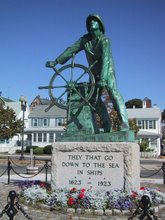
Bristol Bay is known for its gradual shelving bottom, which means that fishing boats need shallow draft to work inshore. It is also known for its fierce wind and wave conditions; together with the topography, that makes fishing extremely dangerous. Until 1952, it was illegal to fish the bay except under sail. Small Bristol Bay gilnetters, such as the one at the left worked the fishery. When I was in Astoria, Oregon, I met a man who had worked in that fishery. He told me that they would routinely fish until the wind got up to 40 knots or so (about 47 mph). That was no tropical breeze, either.
Do we really need to explore for gas and oil in such unforgiving conditions, especially when an accident or oversight could have catastrophic consequences for an important resource? And why are we even talking about doing that when the nation is doing so little to conserve energy? Because, of course, when the oil industry comes calling at this White House, the welcome mat is always out.
Just another reminder that January 20, 2009 cannot come quickly enough!


Saturday, December 02, 2006

CONTEST

The holiday season is upon us, so it seems a good time for a contest.

Actually, the holiday season has nothing to do with it. I just thought it might be a nice change.

So, here we go:

I'm sure you've seen Casablanca, the greatest movie ever made in the English language. You've probably seen it more than once. You may, like the editor, have seen it dozens of times. But, do you know when the story occurs? That's the question: When does the plot of Casablanca take place?

To give your answer, leave a comment to this post. If you want to answer anonymously but still get credit in case you are a winner, send an email with your response.

The contest will close at 11:59 pm. on Decmber 10th, but dont' wait until the last minute--the first correct answer wins.

(General answers, such as "During WWII, will not be credited, even though they are technically right. Specificity is required to win.)

AND, we have several extra credit questions:

What wine did Renault drink with Major Strasser?
Who played Maj. Strasser?
Who played Sasha, the bartender at Rick's?
Who played Berger, the Norwegian member of the resistance?

(Let me hear no argument about whether Casablanca is the greatest movie ever made in English [the only reason I qualify the rating is that I do not speak another language well enough to judge movies; I have little doubt that Casablanca is actually the greatest movie in any language]. Some statements are simply not open to debate. This is one of them.)

Pundits Wrong, Again

A number of the pundits have warned Democrats not to govern by subpoena in the new Congress, lest they lose the support of the swing voters responsible for their new majority. The trouble with that advice is that it assumes a certain level of rectitude, or at least basic honesty, on the part of the Republican administration.

What are Democrats to do when GOP hacks show, for the umpteenth time, that they are absolutely shameless about ignoring any responsibility to the public?

Case in point: The Washington Post reports that Lurita Alexis Doan, a Bush political appointee who is Administrator of GSA--the huge maintenance arm of the federal government--wants to cripple the agency's inspector-general and transfer some audit responsibilities to private contractors (will they ALL have to be Republican contributors?).

Doan, who is clearly a tireless protector of the public interest, compared the IG to a terrorist, according to notes from an August 18 staff meeting. The notes include this piquant phrase: "There are two kinds of terrorism in the US: the external kind; and, internally, the IGs have terrorized the Regional Administrators."

Hmm. Could Osama bin Forgotten by hiding out by masquerading as a federal auditor?

Seriously, if Democrats don't investigate this kind of behavior, aren't they betraying the public trust?

Friday, December 01, 2006

Should Matt Damon Play Othello?

Should Denzel Washington be cast as Iago?

These thoughts were prompted by an article in the Los Angeles Times (registration req'd) suggesting that "Some casting calls that specify gender and ethnicity could violate federal anti-discrimination laws, according to the report by Russell Robinson of the UCLA School of Law..." The report also asserts that "By virtue of their race/ethnicity or gender, actors of color and female actors are presumptively relegated to the margins." Without apologizing to Nicole Kidman or Julia Roberts (or Denzel Washington), there's clearly a lot of truth in that statement.

In one of his earlier careers, your editor was involved in theatre or, as it's sometimes known, "live theatre." (Given some of the audiences we drew, "dead theatre" would not have been far from the mark.) Since at least the early '90's, the theatre--at least the New York theatre, which is most of the commercial theatre in the country--has engaged in "non-traditional casting," that is, looking at actors of color for roles as Greeks and Romans, say, or even northern Europeans. For the most part, that works out just fine. Would you watch Brian Stokes-Mitchell, or Denzel Washington, for that matter, as Hamlet or Henry V? I would. And even cross-gender roles are not foreclosed--think of Hilary Swank in Boys Don't Cry or Nathan Lane in The Birdcage. (Yes, I know, those were special cases, but they make the point.)

In most roles, it's the skill of the player, not his or her color or even appearance that counts. Think Fred Astaire as a romantic lead. As we used to say, "That's why they call it acting!" (Actually, for reasons I won't go into here we always said that with a Yiddish accent, so it came out more like, "Dat's vy dey call it echting!") And it doesn't take long before you stop looking at the skin color of an English king or Danish prince who happens to be played by an African-American; after all, you never insisted that the roles be played by an actual Englishman, or a Dane. (As I understand it, Shakespearean Englishmen spoke like Dubliner's today, so for verisimilitude we should insist on Irish actors.)

So, should Matt Damon play Othello? Leaving aside that Damon may lack the skill or weight for the role now, is the part--with its constant references to Othello as a Moor--to specific for trans-racial casting? Perhaps only if you were to cast a black actor as Iago to complete the role reversal. Or maybe a director could legitimately decide that only an actor who has lived the life of an African-American can do the role justice--even though Shakespeare knew hardly anything about other races.

Even if that is the case, for most roles we should put our expectations aside and watch the performance, and so should those who cast for them. And that idea shouldn't be limited to theatre, film or TV.

Thursday, November 30, 2006

Maybe it was so

Remember when Bush and his allies would ask opponents of the war, "Are you saying that we would have been better off if Saddam was still in power?" And, of course, no one could answer, "Yes."

An affirmative answer to that loaded question looks a lot more credible now, doesn't it?

Look at it this way: No one but George Bush (and maybe Deadeye Dick) thinks that American military force can make a significant difference in the situation, at least not for the long (or even medium) term. There is no force in sight that can keep Iraq--except for the Kurdish provinces in the north--from sinking into a state of anarchy that will make a real civil war look like an improvement. The main contending forces are religious denominations, have the faith of true believers. (I don't mean that to label Muslims--true believers in all religions share the same characteristics.) If there is a force for Iraqi national identity, or even for peace, it is invisible.

So, when the American forces and our allies leave, what alternatives are there? The best of the ones that are at all plausible would be the early emergence of a strong man, whom we may hope to be a lot less brutal and bloodthirsty than Saddam. Much more likely is a lengthy period of the kind of brutality that we saw in the former Yugoslavia. A massacre along the lines of Rwanda is a real possibility.

Are you still so sure that Iraq is better now than it was under Saddam?

I don't mean by this that the United States should have let Saddam and his fellow killers should have their way with the country, and we did not. We protected the Kurds (the only group to organize an effective counterweight to the regime) for more than a decade. The no-fly zones enforced by British and American aircraft crippled Saddam's ability to threaten his neighbors, and humiliated him. What we never did, however, was to organize an effective rebellion outside of the Kurdish areas; indeed, having encouraged the Shi'ites to rise in 1991, Bush senior cut their legs out from under them by holding back on the support they had been promised.

A rebellion would not necessarily have led to a stable regime; Afghanistan in the 1990's is proof of that. But the struggle could have weeded out the incompetent and perhaps developed a sense of common purpose that might have served as the glue for a new state.

Wednesday, November 29, 2006

Sacre Bleu!

A source fresh from Paris reports that a Starbucks is going in to the Louvre.

Talk about American imperialism!

Tuesday, November 28, 2006

Have You Noticed?

How quickly George W. Bush has gone from being the decider to being irrelevant?

Unconventional Wisdom

The New York Times op-ed page carried a provocative piece by Dominic Tierney and Dominic Johnson, respectively a professor at Princeton's Woodrow Wilson School and an assistant professor of political science at Swarthmore. The two Dominics (you didn't think I was going to miss that one, did you?) suggest looking at events in Vietnam and Somalia to provide perspective on Iraq.

I found the following comment especially interesting:

"The Tet offensive was an unmitigated disaster for the communists. Despite the advantages of surprise, the South Vietnamese insurgents, the Vietcong, failed to hold on to a single target in South Vietnam and suffered staggering losses. Of the 80,000 attackers, as many as half were killed in the first month alone, and the Vietcong never recovered. The United States had clearly won this round of the war."

This statement is clearly true, even though it flies in the face of received wisdom. The Tet offensive of 1968 was a disaster for the Viet Cong and their North Vietnamese allies. Before Tet, the North Vietnamese had stayed mainly in the background, supplying the mostly southern Viet Cong and generally keeping out of the front lines. After Tet, the North had no choice; it was forced to commit its forces to the war against the Americans and their South Vietnamese allies.

Despite the objective truth that the Tet offensive was a major defeat for the Communists (and for anyone who wants to argue that the VC and NVN forces were really nationalists, they called themselves Communists), the perception of it as a defeat persists unabated to this day.

That is a tragedy for truth, but did that mistaken perception affect the outcome of the war? In the end, I do not think that it did. Although millions of Vietnamese opposed the Communists, they were overmatched. Many of the same factors that we see in Iraq and Afghanistan--corruption, the absence of cohesive ideology or theory of government, factionalism--worked to undermine the Republic of South Vietnam. Where the North had Ho Chi Minh (a hero even to non- and perhaps anti-Communists), the South produced no Churchill or Ataturk. Misperception of the Tet offensive may have speeded the end of the war--had Americans realized that their forces had won a real victory we might have waited longer before letting the Vietnamese hash out their nation's fate--but unless one theorizes that the Viet Cong and North Vietnamese would have given up the fight, the end would probably have been the same.

While professors Johnson and Tierney deserve credit for controverting conventional wisdom, they did not go far enough. They did not dispute the general conclusion that the United States lost the Vietnam War. While it is true that our allies succumbed, and that we were defeated in a tactical sense, I suggest that the US achieved a strategic victory in Vietnam.

Is that a case of the operation being a success, but the patient dying? No. In an operation, preserving the patient's life is the main object; curing the condition that led to surgery is secondary. In the Vietnam War, however, the primary object was to stop the advance of Communism in Southeast Asia; keeping South Vietnam independent and non-Communist was secondary.

In the 1960's, Communism was an ideology that held sway over more than a billion people. It was self-admittedly hostile to the values and interests of the United States and its allies, and--at least in Asia--it was aggressive. Chinese and Vietnamese theoreticians and political leaders in particular espoused a doctrine of "wars of national liberation" that was openly intended to overthrow pro-western and anti-Communist regimes.

The turning point came in 1965, when the Indonesian Communist Party backed an attempted coup d'etat. The Indonesial army resisted and, led by General Suharto, used the incident as an excuse to push President Sukarno aside, to destroy the PKI, the Indonesian Communist Party, and to kill several hundred thousand Chinese (who were thought to be, and perhaps were, Communist supporters).

I have a vantage point on this. At the time of the coup, I was a college student. One of my professors, Donald Hindley, had done his PhD thesis on the PKI; the result was a book that I recall as having been 400 pages, maybe much longer. When I read it, in the fall of 1965, the work was something of a curiosity, as the Indonesian Communist Party had ceased to exist a few months before.

Prof. Hindley, an Australian by birth, was no fan of American involvement in Vietnam, but he freely admitted that if US forces had not been in that country, the Indonesian army would have joined the Communists in the coup.

What would the late-20th Century world have looked like if Indonesia--with its strategic position and natural resources (especially oil)--had fallen under a Communist regime? Any answer must be speculative, but it seems safe to say that it would have been much more hostile than what we actually faced.

To return to Profs. Johnson and Tierney. Their article also discusses the "Blackhawk Down" incident in Somalia in 1993, where misinformed public perception turned a minor incident into a humiliating defeat. The lesson that they would learn from that--and from Tet--is that we should hesitate before judging Iraq to be a hopeless case.

Here, I must part company with the professors. Many of the factors that led to defeat in Vietnam, and made it impossible for us to find anyone to deal with in Somalia, are present in Iraq today. Indeed, a comparison of Iraq with South Vietnam in 1968 shows that the situation in the former nation is worse than it was in the former. South Vietnam was in the throes of what today we would recognize as a civil war (despite the international agreement that had declare the North a separate nation); there were, essentially, two sides. Iraq--the present debate notwithstanding--looks more and more like a failed state where a large number of factions seem to agree only on making the country ungovernable. In Iraq, as in Somalia a dozen years ago, there is no one to deal with who has enough power or influence to serve as a unifying force.

In Iraq, unfortunately, the conventional wisdom is almost certainly right.

Monday, November 27, 2006

Front Running

A CNN poll shows (drum roll, please) Rudy Giuliani to be the front-runner for the Republican nomination in 2008. Giuliani has support from 33 percent of those polled, followed by Sen. John McCain (R-AZ) with 30 percent. Newt Gingrich (remember him?) and outgoing Massachusetts governor Mitt Romney trail with 9 percent each.

What does all this mean? Merely that polls this early are meaningless.

For more on Rudy's chances, see this trenchant post by Josh Marshall.

Coincidence

On the same day that The New York Times' lead editorial dealt with tobacconeer Phillip Morris' misleading, if not downright fraudulent PR campaign ostensibly intended to keep young people from smoking--it has no effect on teenagers, at best, and may actually lead to more teen smoking--the U.S.Supreme Court let stand a decision from the Illinois Supreme Court that threw out a $10.1 billion (that's "billion") verdict against the company for misleading smokers with its advertising for "light" cigarettes.

The Illinois court had ruled that PM had could not have defrauded anyone, because the Federal Trade Commission permitted cigarette manufacturers to describe their products as "light" or "low tar and nicotine."

While the Supreme Court does not take a position when it refuses to review a case from a lower court--and the refusal may be due to a wide range of reasons, both procedural and substantive--its decision not to hear an appeal always has implications in shaping the law.

For those non-lawyers in the audience, while the Illinois decision may sound plausible, it flies in the face of generations of jurisprudence that government regulation establishes a floor--that is, a standard that must be met--not a ceiling (i.e. a standard that absolves a manufacturer) from claims for negligence or wrongful conduct. However, the cigarette companies and other corporate interests have been working for years to have government regulations turned into exclusive definitions of safe products and, as you can see, they have succeeded all too often.

Money talks.

Republicans Move Out(ward)

USA Today reports that Democrats won solid majorities in the inner and "mature" suburbs in the nation's 50 largest metropolitan areas. In the inner suburbs, Democrats took 60 percent of the vote (up from 53 percent in the last mid-term election), while in the next ring of cities and towns, the mature suburbs, the party received almost 55 percent, up from about half four years ago.

"Republicans are getting pushed to the fringes of the metropolis," said Robert Lang, a sociologist and director of the Metropolitan Institute of Virginia Tech. (Don't ask me why the Hokies, who are not near any metropolitan area, have a Metropolitan Institute.)

Another needle in the balloon of those who say the 2006 elections showed little beyond disgust with incumbents.

NBC Calls It

Networks are calling everything this year. First, it was the elections. Now it's the escalating strife in Iraq. On NBC's Today show, host Matt Lauer announced that the network has determined that the conflict should be called a civil war.

Will the White House see the light? Don't count on it. As one wag said some months ago, "He (Bush) won't think it's a civil war until Ken Burns starts filming."

The other networks are a different story. Better than even money that CBS and ABC, and maybe CNN, will be referring to the civil war in Iraq before Christmas.

Sunday, November 26, 2006

Straight Talk

"YOU CAN READ 1,000 profiles of GOP presidential front-runner John McCain without encountering a single paragraph examining his core ideological philosophy. His career is filled with such distracting drama — torture at the Hanoi Hilton, noisy conversion to the campaign-finance-reform faith, political suicide on the Straight Talk Express — that by the time you're done with the highlights, and perhaps a few "maverick" anecdotes, time's up."

Matt Welch, assistant editor of the LA Times looks at the real John McCain. Take a look and you'll see why TONE is skeptical of people who think McCain will be the GOP nominee in 2008.

Thursday, November 23, 2006

Time for Thanksgiving

It's all too easy to let cynicism take over, so it's nice to see some stories that make us realize that there is reason for thanksgiving.

For instance, David Kurtz, at talkingpointsmemo has a heartening reflection on barbecue and race relations.

And The New York Times has a story about an unlikely family that answers a question I've asked from time to time: why can't people from all ethnic and economic strata live in close proximity to one another?

But to bring us back to reality, there's a tale of Thanksgiving scandal that goes to the top of the US Government.

Wednesday, November 22, 2006

I'm not saying there's funny business going on...

...but have you ever heard Republicans complain that electronic voting machines failed to count their votes?

The Orlando Sentinel has conducted an analysis of 18,000 voters in Florida's 13th district (represented by the inimitable Kathleen Harris) for whom the machines registered no choice in the congressional race. The paper has found that those voters "solidly backed Democratic candidates in all five of Florida's statewide races," giving the Democrat in each of those races a margin of at least 551 votes. Considering that the margin of victory claimed by the Republican candidate Vern Buchanan was only about 360 votes, the finding certainly suggests--especially given that the congressional contest was very highly contested--that voting machines malfunctioned, or worse.

In certain sections of Sarasota County there were thousands of "undervotes," cases of individuals who voted in other races but did not record a choice in the congressional election. The knee-jerk reaction of election officials was that voters had chosen to skip the congressional race; that same argument was trotted out at one point in 2000.

Although officials have certified Buchanan as the winner, Democrat Christine Jennings has filed suit seeking a new election.

The whole matter may end up in front of the House, which is the final judge of its membership. If, as seems likely, the court case delays the decision until the 110th Congress convenes, the Democratic majority could declare Jennings the victor or rule that the seat is vacant, requiring a new election. Unfortunately, any repeat election would have to be held using the same flawed voting machines.

A Thought For Thanksgiving

As we sit down to groaning Thanksgiving tables, please take a moment to the people suffering and dying in Darfur and the neighboring nations of Chad and the Central African Republic. If you haven't been following the details of the continuing crimes being committed there, check the writing of the heroic Nicholas Kristoff of The New York Times.

Take a few minutes to send an email to the White House (whitehouse.gov), your senators (senate.gov) and congressman (house.gov), telling them to take action to reverse the ongoing tragedy in central Africa. Then send another email to each of them the next day. And the next. And the day after that, until the situation is reversed.

Hmmmm

Vehicles at Guantanamo Bay Naval Base are subject to a strict speed limit, because the area is home to iguanas that are on the endangered species list. The government has decreed that the Endangered Species Act applies at Guantanamo Bay, even as it argues that the Constitution does not.

As they say in Brooklyn, go figure.

Monday, November 20, 2006

Two Few Iraqis, II

The New Y0rk Times has 3 articles on its op-ed page from Iraqis who worked as translators for the Americans. These affecting pieces illustrate the tragedy of Iraq in human terms from intelligent men who bring historical perspective to the situation. One of them, Waddah Ali, put his finger on American hubris: "History is an idea to you; to us it is our life."

These three are some of the too few people in Iraq who identified with their nation rather than their sect or ethnic group. Their stories suggest--although they never say so explicitly--that many more Iraqis identified with the polity, and might have been convinced to work for the establishment of a unified state, had we handled the occupation with even minimal competence.

It's easy to assume that Iraqi points of view have been essentially static since the invasion. But all evidence suggests that most Iraqis have undergone significant, in many cases momentous, changes in their view of the world. Maybe, just maybe, an intelligent approach to rebuilding the nation would have had a chance of assembling a sufficient number of Iraqis to have given the new government a chance. Instead, Iraq has fractured in the way that Bosnia and Rwanda did in the 1990s. And as with those nations, the best that we might see is a peace of exhaustion.

(Later reflection: I did not mean this post to suggest that the original invasion was a good idea or, indeed, justifiable. Just that, having made the mistake of going in, we might have been able to salvage something from it, at least in theory.)

Sunday, November 19, 2006

Too Few Iraqis

Since the beginning of the tragic war in Iraq, widespread criticism has fastened on the administration's decision to try pacifying the country with fewer than 150,000 American troops, aided by about 10,000 to 15,000 allied (non-Iraqi) forces. Even today, Sen. John McCain (R-AZ) calls for more American soldiers, despite testimony from the top American general tasked with fighting the war that there are no more troops to send.

What has received far less attention is that there are not too few Americans, but too few Iraqis. I am not referring to the Iraqi army and police, although progress in organizing, training and equipping those forces has been terribly slow. (If you don't think so, study the US Army in the Civil War, or the development of the army between 1940 and 1945.)

When I say that there are too few Iraqis I mean that--from all appearances--there is no substantial number of people in that country who identify themselves as Iraqis first. If you asked Iraqis "what are you?" a clear, perhaps overwhelming majority would answer, "I am a
Shi'ite," of "I am Kurdish," or "I am a Sunni." Few--and fewer each day--would say, "I am Iraqi."

Mr. Bush may still talk of victory, although even Henry Kissinger has now given up hope of anything that might be called that. But without a substantial number of people willing to identify themselves as Iraqis, and to fight for their nation, there is no way in which anything other than a bloody civil struggle can resolve the crisis into which we have plunged that land.

Thursday, November 16, 2006

And Now For Some Humor

For a little relief from the serious news:

"Former Wisconsin Gov. Tommy Thompson, who served as Health and Human Services Secretary in President Bush’s first term, said Wednesday he intends to form a committee to explore a possible run for the White House in 2008."

That Tommy, he's such a card!

Wednesday, November 15, 2006

2008

In our continuing series on the Democratic platform for 2008, let's take a moment to discuss globalization and trade. Specifically, it is important that Democrats do not give in to the easy path of protectionism.

While a progressive administration could and should press for modification of trade agreements to ensure more protection for workers and the environment, long-term prosperity depends on America being able to compete in a world-wide market.

There is a strong protectionist element among Democrats (Sen.-elect Sherrod Brown (D-OH) is one legislator with a protectionist past), the party as a whole needs to take the sometimes difficult road of defending free trade. There may not be an obvious short-term gain to such a plank in the platform, but it represents a policy that is in the best interests of the nation as a whole, and so is the kind of leadership that the American people are seeking.

At the same time, Democrats need to find practical ways in which government can facilitate the discipline and innovation necessary to build a strong economy for the long term.

Leadership

It was good to hear that Charlie Rangel, incoming chair of the House Ways and Means Committee, intends to have a go at fixing the alternative minimum tax. The AMT doesn't have a sexy name like the Death Tax (really the estate tax) or the Marriage Penalty (a lesbian couple I know paid $850 more in taxes because the federal government refuses to recognize their Massachusetts marriage--but that's not the penalty Republicans want to talk about), but it affects an increasing number of middle-class Americans. Republicans may oppose reform covertly, because it would mean even higher deficits, but they cannot do so openly, and a legitimate change that would make the tax code more fair and benefit millions of Americans has a real chance of passage.

Where is he?

Did John Murtha say that Nancy Pelosi's ethics and lobbying reform bill is "total crap," as reported in Roll Call, or were his remarks taken out of context, as he told Hardball? Either way, it's a bad start for the new Democratic leadership. Murtha, who's been a giant on the war, is hardly a hero on reform and ethics. His run for majority leader has led to resurrection of his involvement in the ABSCAM scandal of 1979, something the Democrats do not need just after winning an election in which disgust with incumbents was a major factor.

(On NPR this morning, Juan Williams predicted that Steny Hoyer (D-MD) is expected to win the majority leader's post. He's no gem when it comes to pure government, as we've reported, but he has less baggage than Murtha.)

The vote for majority leader is by secret ballot. Write (or email) your congressman.

Tuesday, November 14, 2006

Necessity Knows No Bounds

In 1914, Germany invaded Belgium as a means of flanking the French defenses. The attack on a nation that had been declared permanently neutral by an international treaty to which Germany was a party outraged the world. Defending Germany's decision, the Chancellor, Betheman-Hollweg, said "Necessity knows no grounds." Bethman-Hollweg was actually a rather decent man and not a rabid nationalist as some in his nation were, but those words haunted him and stained his reputation for the rest of his life and beyond.

I thought of Bethman-Hollweg when I read that the "Justice" Department (we are going to have to put that in quotes as long as this administration remains in office) is arguing to the Fourth Circuit Court of Appeals that immigrants picked up and designated "enemy combatants" by the President have no constitutional rights.

While the law that attempts to strip Guantanamo detainees of their rights is patently unconstitutional, using it--as the "Justice" Department is trying to do--to take rights from persons lawfully in the United States is, if anything, more obviously unconstitutional. No one has ever suggested that an alien--even an unlawful alien--arrested for a crime in the United States is not entitled to counsel and a jury trial. That due process rights apply to everyone within our borders has been a given since the Constitution was enacted. Yet this administration takes it upon itself to change all that, and says it is doing so to protect the nation. "Necessity knows no bounds."

Let's be clear: the United States government is a product of the Constitution. Everything it does must be allowed by that Constitution; no act that is not constitutional can be legal. It's as simple as that.

Monday, November 13, 2006

Still Room

Newsweek reports that Bush's popularity has fallen to a new low, 31 percent. But he's still got room to move. According to Political Wire, Bush senior had 29 percent at one point, Jimmy Carter 28% and Tricky Dick Nixon 23%. (Hard to believe, but almost a quarter of the country approved of Nixon after all that we learned during Watergate.)

The Price of Success

Having got themselves elected, Democrats now have to govern, a process that may well be made easier by George W. Bush's well-demonstrated intransigence. Nonetheless, it is imperative that House and Senate Democrats show the nation that they will move the nation's agenda forward, and not present the Republicans with the opportunity to say that the 110th Congress merely says no to the President. That's true not only because the nation does not want more gridlock, but because voters believe that there are important things that need doing.

Leon Panetta had a good piece in The Times on this subject. He began, "We govern our democracy either by leadership or by crisis." Bush would love nothing better than to govern by crisis for his last two years; that would support his view of the all-powerful executive. Democrats must show leadership.

There are a number of items on which Democrats could display an early willingness to work with the Administration: immigration is one that leaps to mind; it was Republicans in the House who waylaid Bush's proposal. The minimum wage is another. With a majority to move it forward, Democrats can either show that they can get things done when the President signs the first raise in a decade or stigmatize Bush should he veto it (almost unthinkable). Less obvious would be a reform of the alternative minimum tax, which is hanging over millions of middle-income Americans; the Republican congresses have dithered with temporary solutions, but have not been able or willing to devise a permanent change in this tax, which was originally designed to net wealthy individuals who used sophisticated dodges to avoid paying taxes. Not a very sexy issue, perhaps, but a way to show that Democrats really are interested in reducing the tax burden on most Americans, even as they intend to make the rich pay their fair share.

While Democrats should show themselves willing--maybe even eager--for bipartisanship, they should not hesitate to take on the President on big issues,such as stem-cell research, on which W used the only veto of his first six years in office. A few more vetoes of popular legislation will help to push Bush into irrelevance and increase the nation's desire for a change in 2008.

Because they control Congress (and narrowly at that) rather than the executive, and given the nature of the Democratic Party (remember Will Rogers), Democrats will find it difficult to lead on the kind of issues that are central to what should be the 2008 platform: Make America Great Again. Nonetheless, congressional leaders should talk up this goal and should look for ways to push it forward through legislative initiatives. While legislators are necessarily occupied with the minutia of legislation, once in a while they need to lift up their heads from their desks to view the sun coming over the mountain.

Sunday, November 12, 2006

Keep the Heat On

Speaker-to-be Nancy Pelosi pledged lobbying reform as one of her first-100-hour priorities. Will Democrats keep the promise? Perhaps not, unless voters keep the pressure on Democratic House members, and their Senate colleagues. TPMuckraker has a rundown on some of the likely members of the Democratic House leadership.

Pelosi is backing John Murtha for Majority Leader. While Murtha's courageous stand on Iraq helped galvanize opposition to the war and helped to propel it to the forefront of issues in the mid-terms, he has not been a business-as-usual guy in the past. Can he find redemption at this late stage in his career?

Congratulations

to Laurie Frankl and Damian Watson on their wedding yesterday, which TONE and the memsahib were happy to attend.

We trust that they will be happy together for many, many years.

Perspective

According to White House Chief of Staff (I haven't checked his computation) Joshua Bolten, there are 800 days left in the Bush administration.

Friday, November 10, 2006

Another Marine Reporting

From a message sent by Senator-elect Jim Webb to his supporters:

As you know, I made two promises to myself when I started this campaign. The first was that I was not going to trade anything I believed in order to get a vote or a dollar, and I did that. I’m walking into the U.S. Senate with the independence to represent the people who have no voice in the corridors of power, and I intend to do that.

The second promise that I made was that as much as humanly possible, we were not going to run a negative campaign. And I thank all of you for helping me to make sure that we did that.

We have a situation in Virginia where Mark Warner began a journey. Tim Kaine has added on to it. We are going to add onto it even more. We’re going to work hard to bring a sense of responsibility to our foreign policy that will, in my view, result soon in a diplomatic solution in Iraq. We’re going to work very hard on issues of economic fairness in a country that has become divided too much by class in an age of the internationalization of corporate America, where corporate profits are at an all time high while wages and salaries are at an all time low. I look forward to joining my fellow Senators in voting very soon to increase the minimum wage.

And finally, we’ve had a situation where, as a result of this Administration’s policies post-9/11, we’ve had far too much power gravitate to the Presidency at the expense of the power of the Legislature.

With your help, we now have the opportunity to put this country back on the track where it needs to be. Thank you for everything you have done for our campaign and our country.

Remember, folks: the Revolution started here...

Semper Fi


November 10th is Marine Corps Day. The Corps was founded at Tun's Tavern, in Philadelphia, on November 10, 1775.

There's something special about the Marine Corps. They say there are no ex-Marines, only former Marines. A friend who served for four years as a Marine officer, including time in Vietnam, said he never met a gunnery sergeant that he didn't address as "Sir." A reporter for CBS News, in a series on the United States Military, said that he'd told a Marine Sergeant about his Army counterpart who said that he'd never seen a Marine tank or truck or APC that wasn't smoking, making odd noises and dripping oil and transmission fluid. "The Marine seemed to take that as a compliment."

Tonight on CBS, there was a story about Marine boot camp. A drill sergeant asked what honor was. One recruit stood and responded, "Honor is doing the right thing when no one can see, sir!"

Marines aren't perfect, of course; seven of them have been charged with murder in one incident in Iraq, and several have pleaded guilty. But, as Kipling said of another fighting force, "Single men in barracks don't turn into plaster saints."

Marines are fighting, and all too frequently dying in Iraq. They will do that, until they are withdrawn, and then they'll go to the next place we send them, to fight and die for us, for their buddies and the Corps. We might not like what they do, but let us respect them for their willingness to do what few of us would.

"And when he gets to Heaven,
St. Peter he will tell,
'Another Marine reporting, sir,'
I've served my time in Hell."
From a Marine Grave on Guadalcanal

Thursday, November 09, 2006

2008

In our first post on what the Democratic Platform for 2008 should be, I included, "Be the advocate for real democracy in the world. Stop being like the line in the Jim Croce song, 'Let him live in freedom, if he lives like me.'"

The Times has an editorial entitled "A Clean Start," urging Nancy Pelosi to make good on her promise for ethics reform to be the first issue that the House takes up in 2007. As The Times observes, "The House Democrats are perfectly capable of replicating the RepublicansÂ’ fall from grace. They need to throw up protections right away, while they are most conscious of the dangers and least prey to temptation."

Amen! Reform must be carried out swiftly and surgically, the old guard swept away before the siren song of campaign cash can whisper in the ears of newly-empowered congressmen and senators.

If ethics reform is an issue in 2008, then, it will be a sign that the Democrats will have failed. However, The Times' editorial presents a useful counterpoint to my suggestion that Democrats concentrate on encouraging true democracy in the world: The best way to build democracy abroad is to perfect our democracy at home.

This brings up another point. In my earlier post, I let my typing get ahead of my writing. When I speak of encouraging democracy, I do not mean the kind of "nation building" that Bush and the neo-conservatives imposed on Iraq. That was a foolish and fatuous exercise from the start. Buildingg a democratic tradition is a lengthy process fraught with danger; if you don't believe me, look at Greece and Turkey, or check out Chile and Uruguay, the two Latin American nations that had the strongest democratic traditions. All four suffered at least one military coup during the late 20th Century.

Still, there are ways to encourage responsive government that can start nations on the path toward democracy or something close to it. And the first requisite for that is for other nations to see that the United States is, indeed, a vigorous democracy. Indeed, they should see that our country works hard at our system of government, striving to make it more fair and more democratic. That sounds easy, but as we've most clearly for the last six years--although the decline of our system began long before Bush'saccessionn--it isn't. That's why it should be on the agenda in 2008.

Best Line of the Week

From Josh Marshall:

Allen to throw in the tallis.

Ed Bradley Dies

A throwback to the glory days of broadcast journalism, he passed away from the effects of leukemia at 65.

He'll be missed by everyone who cares about the quality of news.

2008

Okay, vacation's over. After a day of rest following the mid-term election, the 2008 campaign begins today.

Tom Vilsack will announce his presidential bid today. Who is Tom Vilsack? That's why he's announcing today. He is the governor of Iowa (motto: Land of the Snow-Covered Caucus), who will be leaving office in January.

Of course, if you've been paying attention to the news the past few weeks, you are surely aware of the maneuvering, posturing and speculation about 2008 that was going on even as the mid-term campaigns reached their feverish climax. Barak Obama's book tour did nothing to dampen speculation about his intentions two years from now. With no serious opposition for her re-election, Hillary Clinton (D-NY) was out helping dozens of Democrats, and collecting IOUs. Rep. Duncan Hunter (R-CA) actually announced his candidacy for the Republican nomination before the voting this week. (The only attention paid to that announcement was well-deserved laughter.)

But let's get serious. What should the Democrats' platform in 2008 be? I suggest that the answer to that question is a simple one, and that the party's presidential nominee should be the person who best enunciates it.

The Democratic Platform in 2008 should be: Make America Great Again.

Not since 1960--a watershed election that was diverted from its new course by the Vietnam War--have Democrats been able to go to the country with a promise to restore the tarnished place of the United States in the world. But now they can, and they should.

America's position in the world has not been this weak since the 1930's. We are despised around the world, at least in those places where we are not ridiculed. Jobs are moving overseas. The trade deficit demonstrates that we are living off our fat and not producing more muscle. The deficit is a millstone around our necks. And all of this has happened under George W. Bush and his Republican henchmen.

What policies should Democrats espouse to make their platform real? We will be returning to this subject a number of times in the coming months, and I hope that readers will make their contributions. To begin, a few ideas (with no claim of originality):

*Get out of Iraq as soon as we can, under circumstances that will permit those Iraqis who want to build a nation some semblance of a chance to do so. (In all likelihood, it is already too late and/or the forces of nationhood are just too weak to succeed.)

*Fight our violent enemies with ideas, and with policies that will help those whom those forces target. (Buy the opium crop in Afghanistan; offer price supports for alternative crops. Take steps to insure Muslims in western countries a real place in those nations, with freedom of expression and economic opportunity.) Force should be exercised mainly as a police function, and should be secondary.

*Be the advocate for real democracy in the world. Stop being like the line in the Jim Croce song, "Let him live in freedom, if he lives like me."

*Inaugurate national health insurance, to assure the well-being of Americans AND to relieve American corporations of the immense burden they face in providing insurance for their workers.

*Start a national debate on how we can rebuild America's place in the economic world, and the proper way in which government can assist--without such a program becoming a transfer of money from individual taxpayers to lucky businesses.

*Make energy independence a first priority. In sync with that, develop "alternative" energy sources.

*As part of the foregoing, set the world's most ambitious goals for reducing our contributions to global warming--realizing that in doing so we will develop new methods and technologies to help the nation rebuild our economic position.

Now it's your turn to contribute. Send us your ideas, either as a comment to this post or an email at old_new_englander@yahoo.com.

A Tearful Farewell

You may think that all is unalloyed joy, what with the Democrats' smashing victory in Tuesday's voting, but we out here in the blog front are confronted with a number of painful losses. What are we going to do without:

Katharine Harris

Rick Sanctimonious

Conrad ("He Actually Swallowed His Foot") Burns

George Macacawitz Allen

Jim No-Talent

Don ("The Strangler") Sherwood

John ("The Wife-Beater") Sweeney

And then there was yesterday's firing of Donald Rumsfeld.

Remember, in the past year we've had to bid adieu to Duke Cunningham, Tom DeLay and Bob Ney.

Even occasional sightings of Newt Gingrich cannot lift the gloom.

Sob!

What Happened?

This morning, the mainstream media are reporting that the Democrats have captured the Senate--pending a possible recount in Virginia.

Well, that's not quite what they are reporting. If you listen and/or look carefully, you'll hear and see that what is being reported is not the Democrats' achievement in the winning a majority in the upper house, but the blessing of that event by, yes, the media. Even the doyen of American newspapers, The New York Times succumbs: "Never mind that Senator George Allen of Virginia had not conceded. Jim Webb, his Democratic opponent, claimed victory Wednesday on the strength of a roughly 7,000-vote margin. And The Associated Press, a widely accepted authority for calling elections, agreed with Mr. Webb, declaring Mr. Allen, a Republican, the loser."

Let's be clear: The vote counting in Virginia was over by about noon yesterday. Jim Webb had a lead of about 7200 votes. Nothing's changed since then, except that news organizations have decided to bestow their imprimatur on the people's verdict.

There's nothing new in this, George Orwell, who died fifty years ago, wrote about the proliferation of manufactured events, such as news conferences, masquerading as real news. (Bush's news conference--called "a presser" in some quarters, a locution that we may adopt--was not an event. Rumsfeld's firing was the event yesterday, not the President's announcement of it.

Wednesday, November 08, 2006

The People Have Spoken

But what did they say?

They said 60 million different things, as many as there were individual voters; it's always dangerous--if not downright misleading--to pontificate on the "message" sent by the electorate.

Nonetheless, let me suggest one message that Americans were sending: that they are tired of secretive, partisan government, where scoring off the opponent, feathering one's nest and engorging one's campaign contributors are seen as the highest goods. I don't mean to suggest that voters want some sort of mushy can't-we-all-get-along politics (or maybe I fear that as the end of blogs like this one), but I do believe that Americans reacted strongly against the kind of extremism, both in doctrine and tactics, that has characterized the present regime.

During the campaign a lot of observers complained that the Democrats had no unified platform, unmindful of the fact that the minority party--lacking a titular leader--never has a single-minded platform. (The cynic--me, for instance--will observe that Democrats seldom have a unified platform even when they are in the majority.) Those pundits made a deeper error, too. They failed to see that American voters are tired of litmus tests, tired of the very single-issue politics that we have grown so used to. The number of conservative, often pro-life candidates who ran as Democrats (and frequently won) is proof of that.

It won't be easy or fun to work out a way for the Democratic Party to accommodate many interests, but it has done so before. If you don't remember the party that dominated American politics for almost almost thirty-five years, from 1933 to 1968, go back and take a look. You'll see segregationists and civil rights advocates, union members and business people (generally small businesspeople), internationalists and people who wanted America to mind its own business. They did not agree on every issue--all of them probably did not agree on any issue--but they found enough common ground to govern, and to bring this nation to its highest level of greatness so far.

Tuesday, November 07, 2006

Be of Good Cheer

As I write this, Americans are going to the polls. (Many citizens, who live in states with early voting, have been going to the polls for the last week or so.)

I have no inside information about the outcome. My message is not about the results of this election.

And yet I say, Be of good cheer, my friends. Whether the Democrats pick up five seats in the House or fifty, two seats in the Senate or seven, two years from today, Americans will throw George Bush and his people out of the White House.

Aha, you say, that idiot doesn't know that Bush isn't going to be on the ballot in two years (barring a coup d'etat).

But I do know that, and when I say that Bush and his people will be thrown out in two years, I don't mean merely that W and Deadeye Dick and their henchpeople will be cleaning out their offices twenty-four months from now. I mean that anyone espousing Bush's policies and doctrines will be trounced in 2008. If Republicans want to have a prayer of holding on to the Oval Office, they will have to find a candidate who repudiates Bush, his programs and his line of thought. Tall order for a party that has made "thinking" (if you can call it that) in lockstep a central principle.

Yes, two years is a long time. We shall have to endure stress and crisis and disheartening developments before we get there. Yet the first rays of the new sun are even now beginning to glimmer over the horizon.

My fellow Americans, it's morning in America. (Now wait a minute, I think someone else used that line.....)

Monday, November 06, 2006

Bugging Out

I've had it. I'm up to here with polls and predictions. I'm not going to read the blogs or the analyses of tomorrow's vote--instant analysis and querulous criticism is making my blood pressure do bad things. (One advantage of having a blog, rather than being a "serious" journalist, is that I can do this.)

So, I won't be out here until tomorrow--I do expect to have something on election day.

One thing before I go: If you're reading this before the polls close on Tuesday, you still have time to go to MoveOn.org and sign up to make calls to voters. I spent a few hours doing so over the weekend. It's not the most fun you'll ever have, but it will give you the satisfaction of doing something instead of just sitting on the sidelines sniping, as we bloggers do.

And remember: Democracy is the worst form of government except for every other form.

Sunday, November 05, 2006

Saddam's Death Sentence

A lot of my friends simply assumed that the administration was behind the decision to delay the verdict in Saddam Hussein's trial until two days before the mid-term elections. I'm not so sure--it's one of those seemingly obvious connections that history sometimes shows to have been unrelated.

In any case, I reasoned, Saddam is old news. The verdict and the sentence of death were fore-ordained. The announcement would be the very definition of anti-climax, and it wouldn't swing any votes.

I still feel that way, although I expect the Republicans--especially in their state of desperation--to try making something out of the news.

What does surprise me is the reaction reported in this story by The AP:
"Saddam Hussein's death sentence was celebrated by some on Sunday as justice deserved or even divine, but denounced by others as a political ploy two days before critical U.S. midterm congressional elections. Worldwide, the range of reactions -- including a European outcry over capital punishment and doubts about the fairness of the tribunal that ordered Saddam to hang -- reflected new geopolitical fault lines drawn after America's decision to invade Iraq in 2003 and depose its dictator."

I never conceived of Saddam's trial as a process of justice, but of politics (although many would see justice in the result). Any time that the winners of a war put the losers on trial, the outcome is pretty much predetermined, no? And in Iraq, with the complete absence of an independent judicial process in its history, how could we expect anything resembling fairness?

Call me cynical, but I did not expect that many people would be outraged by all this. I oppose capital punishment, even in the case of criminals-against-humanity like Saddam, but in a time when Iraqis are being murdered by the thousands, does a show-trial loom large in the consciousness?

I don't think it does, at least for most people. But the very fact that The AP--not exactly a bastion of activist journalism--chooses to post a story about criticism over the trial and the sentence reflects the decline in America's prestige and moral authority since March 2003.

This is hardly a novel observation, but it is worth noting again just how much the intellectual laziness, rigidity, partisanship and incompetence of the Bush Administration has cost the nation that was the world's dominant force even before 9/11. Given the unmatched sympathy and moral authority that the United States enjoyed immediately after the attacks on the World Trade Center and the Pentagon, the speed and severity of American decline would be impossible to credit if we had not witnessed it.

Is George W. Bush the worst president in American history? A better question might be whether anyone else is even close.

Old Tricks

The Republican Party, which sponsored a phone-jamming scheme in New Hampshire four years ago--an effort that saw one of its operatives sent to prison--is up to its old tricks. This time, the NRCC has been paying for repeated robo-calls to voters in the Granite State's hotly-contested 2nd Congressional District. The calls have confused many voters who think they are being made on behalf of Democratic candidate Paul Hodes--which would be funny except that the repetitiveness of the calls is annoying many voters who think that they are coming from the Democrat.

Now here's the really rich part. While Paul Bass (R-NH), the incumbent who is in a statistical tie with Hodes in the polls, has criticized the calls, the NRCC says they will continue. Indeed, a spokesman says that to stop them at the candidate's request would be illegal. "We make these expenditures individually of any campaign, and to heed their calls to do them or discontinue them would be coordination, which would violate the (federal) laws."

A spokesman for Hodes, the Democrat, observed that "If [Bass] can't stand up to his party on this, he can't stand up to his party on anything." If the voters hear that message before they go to the polls on Tuesday, Bass will be hooked and cooked.

Democrats have also complained that some of the calls violate federal law, because they have been made to people on the federal do-not-call registry.

Remember the Republicans are the party that claims to represent traditional values.

Saturday, November 04, 2006

How Low Can You Go?

In Montana, the Free Enterprise Fund--the latest incarnation of the Swift Vote Veterans for (un)Truth that spent millions traducing John Kerry's war record--has been running an ad against John Tester, who's taken on Jack Abramoff's favorite senator, Conrad Burns (R-MT). The ad is entitled "Brokebank Democrats." In case you didn't get the hint, the ad says "they just can't fight their nature." (The sponsor says the reference is to the Democrats' nature of being high-taxers. Sure.)

(Update: talkingpointsmemo.com reports that the telephone number given in the "Brokebank Democrats" ad--supplied for voters to complain about Jon Tester's alleged tendency to raise taxes--seems to be the Democratic candidate's home number. That's the kind of thing that even Nixon's dirty tricksters wouldn't have countenanced.)

In Wyoming, the National Republican Campaign Committee has been running an ad against Democrat Gary Trauner, who's giving Rep. Barbara Cubin a tough ride. (She's the one who said she wanted to hit a man in a wheelchair, a remark that didn't do Trauner any harm.) What's Trauner's sin? He's from New York! Some people think the ad is playing to anti-Semitism. Do you agree? Watch the ad here.

A Jewish congressman from Wyoming? As my grandmother would have said, "Oy gevalt!"

Kafka Would Shake His Head

"The Central Intelligence Agency has told a federal court that Qaeda suspects should not be permitted to describe publicly the 'alternative interrogation methods' used in secret C.I.A. prisons overseas"--The New York Times.

The CIA and the Justice Department argue that allowing alleged--let's not forget that pesky word--terrorists to reveal details of their torture, uh, treatment, would permit as-yet-uncaught terrorists to figure out ways to counter our interrogation methods.

On one level, that is ridiculous. If you're going to be water-boarded, how are you going to prevent the feeling of being drowned--especially because, in effect, you ARE being drowned--learn to hold your breath longer? And knowing about methods of interrogation has not helped prisoners in the past. People knew all about thubmscrews and the rack and good old whips for generations, but those implements still proved effective in extracting information. Maybe not accurate information, but that's always the problem with torture, whether you're talking about pulling out fingernails or applying electric shocks to a prisoner's private parts.

On another level, the government's argument reveals an exaltation of the ends that obscures all concern with means, an approach that is all too easy but should be anathema to civilized nations, particularly democracies.

But perhaps most disturbing is that the people who are making this argument--and those who direct them--have lost sight of what America is all about.

In 1944, when the United States faced a much greater challenge than it does now, Earl Robinson and Lewis Allan wrote a song called, "The House I Live In." Its lyrics can seem campy, but they captured a truth that eludes those in power in the United States today: America is much more than a place. It is, most of all, an idea.

What is America to me?
A name, a map, or a flag I see;
A certain word, democracy.
What is America to me?

...

The house I live in,
My neighbors white and black,
The people who just came here,
Or from generations back;
The town hall and the soapbox,
The torch of liberty,A home for all God's children;
That's America to me.

That song has meant a lot to me, because I learned it from a record by Paul Robeson that my parents had; if you ever heard Robeson, you'll know what I mean. Frank Sinatra had a hit with the song, but the lyrics in his version were sanitized by cutting out a couple of verses that Robeson sang, and including a couple of the more pedestrian verses that Robeson omitted.

(In an ironic twist, Gov. Tom Kean of New Jersey quoted from "The House I Live In" at the Republican convention in 1998. The archives of The New York Times contain a letter to the editor from Earl Robinson, commenting on that. "I need to say that we did not write the song for Republicans exclusively. Nor for Democrats or any other 'ism,'' but rather for people of all stripes and colors, all or no political beliefs, ''All races and religions, that's America to me.' And while I will probably not vote for Mr. Bush this November, I wish to thank Mr. Kean and the Republicans for quoting from my song. It is living proof that a song may transcend politics and give a message to all Americans and people everywhere, as to what our country is all about.")

CLARIFICATION: The Washington Post makes it clear that the government is arguing that the need to keep its interrogation methods secret should block at least "high-value" detainees (i.e., the ones recently transferred to Guantanamo from secret CIA prisons) from even seeing their lawyers. Remember, this is the nation that declares itself on the side of freedom.

Stop the Presses!

Katherine Harris--the Wicked Witch of the South in the 2000 election--is writing a "tell-all" book about her campaign for the Senate.

Given that Harris is about 25 points behind Sen. Bill Nelson (D-FL), the book will not, apparently, tell about winning. Excluding copies for Harris' immediate family, it should sell about a dozen copies.

(It says a lot about how badly the Republicans have been stumbling nationwide that Harris' opera bouffe campaign, with blatant lies and staffers quitting by the carload (not to mention repeated gaffes that make John Kerry's joke-telling look like Jerry Seinfeld's) has not received much attention nationally for the past couple of months.)

Friday, November 03, 2006

Party of Good Government

Remember when Republicans portrayed themselves as the party of government run along efficient, business-like lines?

How times have changed. The New York Times reports that House Republicans slipped a provision into a military authorization bill shutting down the Office of the Special Inspector General for Iraq. This is the office--headed by Republican lawyer Stuart Bowen--that has exposed incompetence and corruption by such administration friends as Bechtel and Halliburton, and revealed the military's failure to keep track of several hundred thousand weapons turned over to the Iraqis. According to The Times, "The clause was inserted by the Republican side of the House Armed Services Committee over the objections of Democratic counterparts during a closed-door conference, and it has generated surprise and some outrage among lawmakers who say they had no idea it was in the final legislation."

Businesslike government? Or just business as usual?

(P.S. when I ran a spell-check on this post, the checker suggesed replacing "Halliburton" with "half-hearted." Who says computers have no sense of humor?)

Random Shots

John Kerry can't tell a joke.
George Bush IS a joke.

Will Kerry's mangled (and poorly thought-out) attempt at a joke about Iraq cost Democrats more votes than evangelical leader Ted Haggard's apparent indiscretions with a self-described male prostitute?

Are Haggard's indiscretions any more relevant to the campaign than Kerry's muff?

Wednesday, November 01, 2006

Silly Season

It's the political silly season as Election Day approaches. (Indeed, early voting is already underway in many places.)

*The Republicans have been all over John Kerry for a flubbed joke. And they have a point--he should have apologized at once for what he said (NOT for what he intended to say), and he should have used that as a springboard to say that while he had to apologize for a few words he spoke in error, Bush and company should apologize for incompetently prosecuting a war that has killed and maimed thousands and thousands of people --Americans, our allies and Iraqis. If Kerry had done that, the Republicans couldn't have made even a talking point out of the incident. Kerry should also have apologized for trying to crack a joke, and pledged never to do it again.

*Having said that, I don't see Kerry's gaffe as making a difference. He's not on the ballot. Bush is, in all but name, and the American people know what's going on. A new NY Times/CBS poll shows that almost 70 percent--that's 7 out of every 10 Americans--know that W has no plan to end the war. You can't get that many Americans to agree on motherhood, apple pie or baseball.

* Remember Jim Gibbons (R-NV), Congressman and stalker? His alleged assault on a woman in a parking garage (or should that be his alleged assault in a parking garage on a woman?) has tightened the race for governor of Nevada (he's the GOP candidate) to a statistical tie--Gibbons, who was pretty well ahead, now has a only a 4 point lead. The story continues to reverberate, so further damage may ensue. And Gibbons has other troubles on the ethics front.

* DSCC has a terrific ad for the vital New Jersey race.

*The DCCC chips in with this powerful spot. (Where were they in 2002 anbd 2003? But that's water under the bridge.)

* And finally, in Colorado Springs, a grandmother was escorted from an early-voting location because she sported a button saying "Grandmothers for Peace." Authorities explained that no one is allowed to wear anything political in a polling place. Sound fishy to you?

Tuesday, October 31, 2006

Don't Look Now

But there could, just could, be an upset building in the Texas governor's race.

For months there has been a lot of talk about how Rick Perry (another of those Republicans notable mainly for his hair) was likely to win another term as governor, even though hardly anyone likes him. The problem is that instead of uniting behind one candidate the not-Perry camp fractured into four: Democrat Chris Bell, former Republican Carol Keeton Strayhorn, independent musician and detective novelist Kinky Friedman and Libertarian James Werner. Bell had a hard time starting off, Strayhorn couldn't get significantly over about a quarter of the vote, Friedman was in the teens and Werner in the low single digits; the net result was that it looked like Perry would be re-elected with less than 40 percent of the vote.

Well a new Zogby poll shows that Bell has pulled within 8 points of Perry; the governor's support has fallen slightly, but Bell has picked up 6 points in a short time. Perhaps more important, if this poll is right, Strayhorn's support has fallen to 15 percent and Friedman is just below her. All of which might mean that the Texas voters have decided that neither of them can win, and that some of them are moving toward Bell as a way to deny the governor another term. It's still a long shot, but if that is the case, Bell just might be able to catch Perry at the wire.

(A few notes of caution: My impression--I've never done a systematic study--is that Zogby's polls are not as reliable as others'. Also, a Zogby poll done six days ago showed Perry at 38 percent and Bell at just 22. Has the Democrat really picked up a point a day? Maybe, or maybe the change is a feature of that pesky "margin of error." Other polls from a few days ago don't show the race as close as Zogby's latest one does, either.)

Where's the Outrage?

A friend wrote:

"You know, I heard on the NPR that a number of weapons given to Iraqi troops in the form of rocket launchers, rifles and machine guns have gone missing. And worse yet, of $133 million spent on the weapons for Iraqi, almost NONE of them have been registered by their serial numbers so they can be tracked.

"Now you know what's really sad? Normally, I would be frigging outraged. But after almost 6 years of almost single-minded incompetence, my outrage tank is almost empty. This is how they win - I know. But if I have trouble staying outraged, imagine how the average American who is less informed gets the outrage level up when they hear this nonsense."

And imagine the chagrin of the blogger who didn't get a chance to post about this when it hit the news yesterday? So much to be outraged about, so little time!

Monday, October 30, 2006

The Magic Fades

Over at talkinpointsmemo, Josh Marshall has a very good, brief, take on the multitude of stories about Karl Rove's confidence that the GOP will maintain its hold on both houses of Congress. Asking the rhetorical question, what does Rove know that the Democrats, the pollsters and the professional political analysts know? Marshall answers, "Nothing." He suggests that Rove is posturing, because he knows that if he or W show doubt, the Republican GOTV effort goes down the drain.

I think Marshall is right, although not quite for the reasons he states.

If you think about it, people who become pre-eminent in their fields usually have a limited life. Very few politicians can kindle much enthusiasm after six or eight years. Look at the lives of superstar entertainers and you'll see that their careers usually show a few years at the very top, followed by many more years in which they were successful, but not at the same level. (Consider the films Denzel Washington is making today vs. those he made a few years ago.) Even great men like Einstein usually have a short period of intense originality, followed by years, even decades of testing, extending and developing the ideas that came to them during that burst of creativity. There are exceptions, of course, but they are just that, exceptions.

Rove's playbook is well-known by now, and a bit dog-eared, and it's clear that he hasn't come up with anything fundamentally new for 2006. Democrats know what to expect and they are better able to meet his tricks.

Finally, the world and the nation have changed from 2000 and 2004. This year--although they did not start out to do it--Democrats have taken a leaf from Rove's script and turned the Republicans' presumed strength on national security into a liability. Thanks to Republican folly, they have also gained the high ground on morality in politics and--a week before the voting--it seems pretty clear that the GOP lacks a Democratic poster boy (or girl) to compare with Mark Foley, Duke Cunningham, Tom DeLay and Jack Abramoff. At this point, it would take Osama bin Laden on a plate to change things.

So let Karl Rove posture and pose. He's not going to pull this one out.

Sunday, October 29, 2006

George Allen Attacks Marine Corps

I'm sure you've heard that Sen. George Allen (R-VA)--who, according to Maureen Dowd, is now known in Washington as Macacawitz--has been attacking Jim Webb for certain passages in some of his novels. Turns out that one of them, Fields of Fire is required reading for Marine corporals and sergeants. The website of the Marine Corps Professional Reading Program calls the book, "The classic novel of the Vietnam War."

The book is also on the Commandant's official reading list.

Of course, Sen. Macacawitz, who is one of the great fakes of our time, wouldn't know anything about that, any more than he would know anything about what it is like to serve in a combat zone or, for that matter, in the military.

Oh, Sweet Irony

The feds are investigating a voting machine manufacturer that was taken over last year "by a small software company that has been linked to the leftist Venezuelan government of President Hugo Chavez."

Could there by anything more delicious? Well, yes, but this will do for now.

Might the administration recognize that the voting machine obeys the hand that feeds it--and that those hands may not always be Republican?

Ah for the principle of the gored ox!

Friday, October 27, 2006

The Tortuousness of Torture

Photo-Ops are designed to insulate politicians from questions--as the name implies they are opportunities for film and video, not interrogation. So it says something about the White House's sensitivities these days that the President used a photo op to declare that, "This country doesn't torture, we're not going to torture. We will interrogate people we pick up off the battlefield to determine whether or not they've got information that will be helpful to protect the country."

Mr. Bush was trying, of course, to undo Dick Cheney's uncharacteristic honesty, when he admitted to a conservative talk-show host in Fargo, North Dakota, that the United States has used water-boarding on al-Qaeda detainees. (Cheney may have been lulled into relaxing his guard by his interviewer's question, "Would you agree a dunk in water is a no-brainer if it can save lives?" Calling water-boarding a dunk in the water is like referring to being burnt at the stake as getting a hotfoot.)

Not that it really matters what the President says; Americans are finally wise to him. The most charitable interpretation of Mr. Bush's veracity would be to use Churchill's description of Prime Minister Stanley Baldwin: "Baldwin occasionally stumbles over the truth, but he picks himself up, dusts himself off and hurries on as though nothing had happened."

Thursday, October 26, 2006

Police Blotter

From the party that brought you family values:.

As we reported, Congressman Jim Gibbons (R-NV), Republican candidate for governor of Nevada, has been accused by a 33-year old woman of accosting and propositioning her.

Now the woman asserts that "she was threatened, pressured, and even offered money, to drop her allegations and change her story." We make no judgment as to who is telling the truth in this affair--or would-be affair. (W.e report--you decide) . But it can't be good news for Gibbons that the story is still on the front burner. Democrats, on the other hand, are chortling.

Fearless Forecast

With less than two weeks before election day, it's time for some fearless forecasting.

If you've read past posts, you know my views on some contests, and I'm not going to give a laundry list here. Scroll down or scan the archives if you're interested.

I am going to predict that we're going to see some surprises. (fearless, or what?) I see Democrats picking up 25-30 seats in the House, maybe more. In the Senate I'm less certain, in part because there are fewer seats up for grabs and also, truth to tell, because the race in New Jersey seems to be closing again (the latest NY Times poll has Menendez one point ahead and fully 37 percent of respondents said they could change their mind by election day!) nonetheless, I'm going out on a ledge and saying that Democrats will have a majority in the upper chamber.

One reason for my predictions is that I believe that one or two races that were not supposed to be all that close will turn into upsets. For instance, in Arizona, a new poll has Democrat Jim Pederson within six points of Sen. Jon Kyl (R-AZ), who leads 47-41 percent. There's a libertarian candidate who garnered support from 3 percent of those polled--leaving 9 percent undecided. Nine percent doesn't sound like a lot when you need to pick up six points, but remember that people undecided this late in a campaign don't break predominantly for the incumbent--if they support the person who's in, they usually make that pick early. And there is still time for the race to shift; given the string of bad news for the Bush administration, changes are most likely to favor the Democrat.

Similar results may occur in some House races, meaning that Democrats could gain more seats than anyone (TONE included) is willing to predict. If it happens, watch this space as I proclaim my prowess in prognostication.

Now, some of you are thinking that I'm forgetting the GOP edge in cash (although Pederson is personally wealthy) and its vaunted get-out-the-vote operation. Well, I may be whistling past the graveyard, but I suspect that the Republican GOTV effort is going to prove a lot less effective than is commonly thought, if only because so many people have been so turned off that a phone call or offer of a ride to the polls is not going to bring them back to the party.

I also believe that there are so many seats in House and Senate up for grabs, and that negative ads have been so widely circulated and so broadly condemned that a late surge in Republican advertising will have little effect.

No doubt about it, what I predict is what I'd like to see. I may well be wrong; the smart money has to see Democratic control of the Senate as a long shot. So maybe I look like a genius on November 8th.

[ Caveat: I have not considered the effect that problems with voting might have in a number of close races, especially in Ohio and Pennsylvania. Call me a fool, but I'm going to assume that the Republicans will not try to steal enough races to make a difference.)

No Brainer

Surprising that this hasn't made front pages across America (and the world): Dick Cheney has admitted that the United States has subjected captured al-Qaeda operatives to water-boarding. To the Vice-President of the World's only superpower, "It's a no-brainer for me."

According to Vice, water-boarding, which induces the sensation that the subject is on the verge of drowning is not torture. Maybe we should try it on his wife and daughters and see if that changes his opinion.

(The link contains an illustration of water-boarding. The form shown is actually a rather "benign" form of this practice--I have read accounts of water-boarding that is much more brutal and carries a substantial risk of actually drowning the victim.)

For some perspective, back around 1960 I recall reading--it seems to have been in a Time-Life publication--of how Dostoevsky was arrested by the Czar's police, then taken from his cell, blindfolded, tied to a stake and made to listen to the preparations of the firing squad, following which he was made to wait for the fatal fusillade. After some time (maybe 20-30 minutes), he was untied and returned to his cell. The article left no doubt that such treatment constituted torture.

Tuesday, October 24, 2006

Surprising? Perhaps not

I suppose that we shouldn't be surprised that the party that brought you the Iraq war would also be the party of physical violence, but still...

Consider:

*Rep. Don Sherwood (R-PA) had a five-year affair with a woman thirty years younger than he, which ended when he reportedly tried to strangle her. Sherwood admits the affair (moral values, anyone?), but denies the strangling. Nonetheless, he apparently paid the woman more than $5 million to settle her charges. (Where did he get $5 million plus? If you know anything about the Congressman's finances, please post a comment to illumine the rest of us.)

*A 32-year old single mother made no fewer than 3 calls to Las Vegas police to report that a man who turned out to be Congressman Jim Gibbons (R-NV), who is also the Republican candidate for governor of the Silver State, tried to force himself on her in a parking garage. (A parking garage???) When the woman found out who her assailant was, she dropped the charges, "because of who he is. I just don't want to go up against that," she said.

*Wyoming's only House seat is held by Barbara Cubin (R). After a debate among the candidates had ended last night, she walked over the Libertarian candidate, Thomas Rankin, and told him, "If you weren't sitting in that chair, I'd slap you across the face." Mr. Rankin, who has multiple sclerosis, uses an electric wheelchair. One of his aides confirmed Cubin's comment and her campaign did not deny it. (If you'd like to tell the Congresswoman what you think of threatening to beat up a man in a wheelchair, send an email to cubin4congress@wercs.com.)

And Republicans seem surprised at reports that "values voters" plan to sit this one out--or even vote for Democrats.

Loathsome, or Merely Desperate?

It's been widely reported that Republicans have just about given up hope of keeping senatorial seats in Rhode Island, Pennsylvania, Ohio and Montana. Bob Menendez seems to have opened up a small lead over young Keane in New Jersey; if it holds the Democrats should not lose a single seat in the Senate this year--a remarkable achievement for any party in any election year. (Or, perhaps, a remarkable failure by the GOP.)

To keep control of the Senate, Republicans have been thrown back upon their Bavarian Redoubt: Virginia, Tennessee and Missouri. Lose two of those seats and Democrats control the Upper House (as long as Joe Lieberman keeps his promise to caucus with them).

The Republican National Committee has started running a new ad in Tennessee, targeting Harold Ford. It features a series of comments from fake men-in-the-street types, and from a woman one of my friends described as a trailer-park bimbo. Take a look at the ad here.

The ad is pretty standard low-humor negative advertising, distorting Ford's record on things like gun control. But, as Josh Marshall perceptively catches, the real point of the ad race, and it's raised by that bimbo. While the other actors talk about issues, she simpers, "I met Harold [Ford] at the Playboy Club." Now, in case you didn't know, Ford is African-American. If he's elected, he'll be the first black senator from the old Confederacy since reconstruction. This ad is directed at his race, and at ancient fears of black men having sex with white women. It's semi-subtle, but it's there.

A new low, even for this political season.

Pets and Theology


The photo above shows our felines, Natasha and Shay-Shay. You may notice that Mr. Shay seems a bit ill-at-ease. That's probably because, although he has the upper hand--or at least the upper position--in this picture, his sister bullies him. (Those who know cats will understand the silly anthropomorphism of saying that they are "our" felines; it would be more accurate to say that we are their humans.)

As I write this, Shay-Shay is in the Angell Memorial Hospital in Boston, battling a kidney infection. (He's supposed to come home today.) He has chronic kidney disease and has just been diagnosed with heart disease as well. His sister, who is about a year older, has diabetes and a thyroid condition. All of which has sparked a good deal of thinking about the mortality of our cats and their place in our lives. That, in turn, has reminded me of something I first realized some years ago.

We live in an age of revived religious enthusiasm that might be compared to the Great Awakening in colonial America during the mid-18th Century or, less favorably, to the religious struggles that consumed Europe 200 years earlier. Religion is on the march, for good or ill. But it seems to me that one great obstacle to conventional theology--at least in the Judeo-Christian-Islamic monotheistic tradition--lies in pets. Yes, pets.

Ask a clergyperson and he or she is almost certain to tell you that animals--not being made in the image of the almighty--have no souls. Take that a step further and one must conclude that, if there is a heaven, pets can't enter, because they have no soul to be--in the Christian sense--saved. (Jews don't have a highly articulated or formalized view of an afterlife, although traditional Judaism envisions a time when the Messiah will come and the dead will rise from their graves, presumably freed from their burial shrouds and the effects of decay, but you can see the parallels.)

Would it be heaven without pets? For many people, no. For myself, I think I probably don't deserve to go to Heaven, but Shay-Shay and Natasha do. And if religion can't accommodate them, there has to be something wrong with religion. I suspect that many people, if they thought about it, would feel the same way.

Are you listening, secular humanists?

Monday, October 23, 2006

21st Century Bourbons

Talleyrand is said to have remarked that the Bourbons of France had learned nothing and forgotten nothing. George W is looking more and more like one of them.

Consider that, even as Sen. Lindsay Graham says that Iraq is descending into chaos, but "the Bush administration said Monday there are no plans for dramatic shifts in policy or for ultimatums to Baghdad to force progress." It's not as if Republicans are united in this; instead, just about every day another member of the GOP finds a way to declare that the present policy is a disaster.

Meanwhile, W has named Richard Strickler, a former coal industry official, to head the Mine Safety and Health Administration. Strickler's nomination was twice rejected by the Senate, so Bush made another of his recess appointments, which allow an appointee to serve, without approval from the Upper House, until the end of the next congressional session. Remember that this comes not only as Bush's popularity is lower than a hard-rock mine, but also following the Sago mine disaster in West Virginia focused attention on the degree to which mine safety has been sacrificed to the interests of the coal operators.

Like the man said, learned nothing and forgotten nothing.

Will that change when the GOP takes a pounding in two weeks, and W becomes a very lame duck? My prediction is that his isolation and arrogance will only increase.