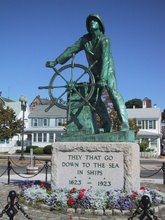
Have you no sense of decency, sir? At long last, have you left no sense of decency?
Friday, March 11, 2011
Echoes
The House Homeland Security Committee, chaired by Rep. Peter King (R, Lon Guyland), began its hearings into the purported radicalization of American Muslims. TONE is mightily tempted to dilate at length on the absence of hearings on the radicalization of the Rebuplican Party, but it seems more appropriate to remember the words of Joseph Welch to Joseph McCarthy at a similar juncture in our history:


Thursday, March 10, 2011
That sound you heard from Madison last night
was the door closing on Rebuplican hopes to recapture the White House next year. (The sound was not too loud, because the GOPhers' chances were already slim to the vanishing point.)
The trouble with lies is that they catch up with you. That's why David Mamet has one of his characters say to another in Glengarry Glenross: "Always tell the truth--it's the easiest thing to remember."
Every day, more Americans come to realize that the GOP stands for three things: 1) Money; 2) Power; and 3) The power of money.
I think it's safe to say that Americans don't like bullies. And if there were any doubt to fair-minded people--who still hold the balance in this country--the Rebuplican steamroller of workers' rights in the Badger State put an end to them. Not to mention any question about the party's respect for truth. As a Wisconsinite told talkingpointsmemo:
It's not just the budget bill needs a quorum -- the big issue is that *any* bill with fiscal implications is supposed to have a quorum in the Wisconsin state Senate. So there are two choices here:
1. Collective bargaining has fiscal implications, and so the bill will be blocked in the courts and ruled unconstitutional.
2. Collective bargaining DOES NOT have direct fiscal implications, and Gov. Walker has been lying this entire time by making the case that it's fiscally necessary.
So either the state R's just passed an illegal bill, or Walker has been lying this entire time and really is just interested in union-busting.For another example of the Rebuplican respect for truth, see todays NYT.
The trouble with lies is that they catch up with you. That's why David Mamet has one of his characters say to another in Glengarry Glenross: "Always tell the truth--it's the easiest thing to remember."
Every day, more Americans come to realize that the GOP stands for three things: 1) Money; 2) Power; and 3) The power of money.
Wednesday, March 09, 2011
Sometimes there is progress
Illinois Governor Pat Quinn has signed a bill--passed by both houses of the legislature--abolishing capital punishment. He has also commuted the sentences of 15 men on death row. This is a major step forward--a major state abolishing the death penalty through legislative, not court action.
Tuesday, March 08, 2011
Somebodies being dumb
Mitt Romney is going around the country trying to run away from his past. Specifically, from his history as governor of Massachusetts. More specifically, from the healthcare reform that he sponsored, which was one of the progenitors of the national reform that Congress passed in 2009.
For a smart guy, the Mittster is being remarkably dumb. The more he tries to avoid his history, the more his opponents will tag him with it; he'll have to spend more time defending himself than he would if he were straightforward. (Those who followed Mitt's campaign in 2008 will recall that that was a feature of his effort then. He has not learned from his history.)
Mitt would be smarter to take the opposite tack. He should say, "The Massachusetts healthcare reform package was imperfect. So is Obamacare [let him use the word; to digress, I think Democrats should take the name on as a badge of honor]. But it has many good features. In today's world, everyone needs healthcare, and insurance is the way we pay for it. No one except an insurance executive wants people to be denied coverage because of a pre-existing condition. No one wants a cancer patient to be told that he can't get more treatment, because his insurance has a limit and that limit has been reached. So, let's reform Obamacare, not repeal it. And, you know, if you look at my home state of Massachusetts, almost everyone does have health insurance, the state has a lower unemployment rate than most, it did not suffer as much from the recession and it is coming out of the recession better than other comparable states. The work we did in Massachusetts had a lot to do with that."
Mitt won't say that, of course. He doesn't have the guts to go against the Rebuplican tide. And he's probably right that the message I have outlined will not get him the nomination. But the one he is trying to peddle won't, either, and if by some mischance he is nominated, he'll go down to ignominious defeat against President Obama.
Oh, and the Rebuplicans are being dumb in their refusal to recognize the need for real reform of the nation's healthcare system. As in their refusal to recognize reality in so many other forms. Don't be misled by the mid-term elections: Americans are waking up to the intellectual bankruptcy of what used to be the Grand Old Party.
For a smart guy, the Mittster is being remarkably dumb. The more he tries to avoid his history, the more his opponents will tag him with it; he'll have to spend more time defending himself than he would if he were straightforward. (Those who followed Mitt's campaign in 2008 will recall that that was a feature of his effort then. He has not learned from his history.)
Mitt would be smarter to take the opposite tack. He should say, "The Massachusetts healthcare reform package was imperfect. So is Obamacare [let him use the word; to digress, I think Democrats should take the name on as a badge of honor]. But it has many good features. In today's world, everyone needs healthcare, and insurance is the way we pay for it. No one except an insurance executive wants people to be denied coverage because of a pre-existing condition. No one wants a cancer patient to be told that he can't get more treatment, because his insurance has a limit and that limit has been reached. So, let's reform Obamacare, not repeal it. And, you know, if you look at my home state of Massachusetts, almost everyone does have health insurance, the state has a lower unemployment rate than most, it did not suffer as much from the recession and it is coming out of the recession better than other comparable states. The work we did in Massachusetts had a lot to do with that."
Mitt won't say that, of course. He doesn't have the guts to go against the Rebuplican tide. And he's probably right that the message I have outlined will not get him the nomination. But the one he is trying to peddle won't, either, and if by some mischance he is nominated, he'll go down to ignominious defeat against President Obama.
Oh, and the Rebuplicans are being dumb in their refusal to recognize the need for real reform of the nation's healthcare system. As in their refusal to recognize reality in so many other forms. Don't be misled by the mid-term elections: Americans are waking up to the intellectual bankruptcy of what used to be the Grand Old Party.
Saturday, March 05, 2011
Is this the same guy?
As I recall from 2008, Mike Huckabee was a very conservative but decent guy, characterized by good humor and a tolerant attitude. He sure has changed. I'd guess that the presidential bug has really dug deep in him, but maybe this is what comes from too much time hanging around the toxic precincts of Fix Schmooze.
You probably saw this story: Huckabee was asked by a "conservative radio host," Steve Malzberg, about President Obama's background. (Republicans have not paid so much attention to a president's upbringing since Abe Lincoln, "the Railsplitter.") Malzberg, whose grasp of facts is at best shaky, said, " How come we don’t have a health record, we don’t have a college record, we don’t have a birth certificate — why, Mr. Obama, did you spend millions of dollars in courts all over this country to defend against having to present a birth certificate?"
None of those assertions is true, but Huckabee didn't bother to correct his host, or to enhance the radio audience's understanding. Instead he wandered off: “I would love to know more. What I know is troubling enough," he began. Then he said, “If you think about it, his perspective as growing up in Kenya with a Kenyan father and grandfather, their view of the Mau Mau Revolution in Kenya is very different than ours because he probably grew up hearing that the British were a bunch of imperialists who persecuted his grandfather.”
That statement, too, is devoid of facts. Mr. Obama did not grow up in Kenya; he did not set foot in that country until he was 26, and then on a short visit. He did not grow up with his father, whom he met only twice after the man left the President's mother when Mr. Obama was a baby. Clearly, he did not hear tales of the Mau Mau at his father's or grandfather's knees.
One of the things notable about this story is Huckabee's amazing ignorance of American history; I mean the guy is a conservative who achieved high office and is seeking an even higher office. But the former governor seems to think there is something essentially different about stories of British imperialists persecuting freedom-loving fathers and grandfathers in Africa from the stories we hear as children, about British imperialists persecuting our forefathers. (Coincidentally, today is the anniversary of the Boston Massacre.)
When it was pointed out that Mr. Huckabee had engaged in fiction, his spokesman, Hogan Gidley, the executive director of the former governor's PAC, said that Huckabee "simply misspoke," and that “he meant to say the president grew up in Indonesia."
Now, that makes sense. It's so easy to confuse a nation in Africa characterized by high plains, large mountains and people with a pastoral background with one strung through Asia on more than 1,000 islands. And who of us has not mistaken the Serengeti Plain for Borneo? Or British overlords with the Dutch?
What really gets to me is the utter contempt for the American people that Huckabee shows. "Simply misspoke?" Huh? At least he could have asserted that he spoke in ignorance--although that is highly unlikely as well; too much thought must have gone into the comment about Kenya and the Mau Mau movement (the leader of which, Jomo Kenyatta, became the first president of an independent Kenya). The fact is that Mr. Huckabee lied (that is, he told a knowing and intentional untruth), and that he tried to cover it up with another lie.
Sadly for the party that gave us Lincoln, Theodore Roosevelt and Eisenhower, this incident is now par for the course for today's Rebuplicans. They have become the Party of Ignorance.
Friday, March 04, 2011
Anniversary
Abraham Lincoln was inaugurated as President (for the first time), 150 years ago today.
FDR was inaugurated for the first time 78 years ago today.*
They still live in our hearts.
*The date of inauguration was changed to January 20th during FDR's first term.
Tuesday, March 01, 2011
The big lie
Guess how much Wisconsin taxpayers are paying for state workers' pensions.
You're wrong. Unless you guessed $00.00. That's right, the Badger State's taxpayers don't pay any part of the pensions. The workers do, because their pensions come out of deferred compensation--that is, money that's owed to them as wages, but that they have elected (through their collective bargaining agreements) to defer and put into the pension system.
It is true that taxpayers would have to make up shortfalls if the projections of payouts fall short (i.e. retired workers live too long). But that is the product of short-sighted public officials who made overly-optimistic projections to make the deal seem sweeter to employees. (The plans are defined-benefit plans; if Gov. Walker really wants to save money down the road, he should negotiate with public workers so that new contracts, or perhaps newly-hired workers, go into less generous defined-contribution plans. But then again, saving money isn't what he's really about.)
Monday, February 28, 2011
We tell the truth in our jests
From a friend of a friend:
A public union employee, a tea party activist, and a CEO are sitting at a table with a plate of a dozen cookies in the middle of it. The CEO takes 11 of the cookies, turns to the tea partier and says, "Watch out for that union guy. He wants a piece of your cookie."
Last American veteran of WWI dies
Frank Buckles, the last surviving American veteran of WWI, has died at age 110.
He must have been some guy. He enlisted at 16, by lying about his age. He served in France, although behind the lines. He came to Washington for the 90th anniversary of Armistice Day, November 11, 2008, to be at a ceremony at Arlington National Cemetery. He was back in Washington a year later--he must have been 108--to testify before Congress on a proposal to designate a National WWI Memorial on the National Mall.
Oh, and he also survived being a POW in the Philippines during WWII.
Wow.
Sunday, February 27, 2011
Where'd they get the flags?
If you've been watching the news from Libya--and how can you not be?--you've seen the opposition (or should we call them rebels, or just the people?) flying black, red and green flags with a crescent and star. That was the Libyan flag under the monarchy that Qaddafi overthrew in 1969.
So, where did they get all the flags? There seem to be too many for them to have been made in the past couple of weeks. Have people been saving them all these years, dreaming of the day when the dictator would fall? Has there been an underground movement making flags as a means of resisting tyranny?
If you know, or have an idea, let us know.
If ya can't join 'em, beat 'em
Note: This is a re-write of an earlier post
Worse, none of the reports I have seen ask this question: Why aren't more people in unions? More specifically, If people in unions are better-paid, have more benefits and enjoy more job security than unorganized workers, wouldn't it be a good thing for more people to join unions?
Questions like these may seem obvious, but they must not be. Or, they are ignored and obscured by those who don't like the answers? (Part of it is certainly short budgets, short deadlines and shortsightedness by reporters and editors.) Unfortunately, not enough speakers who are on the side of working people are asking questions like these, and when they are asked it is not done often enough or at sufficient volume.
Again, we see progressives getting beaten down, objecting but not really digging in for a long struggle to change minds clouded by sustained, well-funded barrages from the plutocrats. The Right was willing to spend decades taking its foolish ideas from the realm of derision and fantasy to the center of the national stage. Progressives--who, after all, have truth (that's small "t" truth, not large "T" truth) on their side, must be willing to fight as hard. Perhaps what's happening in Wisconsin will wake us up, finally.
Speak up!
Rebuplicans
Readers may have noticed that this page has been referring to Rebuplicans lately. Readers may also know that for the past few decades--or longer, an article in Wikipedia puts its origin in 1940--members of that party have consistently referred to my party, the Democratic Party, as "the Democrat Party." That is a slur. It is meant to convey disrespect: Members of the GOP cannot be bothered to learn the true name of their political opponents' party.
The other night, Lawrence O'Donnell interviewed Scott Fitzgerald (yes, that is said to be his real name), the majority leader of the Wisconsin State Senate. O'Donnell went out of his way to be polite to Sen. Fitzpatrick, but the senator repeatedly referred to his colleagues across the aisle as "Democrat senators." Unfortunately, although understandably, O'Donnell did not correct Mr. Fitzhugh. The governor of Wisconsin, Scott Walker, shows a less subtle condescension and contempt for the opposing party.
On this page, anyway, members of the other party will be known henceforth as Rebuplicans until they learn to call our party the Democratic Party. Feel free to join us and get others to do the same. Who knows, if it spreads, maybe the Rebuplicans will learn some respect. Not a small thing. It is, after all, one of the keys to democracy.
Thursday, February 24, 2011
More wisdom
I recently found a terrific blog on politics and life by DEK Rivers, and it's based in Wisconsin! (I happened upon it before the recent blow up). I much recommend Caffeinated Politics.
Here's a small sample:
"Sometimes I wonder whether the world is being run by really smart people who are putting us on or by imbeciles who really mean it."
Mark Twain
What would Twain have made of America today?
Knowledge vs. Wisdom
Thanks to Ron Dean and Barry Roseman, plaintiffs' employment lawyers, for this quotation:
"Knowledge is knowing a tomato is a fruit; wisdom is not putting it in a fruit salad."
The Rebuplian DOMA problem
As you have no doubt heard, the Obama administration has declared that the fraudulently named Defense of Marriage Act is so patently unconstitutional that the Justice Department will no longer defend it.
Rebuplicans are predictably outraged. But they have a problem here. DOMA declares marriage to be the union of a man and a woman. But GOPhers are resolutely anti-union these days.
So where does that leave them?
(If you respond that the GOP must have become the party of divorce, you're right. Divorced from reality, at any rate.)
Wednesday, February 23, 2011
Words for these times
Proof that history does repeat itself, that the same battles need fighting, over and over again.
Good news to you I'll tell,
Of how the good old union
Has come in here to dwell.
Which side are you on, boys?
Which side are you on?
Which side are you on, boys?
Which side are you on?
My daddy was a miner
And I'm a miner's son.
I'll stick with the union
Til every battle's won.
Which side are you on, boys?
Which side are you on?
Which side are you on, boys?
Which side are you on?
They say in Harlan County,
No neutrals are there there.
You'll either be a union man,
Or a thug for J.H. Claire.
Which side are you on, boys?
Which side are you on?
Which side are you on, boys?
Which side are you on?
Oh, workers can you stand it?
Oh, tell me how you can.
Will you be a lowdown scab,
Or will you be a man?
Which side are you on, boys?
Which side are you on?
Which side are you on, boys?
Which side are you on?
Don't scab for the bosses,
Don't listen to their lies.
Us poor folk hasn't got a chance,
Unless we organize.
Which side are you on, boys?
Which side are you on?
Which side are you on, boys?
Which side are you on?
(later verse)
They say down in Hinds County,
No neutrals have we met.
You'll either be for Meredith,
Or a Tom for Ross Barnett.
Which side are you on, boys?
Which side are you on?
Which side are you on, boys?
Which side are you on?
Florence Reece (except last verse)
Evolutionary question
Your editor has no more doubt about evolution than he does that the Sun will rise tomorrow. Well, no more than he would have if he believed that the Sun actually rises.
But here's a challenge for proponents of Darwin's theory: Why don't earthworms sleep late?
Thursday, December 23, 2010
A Christmas Story
I've noted before that, although I'm not a Christian, I love Christmas. Not for the theology--that won't surprise you--but for the spirit. Yes, the Christmas spirit. Tomorrow night, as we do every Christmas Eve, the lovely Diane and I will watch Miracle on 34th Street (the original, 1947, B&W version, of course), and at the end I'll tear up.
One reason that it's easier for a non-Christian to love this season is that it never came with any of that baggage that that bedevils (you should pardon the expression) so many for whom the holiday has religious and family trappings. I can appreciate the spirit of Christmas in its essence. Of course, the spirit I cherish was largely constructed by American business and Hollywood. The miracle on 34th street, after all, was that Macy's would put customers ahead of profits (and in so doing, as the actor portraying RH Macy notes, make even more profits).
But enough Scrooge.
Tonight's CBS Evening News had a truly wonderful Christmas story, about a young (really young) man who truly knows the spirit of Christmas. Take a look. Oh, and go here to learn more about how you can get in on the goodness.
MERRY CHRISTMAS TO ALL!
Sunday, December 19, 2010
Good news--for me, at least
Just saw a story that asserts that my home state, Massachusetts (a commonwealth, actually), is one of the 10 worst states for retirement. Whew! I don't want to spend my retirement (when and if) among a bunch of old people, any more than I want to be surrounded by tourists when I travel. When I travel, I want to be the only tourist (well, with the lovely Diane), and when I retire I want to be among younger people.
So, all you alte kakas out there: Go to Florida!
Thursday, December 16, 2010
Insanity
You have no doubt head the saying that the definition of insanity is doing the same thing over and over and expecting a different result. If that's the case, then our attitude toward guns is the very definition of insanity.
In Panama City, Florida, the other day, a man stood up at a school board meeting and started taking potshots at the School Committee. In Sacramento, a young mother, a supervisor at a bookstore, was killed after a man apparently walked into a barber shop and started shooting. The mother was found in a position that led police to conclude that she heard the firing and placed her body to protect her 2-year old son. He will now grow up without a mother. Meanwhile, TPM reports that a plan to reduce gun smuggling to Mexican drug cartels has languished at the Justice Department out of fear of NRA influence.
Insanity.
Monday, December 13, 2010
The tax psychosis
The prevailing attitude toward taxes in this nation--at least so far as the mainstream media are concerned--may best be described as a psychosis, that is, a derangement characterized by a loss of contact with reality. This disease has grown over the past 30 years, to the point where it now dominates our politics.
Reality is that the nation faces great challenges: an educational system that has been overhauled and surpassed at all levels by countries in both Europe and Asia, the immense financial burden of war, a deteriorated infrastructure, a high-tech sector that is losing ground daily to foreign competitors, and a dependence on foreign energy sources that is only increasing, to name a few. Yet every serious attempt to deal with these problems--and to restore the United States to a position of leadership--is crippled by a reflexive refusal to consider any increase in the levies on those who can easily afford to pay more, who are also those who by every measure get the greatest benefits from government.
Not surprisingly, the tax psychotics are also bullies. Anyone with the courage to question their delusion is bullied and shouted down. They have to do that, because no rational defense of their position can be mounted.
Like many sane people, Democrats have been hesitant to challenge the delusion. Instead of calling the tax psychosis was it is--crazy--Democrats have temporized, tried to avoid conflict and attempted to reason. To no avail.
The anti-tax movement did not start out by being loony (although elements of the movement got there quickly). In the hands of its initial proponents, opposition to taxes was an expression of a belief that government was too large. And there are still those who espouse the need for smaller government, although few indeed are the members of this camp whose positions are consistent. But even the "starve the beast" camp of Grover Norquist et als has been obscured by a simple, reflexive and complete rejection of any tax hike, no matter how needed or equitable it might be.
The tax psychosis has crippled the United States. It distorts the debate about vital national issues and limits the range of solutions to problems that have have led to our national decline. It empowers the forces of reaction and fear.
Unless and until the progress of the tax psychosis is reversed and room for a healthy, real debate about tax policy created, there will remained hobbled, at home and abroad.
Future posts will pose some suggestions about how to counter the tax psychosis. Your suggestions will be welcome.
True intellectuals
Democrats tend to consider themselves more thoughtful and, truth to tell, more intelligent than Republicans.
But consider: It is said that the mark of a true intellectual is someone who can keep opposing thoughts in his or her head at the same time. And Republicans, as we know, believe that we must not tax the rich at the same time that they think that diminishing the deficit immediately has to be our first priority.
Wednesday, December 08, 2010
The price
"Why didn't you people shoot?" With those words Adm. Wilhelm Canaris, chief of German military intelligence, greeted his new deputy, Col. Erich Lahousen, formerly his opposite number in the Austrian service.
What would have happened had the Austrians resisted the forced annexation of their country? No one knows, of course. Had the Austrians fought (there was substantial division in that country over the Anschluss), they would have had to pay a price in blood, and most probably Germany would have prevailed. But it seems safe to assert that the butcher's bill would have been lower than it turned out to be. In all probability, many fewer Czechs, Poles, French, Norwegian, Dutch, British, Russians and Americans would have died to destroy Nazi Germany.
Had the world resisted Hitler earlier, the cost would have been even lower. When the German Army marched into the Rhineland in 1936, its orders were to turn around if the French put up a hand and said Stop.
I do not for a moment mean to equate Republican congressional leaders with Hitler. The point is that there is always a price to pay for standing up to bullies, and the cost gets higher the longer the bullies are allowed to prevail. Worse, that cost curve provides further justification for refusing to fight We saw that yesterday, when the President argued angrily that the cost of further resistance to Republican obstructionism on the Bush tax giveaways is too high. What he ignored is that the price has risen precisely because he has not been willing to fight back. Had he and his administration stood up to the GOP earlier, many fewer people would have had to suffer before the Republicans knuckled under--as they would have been forced to--on issues like taxes and unemployment compensation.
Ultimately, the West was forced to stand up for Poland, a nation that was geographically isolated and profoundly undemocratic. But by September 1, 1939, there was no choice. Even then, the Allies' unwillingness to take risks led to the occupation of Western Europe.
So far, Barack Obama has refused to learn from history. But he is a smart man and there is yet time for the light to dawn. Let's hope that the fury of his supporters and allies wakes him from the stupor that has taken up much of his first two years.
The President's defense
Did you see President' Obama's spirited defense of his "compromise" with the Republicans?
This is called--as the President should recall--putting lipstick on a pig.
Wednesday, December 01, 2010
How come?
Today's Times reports that the President's commission on the national debt lacks to votes for a comprehensive plan.
There are essentially three ways to bring the federal budget into line and, ultimately, to reduce the national debt: 1) For the economy to grow fast enough so that increases in federal revenues are greater than increases in spending. 2) To raise taxes. 3) To cut spending.
How come the deficit commission concentrates almost all of its energy on the third of these? As do Republicans and a surprisingly high percentage of commentators who ought to know better. As far as raising taxes are concerned, the deficit commission's chairs, Erskine Bowles and Alan Simpson, would concentrate on extracting more from the middle- and working-classes while letting the affluent off pretty much scot-free. They pay no attention to the first source of needed funds.
Does that make sense to you? Me, neither. But maybe that's because we're not rich enough. Or being paid by those who are.
What the President should say
Last night, I suggested that President Obama should announce that he will veto any extension of the Bush tax cuts for those earning over $250,000. On thinking about it, he should be more clear. Here is the kind of thing he should say:
The Bush-era tax cuts for those earning more than $250,000 will expire at the end of this month. They are history. They will not be restored. I will veto any measure that extends those tax cuts. If Congress sends me a bill that extends the Bush tax cuts for all taxpayers, I will veto it. If Congress attaches an extension or reenactment of the tax cuts for those earning more than $250,000 to a defense-authorization bill, I will veto it. If Congress attaches an extension or reenactment of the tax cuts for those earning more than $250,000 to a bill raising the debt limit, I will veto it. I trust that I have made myself clear. It is time for Congress to get on with the business of the nation, to pass measures that will be effective in bringing the nation out of recession and in starting to plan how we are going to deal with our huge load of debt once the economy is strong again. It is past time to talk about tax cuts for those who can well afford to pay a little more for the benefits that they receive from this nation.
Tuesday, November 30, 2010
Saying it all
A letter in The New York Times exposes the foolishness of those who believe that Wikileaks' disclosure of American diplomatic traffic is a welcome example of transparency. Thanks to Ilya Shlyachter of Cambridge, Massachusetts:
You seem to believe that disclosing diplomatic conversations will not have a dangerous chilling effect on the diplomats’ work. But are you willing to have your internal editorial discussions published? To have others decide what will and what won’t compromise your news-gathering methods? Would that not chill your ability to work.We’ll know the answers when WikiLeaks publishes a trove of secret New York Times documents.
.
What am I missing?
Why doesn't President Obama simply announce that he will veto any tax bill that includes continued tax relief for people earning more than $250,000?
If he did that, he would call the Republicans' bluff.
Are the Republicans willing to go to the nation and say, "Yes, we raised your taxes, because the President would not agree to tax relief for the wealthy?"
I say, Let them.
Saturday, November 20, 2010
The secret to delicious Thanksgiving turkey
I know that regular readers come here for iconoclastic commentary on politics and public affairs, but in this era of national anxiety, I thought we would do our part to allay that concern by providing the solution to what worries millions and millions of Americans at this time of year: How to make that perfect Thanksgiving turkey. As it happens, TONE knows the secret, and we conceive it to be our duty to share it with the nation. Indeed, with the world, the Internet being what it is.
So, go get a pencil and a piece of paper, because we're only going to say this once.
Here it is:
Remember to defrost the turkey early enough to get the bag of innards out of the cavity before you put it in the oven. Oh, yes, and remember to reach in and pull the bag out.
That's it.
For all the debate about brine, bags, deep-frying, whatever, the truth is that turkey is just about the easiest dish you can cook. Turn on the oven and let it heat to 325 or 350 degrees, put the bird in and, after a sufficient amount of time, take it out. Remember that, and don't get caught up in all that dithering about how to cook the turkey.
OK, a couple more hints: You can start the bird at 425, then turn the heat down after 30-45 minutes, to get the outside crisper. you can also help a crisp exterior, and maintain a moist interior, by basting the turkey every 15-25 minutes. Use whatever oil you prefer: canola, olive, peanut, motor....
One more thing: If you don't get soften the bird sufficiently to pull the bag out before it goes in the oven, roast it for an hour or so, then take it out and pull it out then. You won't notice the difference.
Oh, and if you feed your guests enough wine, beer, hard cider (TONE's preference, an authentic early American touch) or whiskey, they won't care what the turkey tastes like.
Happy Thanksgiving.
Wednesday, November 03, 2010
The hangover
Now comes the hangover. Like someone who has gone on an epic bender, the voters are sleeping it off; they probably will be in a stupor for some months. Slowly, they'll begin to wake, and as they do the awful uncertainty in the gut, followed by nausea, will make itself known. Then the headache will begin to pound, and voters across the nation will ask themselves, What have we done?
The hangover will last two years, at least. Let's hope that, like the person who comes to realize that drinking too much is no fun, the electorate will sober up for 2012. I, for one, am confident that we will.
(Note to readers: This is likely to be the last post for a while. I am preparing to conduct a trial that seems likely to last until Thanksgiving. Trying cases is an all-consuming occupation.)
Sunday, October 31, 2010
England or Spain?
If you had been a dispassionate observer of the European political scene in 1585, you would almost certainly have said that Spain was far and away the most dominant power. With its Empire in the Americas sending huge amounts of treasure to the mother country each year, Spain was much the richest of nations. It's armies dominated Europe, using a military system based on blocks of pikemen with arquebusiers at the corners that rolled over opponents. Through its dynastic connections with the Hapsburg emperors of the Holy Roman Empire, Spain's domains were spread across Western Europe.
England, in contrast, was a small nation on the periphery of the continent; it shared the British Islands with Scotland, a traditional ally of England's enemy, France. The English had a substantial fleet, but no regularly organized navy to speak of, and no standing army beyond a palace guard. Although prospering from trade and fishing, the English were poor when compared to the Spanish.
As we can see now, by the mid 1580's Spain had passed its zenith and was on a downward curve that would lead, with a only a few brief intervals, to the poor, weak and divided nation that emerged from the blood-soaked exhaustion of its Civil War in 1939. England would go on to establish the greatest empire the world has seen--for two hundred years it was literally true that the Sun never set on it--be a power of the first rank for three and one-half centuries and the Earth's richest nation for much of that time. England--later the United Kingdom--survived the loss of the American colonies that became the United States and the rise of the Napoleonic and two German empires; it outlasted them all.
Spain, confident in its wealth and power, sank into centuries in which it lived off its assets and watched is political horizons to become steadily more limited. England, in contrast, gave freer rein to its citizens, rewarding initiative and encouraging innovation. Where the Spanish aristocracy continued to rule even as it became increasingly entrenched and entrusted, England permitted commoners to rise and even to rule.
The question facing the United States today is whether we will be like England or Spain. Are we on a path of irreversible decline or will the American system prove resilient and regenerative? Actually, we may first have to face a preliminary question: Do we care enough to accept the challenge of being the world's leader? (For those who believe that this is only question of empire-building, see Tom Friedman's column today.)
This is a much larger question than whether Democrats or Republicans should control Congress, or the importance of the Tea Party. Indeed, the scope of the issue dwarfs the mean, petty, self-destructive quarrels that constitution our politics.
And the American people are quite aware of the challenge the nation faces. On NPR, both E.J. Dionne and David Brooks--who agree on little--reported that they have found a wide and deep-seated feeling (or maybe fear) that the United States is in decline. Indeed, I suspect that much of the rage that is said to power the electorate this year represents frustration with apparent decline at just the moment when we--the World's Only Superpower--should be supreme.
The party that dominates American politics in the next quarter century--and perhaps much longer--will be the one that recognizes and acknowledges this issue and can mobilize the nation to confront it. Which one will it be: Democratic? Republican? Or some new grouping?
The activist Constitution
Yesterday, the lovely Diane and I watched Hubert H. Humphrey, The Art of the Possible, a terrific documentary on one of the most underrated figures of Twentieth-Century American politics. The close of the program is Humphrey explaining the inspiration he found in the Preamble to the Constitution. The opening words of the Preamble, "We the People," embodied for Humphrey the essence of American democracy: that all power and all sovereignty derive from the citizenry. That's a truth that's all to easy to overlook--a lesson for political leaders and would-be leaders of both Left and Right.
But what really affected me was the way that Humphrey proceeded to explain how the Preamble formed the basis of his view of the Constitution and, indeed, of the role of the federal government.
The Preamble reads:
WE THE PEOPLE of the United States, in Order to form a more perfect Union, establish Justice, insure domestic Tranquility, provide for the common defence, promote the general Welfare, and secure the Blessings of Liberty to ourselves and our Posterity, do ordain and establish this Constitution for the United States of America.
As Humphrey noted, each of the verbs is active: to "establish" Justice; justice does not spring up on its own. "Insure" domestic tranquility: we must act to assure a civil society. "Provide" for the common defense: we must make the efforts necessary to defend the nation. "Promote" the general welfare; it does not come automatically. "Secure" the blessings of liberty: we cannot simply expect that freedom will flower, we must work to make liberty real.
As the Preamble sets the tone for the Constitution that is the foundation of the United States government, Hubert Humphrey argued that it should set the tone for our politics as well. In doing so, he also refuted those who would take a cramped and narrow view of government's role.
(Your editor worked very, very hard as a volunteer for Humphrey's 1968 presidential campaign. Hubert Humphrey was a good and gentle man, but tough enough to come within a whisker of winning that year; indeed, had the Left turned out, he would have been President. I recall how I walked around in a near-stupor for days after the election, unable to believe that the American people had chosen moral midgets like Richard Nixon and Spiro Agnew over men with the stature of Hubert Humphrey and his running mate, Edmund Muskie.)
Tuesday, October 26, 2010
Post hoc
As most of those who read this post yesterday probably realized, I indulged in the fallacy of post hoc ergo propter hoc (after therefore because) in suggesting that, had President Obama taken a stronger position against the big banks, Wall Street and the health insurers, we might have had no financial or health care reform.
What I assumed was that the political equation would have been the same if the White House had come down on the side of more change than they were in light of the President's tepid positions and that, therefore, the outcome for reform would likely have been worse (even) that it has been. Yet the power of the President is the power to persuade, as Richard E. Neustadt wrote in Presidential Power in 1960. (The link is to a later edition.) Had Barack Obama taken to the airwaves and the stump to call for real, top-to-bottom financial reform, had he espoused single-payer national health insurance, or the replacement of fee-for-service with other approaches to charging for health-care services, or just the breakup of huge health insurance companies to insure competition in the market, he could have changed the terms of debate. That, if accompanied by adroit political handling, might have led to very different results, to the benefit of the nation.
So, we'll never know what might have happened. More's the pity, especially as we are faced with the substantial likelihood that the next two years (at least) will see even more division as the forces of reaction block progress on almost all vital issues.
Monday, October 25, 2010
Were the liberals right?
If Obama had pushed to break up the big banks and weaken the huge investment banks (banking and investment banking used to be entirely separate lines of business; they should be again), Republicans would have had a lot more trouble in arguing that the Administration is in bed with Wall Street, and perpetrating the lie that it was the Obama, rather than the Bush Administration that bailed out the banks.
If Obama had taken on the health insurers, Republicans would have had a harder time assailing the Administration over "Obamacare," and particularly at the charges that health care reform will raise rates.
On the other hand, we might not have health care reform or financial reform on the books, even in their highly imperfect forms.
One thing is, however clear: The President should have been much stronger at criticizing Republican obstructionism from the beginning, and he should have made it clear that the bills he signed had many flaws and were only first steps toward real reform. The political people in the White House should have resisted the understandable, nay, inevitable, urge to celebrate the passage of health care and financial reform and urged the President to make the signing ceremonies muted affairs at which he noted the progress that had been made, but coupled that with strong statements that we need to go much further--with specific statements of the direction that further change should take.
Oh, and Mr. Obama should not have surrounded himself with people who were in the Wall Street club. He didn't do that on health care, and so you don't see Republicans attacking the administration for being too cozy with the health care establishment.
Friday, October 22, 2010
Shake the tree, you never know what will fall out
Some fallout from Virginia Thomas' misguided attempt to obtain an "apology" from Anita Hill.
This will not surprise most thoughtful people who, I suspect, long ago concluded that Prof. Hill was telling the truth, and that Clarence Thomas either perjured himself or engaged in the most massive self-deception in his quest to join the Court.
Some of us have not forgiven such examples of Senatorial rectitude as John Danforth (then R. MO), Arlen Spector (R/D PA) and Alan Simpson (then R WY) savaged Prof. Hill although they must have known that she was telling the truth and that Thomas was not.
I'm voting Republican, redux
Remember that great "I'm Voting Republican" video that we featured in this post? Funny thing: within a day after I first saw it, the number of views skyrocketed from a bit over 600,000 to more than 4.6 million. (Disclaimer: Not because it was posted on this blog!)
But then the number of views reported by YouTube got stuck. Go to the piece today, as I just did, and the number is still 4,673,586.
What gives?
Update: a few hours after this was posted, I checked again and let the video run full length to see if the clicker would roll over. Now the number of views is 4,673,932. But that is still a very small number of new views over several weeks.
Wednesday, October 20, 2010
Why didn't I think of that?
And why didn't the Democrats who are actually running? From Malcolm Fleschner, a very funny guy with whose mother I worked:
Wednesday, October 13, 2010
Truth or lies
Todays Times has a fine lead editorial on the Senate race in Wisconsin, between Russ Feingold (D), who is one of the best Senators in a long time, and Ron Johnson (R), a former plastics manufacturer (remember The Graduate?) and political neophyte. Astoundingly, Feingold is trailing in the polls, and if you believe them he is seriously behind. Clearly, the ghost of Tailgunner Joe McCarthy is haunting the Badger State.
As the Times editorial points out, Johnson has got to his present place by dismissing the importance of mere details (like the effect of healthcare reform on costs, the number of people put to work by the stimulus bill and the effect of letting the Bush tax cuts for the wealthy expire on the vast majority of small businesses), and by outright lying.
Republicans have had little regard for truth--unless it happens to support their pre-conceived positions--for many years. This year, they have taken their cavalier attitude to new heights.
Truth does not always win out, but it's a better base for getting votes than lies. The truth can't be exposed.
How I would love to see a [Democratic] candidate turn to her/his [Republican] opponent in a debate and say, "If you believe that you are a fool. If you do not, you are a liar. You may choose." Think about how often that would fit.
So, in the last few weeks of the campaign, Democrats ought to make truth an issue. Maybe the issue. Expose the lies. Ask the voters: Do you want people to tell you the truth, or people who lie. If the voters choose the liars, they will get what they deserve. (You and I shall not deserve that, of course.)
(I do not suggest that Democrats and truth are perfectly congruent, or that all Republicans lie; there must be some who do not. But the difference is sufficiently great to be significant and worth making a bloody fuss over.)
Monday, October 11, 2010
Challenge
When was the last time an American President challenged the American people? I'll save you the troubled of going to Wikipedia. It was Lyndon Johnson, with the War on Poverty.
That is both a symbol and a cause of our national decline. Where is the President to challenge us to rebuild our roads, bridges, water and sewer systems, to provide broadband to all areas of the nation, to improve an educational system that has fallen to 12th among industrialized nations in the proportion of college graduates?
Yes, its true that President Obama has raised all of these issues, but he has not used the power of his office to challenge the American people to participate in these efforts, not because they will help in the short run, but because they are imperative in the long run. And that is one reason--just one, but an important one--why his numbers are unfavorable.
The fact is that people, especially Americans, want to be challenged. Why politicians--Republicans and Democrats--have forgotten this remains a mystery.
The difference
What's the difference between Democrats and Republicans?
Democrats believe that we're all in this together.
Republicans believe that it's every man for himself.
Democrats need to point that out.
Wednesday, October 06, 2010
This is what we have to look forward to
if Democrats and intelligent independents don't get out to vote on November 2nd.
Gene Cranick owns a farm in rural Tennessee. He and his neighbors have to pay a $75 annual fee for fire protection from a nearby department. Cranick hadn't paid. When his house caught fire last week, he called 911 and in the call he offered to pay the costs of fighting the fire. No dice. Firefighters responded when his neighbor--who'd paid the fee--worried that the blaze would spread. But they sat by and watched Cranick's house burn. More details here.
Is this the way we really want our country to run? A fee for everything, even the most basic services? A system in which its every man (and woman and child) for him/herself? Or are we all in this together?
Justice Holmes was right: "Taxes are the price we pay for a civilized society." He had taxes in mind--not user fees.
(I might note that by not fighting the fire at Cranick's house, firefighters increased the likelihood that the flames would spread, not just to the neighbor who called them, but to other property or structures as well.)
You gotta see this
Regular readers will know that they haven't been able to be regular readers, because the Editor has not posted anything for some weeks. (He's been too busy to turn around, if that's an excuse.) He is roused from his torpor, however, by this video. Take a few (3) minutes to sit back and watch why your neighbors are voting Republycan this year:
Wednesday, September 22, 2010
Splitting the sane vote
When Lisa Murkowski (R, for now, AK) announced that she would run for her Senate seat as a write-in candidate, I thought that was good news for Scott McAdams, the Democrat in the race. Apparently, I was naive. According to a new poll, Murkowski is splitting the vote of the sane people in Alaska with McAdams, providing Tea Partier and right-wing crank/crazy Joe Miller (now that has to be a made-up name, right?) with a big lead.
Sigh.
Education
Standardized tests are at the center of discussions about education. Standardized tests teach children how to answer. A good education teaches them the questions to ask.
We know that good teachers can inspire children whose parents are indifferent to education. We know that parents can get a good education for their children despite uninspiring teachers. We know that learning can take place in humble surroundings. We know that some children can succeed without support from parents or teachers (although such children are rare).
Time to stop pointing fingers and accept that we are all in this together--even those of us who do not have children in school. Time to stop placing blame, discuss how to increase the value we place on education, and then do it.
Monday, September 20, 2010
Yellow dogs, blue dogs and beaten dogs
I'm almost a yellow-dog Democrat. That's a term that has almost disappeared from the political lexicon; it referred to someone who would vote for a yellow dog if he ran on the Democratic ticket. Now we have blue-dog Democrats, on the party's right, who all too often undercut the leadership and act like a GOP fifth column. A reader of Talkingpointsmemo suggested that Democrats exhibit a beaten-dog syndrome, "to describe a generation's worth of Democratic electeds and operatives who have so internalized GOP attacks that the mere suggestion that they are coming cause these people to involuntarily cower."
Apart from the split infinitive, that's right on the mark. Sad as it is to say, since at least 1980 the Republicans have so dominated debate in this country that Democrats have largely lost the ability to define themselves, their party or--most important--their values. True, the Obama campaign reversed that in 2008, but the effort was centered on electing a President, not raising the position of the party. And once in office, Obama seemed unable or unwilling to espouse a strong, consistent, principled line of policy and program that would build up the party.
In 2008, with a substantial majority in the House and--for a short time--a filibuster-proof majority in the Senate, it seemed as if a vital change in our politics had come. Six weeks before the mid-terms, things look very different. I'll have something to say about why that is so in another post.
Democratic weakness has not only meant losses for the party, it has been a tragedy for the nation. Even if you do not support the Democratic platform, a healthy democracy needs differing views. Although the Democratic Party itself all too often displays such a divergence, the dominance of Republican theory has held back the nation's development. (Think action on global warming and green jobs.) Democratic fecklessness has led to what may fairly be called American decline. Democratic weakness, their failure to offer a contest to Republican ideas, has left the Right dominant by default. And Democrats must share some of the blame.
Disturbing headline
From the Times:
Obama Aides Weigh Bid to Tie the G.O.P. to the Tea Party
If Democrats need to think twice about this, the party is in worse shape than I thought.
Sunday, September 19, 2010
Strange attitude
Am I the only one who's getting tired of hearing the Tea Partiers--those self-proclaimed champions of a strong America--play the victim whenever they get criticized? The latest is Christine O'Donnell, speaking to the "Values Voters" conference in Washington yesterday.
"Will they attack us? Yes. Will they smear our backgrounds and distort our records? Undoubtedly. Will they lie about us, harass our families, namecall to try to intimidate us? They will. There's nothing safe about it," she said.
Now, there's no reason for Democrats to lie about O'Donnell--the woman once said she was a witch, for Heaven's sake--but what strikes me is that way that she and others of the Right (Sarah Palin being a prime example) quickly turn themselves into victims when the going gets tough. They have a perfect right to take that tack, but you would think that voters will begin to notice the contrast between the ostensible toughness of the Tea Party campaigners and the whining that rises when they are challenged.
Friday, September 17, 2010
Still not ready for prime time (not even close)
Christine O'Donnell, darling of both the lunatic Right and the Democrats (though not for the same reasons), says that the rigid moral views she has espoused in the past would not guide her in the Senate. According to the LA Times, she said, "When I go to Washington, D.C., the litmus test by which I cast my vote for every piece of legislation that comes across my desk will be whether or not it's constitutional."
Memo to Christine: If, by some horrible mischance, you do get to the Senate, 99.9% of the legislation you see will have no constitutional implications. The legislative process is a whole lot more complicated than you seem to believe.
Thursday, September 16, 2010
No surprise
Certainly not to Red Sox fans. The New York Times reports that "A curious phenomenon has emerged at the intersection of fashion, sports and crime:" many miscreants commit their crimes wearing Yankees caps.
Wednesday, September 15, 2010
No doubt anymore
Rand Paul
Jan Brewer
Sharron Angle
Christine O'Donnell
Carl Paladino
Sarah Palin
Jim DeMint
Ben Quayle
John Boehner
Eric Cantor
Paul Ryan
James Inhofe
Mitch McConnell
Can there be any doubt that the Republican Party is dominated by radical right-wingers out of step with the American mainstream?
Just a thought
We have the worst economy since the 1930's, and the world is more violent than it has been since then. Why should we be surprised that we have the worst politics since the 1930's?
Tuesday, August 31, 2010
Warms the cockles of your heart.
Seven states that are among those suing to overturn Healthcare Reform are claiming federal subsidies under that very act.
A New Force for Afghanistan
Even as the U.S. buildup in Afghanistan continues, commentators are looking forward to next July 1st, when the withdrawal of American combat troops is scheduled to begin. Given the continuing and even increasing threat posed by the Taliban, there have been a number of stories on the way that women's rights have advanced in the country since 2001, and how they are threatened by the Taliban. Katie Couric did, I think, two stories when she was in Afghanistan recently. Time magazine ran a cover story that showed--on that cover--a beautiful young woman whose nose had been cut off by her husband in a fit of anger--a typical punishment in the traditional society.
Should we keep troops in Afghanistan longer than we would otherwise, because we believe in women's rights? Will we do women an injustice by withdrawing? These are complicated issues, and people of good will may be on all sides.
But I have an idea on how we can help women in Afghanistan to help themselves: Arm them! Let women form militias. Let them fight the Taliban. Women have fought in resistance movements for many years. More and more armies let women fight in combat; the United States does, even though our laws still formally forbid it. Let Afghan women fight for their rights.
And nothing will advance women's rights in Afghanistan faster than letting them face their abusers and would-be abusers with guns in their hands.
Monday, August 23, 2010
The wrong speech
President Obama is scheduled to give a national address on Iraq next week. That's not the speech he should give. Iraq is yesterday's news. Americans are worried about the state of the economy--more worried than we were six months ago. That's the issue that the President should address. Here's what I'd like him to say:
My fellow Americans, you don't need me to tell you that our economy remains in tough shape. Although we are recovering from the recession, the pace of recovery is much too slow. Millions of Americans have been out of work for months, with little prospect of getting new jobs in the near future. Hundreds of thousands of homeowners are still facing the threat of foreclosure. Tens of thousands of business owners worry about whether their shops and factories and farms can survive. Cities and towns across the nation are laying off teachers, police and firefighters--people who provide essential public services.
At the same time, there is much that needs to be done in this nation. We have half a million bridges that need to be rebuilt or repaired. We have thousands of dams that are in states of disrepair. Our roads need to be maintained and upgraded. Our electrical grid is not well constructed for the diverse sources of clean power that we need to bring on line in the next few years. We are buying millions and millions of barrels of oil from other countries, and some of them have supported forces that have tried to do harm to the United States; we need to learn to use less oil. We lack the broadband Internet capacity of many nations with which we compete. While we have started on high-speed rail lines, we need thousands of miles more track that can take the trans that have been commonplace in Europe and China for years.
In 2009, Congress passed the American Reconstruction and Recovery Act, the stimulus package. That program has been a great help. It has saved or created more than two million jobs. It has supported programs to rebuild America. But it is not enough. The stimulus was designed to spur the economy for two years; that time is expiring. The truth is, government needs to do much more to help our economy get rolling again.
Government needs to take on that role, because private enterprise is not. Businesses are not creating enough jobs. They are not investing enough in out future prosperity. There are banks--many of them the very ones that were baled out with billions or our taxpayer dollars--that are holding on to huge profits, but not lending to businesses or homeowners. There are large corporations sitting on large profits that they could be using to modernize plants, develop new lines of products and hire new workers. There are small businesses that simply cannot afford to expand or to hire. Whatever the reasons for this behavior, the evidence is clear: private business is not moving our economy forward fast enough.
Government can help. As the Reinvestment and Recovery Act has shown, public investment can create and preserve jobs. It can meet important public needs. It can inspire new investment. That is why I am calling on Congress to enact a stimulus package of $750 billion before April 15, 2011, and another of equal size by April 15, 2012. As part of those packages, I call on Congress to dedicate at least one third of the amount appropriated to rebuilding and extending our infrastructure.
Government needs to take on that role, because private enterprise is not. Businesses are not creating enough jobs. They are not investing enough in out future prosperity. There are banks--many of them the very ones that were baled out with billions or our taxpayer dollars--that are holding on to huge profits, but not lending to businesses or homeowners. There are large corporations sitting on large profits that they could be using to modernize plants, develop new lines of products and hire new workers. There are small businesses that simply cannot afford to expand or to hire. Whatever the reasons for this behavior, the evidence is clear: private business is not moving our economy forward fast enough.
Government can help. As the Reinvestment and Recovery Act has shown, public investment can create and preserve jobs. It can meet important public needs. It can inspire new investment. That is why I am calling on Congress to enact a stimulus package of $750 billion before April 15, 2011, and another of equal size by April 15, 2012. As part of those packages, I call on Congress to dedicate at least one third of the amount appropriated to rebuilding and extending our infrastructure.
This money must be directed to America's needs, not to the well-being of individual politicians. It must be used to improve our public works and public ways, to inspiring private investment, to retain jobs in pubic services and to inspire private enterprises to hire more Americans.
Some of you will be concerned that this program will increase the deficit. Even though our economy has not been progressing as strongly as it could, many voices have been raised to call for reducing the deficit now. It' is true that the federal deficit is a serious problem. I do not mean to suggest otherwise. Simply put, we need to reduce the deficit substantially.
But the deficit is a chronic problem, while the current economic situation creates an immediate need that demands work now. It's like this: suppose a patient who has cancer also develops pneumonia. The cancer needs to be treated, but if the doctors do not work at once to cure the pneumonia, the patient will die before the cancer can harm him. The deficit is like that cancer: it demands to be treated, but first we have to deal with the economic need that we face now.
Accordingly, following two years in which we use government resources to move our economy forward, it will be time to begin to reduce the federal deficit, not just by a small amount, and not just for one or two years, but for as long as it takes to bring it under control. That will require hard work and hard choices. It may seem an impossible task, but remember that that is what we did in the 1990's, when for several years the government ran surpluses that permitted us to pay down the federal debt. We can do that again, and we can do it without placing the burden of deficit reduction on those who can least afford it. But we cannot do that with an economy that is weak.
As you know, voters will go to the polls on November 2nd. I suspect some will say that the election this year should be a referendum on the plan I have outlined tonight. That is fine with me. Let those who argue against using government to move us forward explain how they would create jobs. Let them tell people who are out of work how they will get them back to earning paychecks. Let them tell us all how they will keep our bridges from falling down and our dams from breaking. Let them tell homeowners how they can avoid losing their homes to foreclosure. Let them tell teachers and firefighters and policemen how they will be able to keep on serving our communities. Let them tell the American people how long we can afford to let our nation's economy stagnate. Let the debate begin.
Some of you will be concerned that this program will increase the deficit. Even though our economy has not been progressing as strongly as it could, many voices have been raised to call for reducing the deficit now. It' is true that the federal deficit is a serious problem. I do not mean to suggest otherwise. Simply put, we need to reduce the deficit substantially.
But the deficit is a chronic problem, while the current economic situation creates an immediate need that demands work now. It's like this: suppose a patient who has cancer also develops pneumonia. The cancer needs to be treated, but if the doctors do not work at once to cure the pneumonia, the patient will die before the cancer can harm him. The deficit is like that cancer: it demands to be treated, but first we have to deal with the economic need that we face now.
Accordingly, following two years in which we use government resources to move our economy forward, it will be time to begin to reduce the federal deficit, not just by a small amount, and not just for one or two years, but for as long as it takes to bring it under control. That will require hard work and hard choices. It may seem an impossible task, but remember that that is what we did in the 1990's, when for several years the government ran surpluses that permitted us to pay down the federal debt. We can do that again, and we can do it without placing the burden of deficit reduction on those who can least afford it. But we cannot do that with an economy that is weak.
As you know, voters will go to the polls on November 2nd. I suspect some will say that the election this year should be a referendum on the plan I have outlined tonight. That is fine with me. Let those who argue against using government to move us forward explain how they would create jobs. Let them tell people who are out of work how they will get them back to earning paychecks. Let them tell us all how they will keep our bridges from falling down and our dams from breaking. Let them tell homeowners how they can avoid losing their homes to foreclosure. Let them tell teachers and firefighters and policemen how they will be able to keep on serving our communities. Let them tell the American people how long we can afford to let our nation's economy stagnate. Let the debate begin.
Thursday, August 19, 2010
Re-thinking W
Who's the leader of the responsible, moderate faction in the GOP when it comes to the controversy over the Cordoba Center in lower Manhattan?
George W. Bush, would you believe? As a number of commentators--most recently NPR on today's' Morning Edition--have noted, Mr. Bush consistently linked his opposition to al Qaeda with respect for Muslims and their institutions, and statements assuring Americans that Islam is a religion of peace.
So, in less than two years we've come to the point where George W. Bush is on the left of the Republican Party.
(I should note that Mr. Bush has refused to take a position on the question gripping the nation: whether the Center can be built in a neighborhood of porn shops, strip clubs and OTB parlors.)
Retail politics
News Corporation, which is controlled by Rupert Murdoch, has given $1 million to the Republican Governors Association. Yep, $1,000,000 bucks.
This raises a number of questions, aside from the obvious--what is Murdoch getting for his money?
When the Supreme Court handed down its decision in Citizens United, declaring that corporations have an untrammeled right to buy political influence, many people asked whether that meant that foreign corporations had the same rights as American companies. (At this writing, the Court's majority has not yet declared that foreign individuals may buy American politicians the way wealthy Americans can.) News Corp. may be an American enterprise (I haven't checked on the locale of its incorporation, but I'd put my money on Delaware), but it is controlled by Mr. Murdoch, an Australian. So, is this kosher, or are there still some limits to the extent of our corruption?
Another question: is the White House going to continue to treat Murdoch's Fox News as if it were a news organization, rather than a mouthpiece of the Republican Party? It made headlines when Helen Thomas' seat in the front row of the White House press room was given to Fox (I suggested that the administration might be following Sun Tzu's dictum, "Keep your friends close and your enemies closer"), but the formal entrance of the Murdoch empire into partisan politics should perhaps move the Obama Administration to throw Fox out of the room entirely.
Democrats have shown a regrettable tendency to act as if Republicans operate on the same assumptions of civic discourse and respect for institutions as they do. The Republicans do not. By their actions they have forfeited any assumption of good faith about their policies, principles or programs. So, when a "news" organization enters the lists on behalf of Republicans, it is perfectly appropriate to declare it persona non grata in the halls of government.
Wednesday, August 18, 2010
Bigotry stalks the land
The uproar over the planned Cordoba (Islamic) Center in lower Manhattan may be dying back, although Republicans will undoubtedly try to keep the flames hot until the November election. Still, it is a story that needs more light shed on it.
President Obama has faced a storm of criticism for having pointed out that the proponents of the Center have every right to build it--although he gave the unfortunate appearance of dithering when he said the next day that he was not commenting on the wisdom of the location.
Apparently realizing that they could not win an argument over the First Amendment, opponents of what they mis-characterize as the "Mosque at Ground Zero" have receded to making a case that the Center should not be built, "there."
To begin with, where is "there?" If the proposed location--in a derelict Burlington Coat Factory--is too close to sacred ground (let's not forget that Muslims died in the attack on the World Trade Center, too), is 14th Street OK? How about 23rd Street, where I lived for a couple of years? Or 34th Street? No, that last won't work: it's too close to the site of Miracle on 34th Street.
Let's be honest: what is behind opposition to the siting of the Cordoba Center is bigotry. Anti-Islamic bias is the currently acceptable form of open or slightly-camouflaged prejudice in the United States. As Josh Marshall points out, George W. Bush held the outright bigots in his party in check by making inclusive remarks about Islam. Now that his is out of the picture, there seems to be no one on that side of the aisle ready to call out the extremists. That's right, the Republican Party has moved to the point where W looks like a moderate.
Time for all of us to stand up and make it clear that the First Amendment contains no clause excluding Muslims, or anyone else. We need to do that for our own freedom.
Sunday, August 15, 2010
Mad as hell
Those who might have consulted this page in the past 3 months will have noticed that there's been nothing new. Truth is, I had pretty well convinced myself that I lacked the energy to keep coming up with new fusillades. But the assaults on truth, sense and honesty multiply and, to quote a famous speech from a two-star movie, I'm mad as hell and I'm not going to take it any more.
So be warned: Expect to see more fulminations in the coming days.
(Oh, and I hope that future quotations will be less trite.)
Subscribe to:
Posts (Atom)