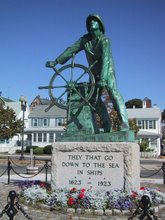
The early days of the United States were amazing in many ways, none more so than the line up of personalities that came to the fore just when the new nation needed them. Think of it: a nation of about 3 million people produced Washington, Jefferson, Franklin, Madison, John and Martha Adams, John Marshall, Alexander Hamilton and dozens (perhaps hundreds) of lesser but still notable personalities.
Now look at Iraq, with eight times the population of the early United States. Do you see a Washington or Jefferson? Or even a Hamilton?
Where does the difference lie? Part of it is a matter of luck--something that the early American republic had but that Iraq seems to lack.
Much of the distinction lies in history: Americans of the Eighteenth Century grew up in a society where a man could rise from poverty to substance through his wits and a system that rewarded enterprise and intelligence. Today's Iraqis have grown up in a society characterized by violence, tribal structures and ethnic identities, where tribal and familial relationships are vital and the most important characteristic for success has been brutality.
Can Iraq move toward democracy? I'd like to think that it can. But that road will be long, hard, dangerous and likely to fail. The best model for the development of at least a proto-democracy in Iraq is likely to be Turkey, not the United States. Turkey, y0u may recall, developed the beginnings of a democratic system because of a brilliant autocrat, Kemal Ataturk, who decreed that a multi-party parliamentary system would succeed his rule. I am not an expert on Turkish history, but I understand that Ataturk went so far as to say to one politician, "you will be in this political party," and to the next, "you will be in that party," and so on. Not surprisingly, the system he created took a long time to develop into anything approaching what we would call a democracy. There has been military rule, and the armed forces still play a much larger role than is healthy for civil society. The nation is riven by disputes over how to deal with the Armenian genocide and the restive Kurds in its southeastern quarter. (The greatest danger to Iraqi Kurdistan lies not in al Qaeda, but in Turkish secularists.)
And yet, Turkey is the most successful of the traditional Middle Eastern states in moving toward representative government.
Now, how is it that we expect to stay in Iraq long enough for something similar to happen in that country?
Monday, February 26, 2007


Sunday, February 25, 2007
The question
The question that should be asked of Hillary Clinton, John Edwards and all other candidates who have repented of their votes on the Iraq War resolution--or who supported the war at its outset--is this: Do you now believe that the war was wrong from the outset, or is it the way that the war has been fought that leads you to oppose it now?
On an immediate practical level, I admit that one reason for opposing the war now is pretty much as good as another, but a candid answer to this question would give a valuable clue to the foreign policy that a candidate would likely follow should she or he be elected President.
On an immediate practical level, I admit that one reason for opposing the war now is pretty much as good as another, but a candid answer to this question would give a valuable clue to the foreign policy that a candidate would likely follow should she or he be elected President.
The madness from the inside
We sit in comfortable surroundings and gauge the war in Iraq. Bur we have no comprehension of life in that country. Here's a tiny snippet of the madness that is Iraq in the fourth year of the American misadventure.
Wednesday, February 21, 2007
And it was so obvious!
The redoubtable folks at talkingpointsmemo.com have come up with the key to giving those people at Guantanamo their rightful day in court. Why didn't we think of this sooner?
Why don't they print the good news?
The answer to that common plaint is that good news is routine--it's the bad stuff that IS news, and that's a good thing. Look at it this way: In Baghdad, a day without a car bomb is news.
That being said, sometimes good things do make the news, like this story about a woman celebrating her 60th birthday in an iron lung. (Yes it is a good-news story.)
That being said, sometimes good things do make the news, like this story about a woman celebrating her 60th birthday in an iron lung. (Yes it is a good-news story.)
Tuesday, February 20, 2007
Update on Gitmo decision
For a good, relatively brief, discussion of the legal elements of the DC Circuit's Gitmo decision today, go here.
(The discussion will be well within the reach of the informed layperson.)
(The discussion will be well within the reach of the informed layperson.)
A blow to liberty, and law
The federal Court of Appeals for the District of Columbia has upheld the part of the Military Commissions Act that denies courts the right to hear cases arising out of the detentions at Guantanamo Bay (and any secret prisons that the US may be running here and there around the world).
The Constitution is pretty clear about habeas corpus: "The privilege of the writ of habeas corpus shall not be suspended, unless when in cases of rebellion or invasion the public safety may require it."
You might think that it doesn't take a lawyer to figure out that Congress and the President can't get around this provision by saying that courts may not hear a case in which a writ of habeas corpus is sought. I mean, if the right to the writ cannot be repealed unless we're invaded or there's an armed rebellion (and it's pretty clear that even then the repeal is only in areas actually affected by the revolt), how can the same result be achieved by keeping the case out of court?
Only through the subtlety of "legal reasoning."
I won't go into the argle-bargle that two judges used to get around the clear language of the Constitution. Instead, I'll quote from the dissent by Judge Judith W. Rogers:
"When a court has no jurisdiction, it is powerless to act. But a statute enacted by Congress purporting to deprive a court of jurisdiction binds that court only when Congress acts pursuant to powers it has derived from the Constitution."
Game, set, match.
At the turn of the last century, Finley Peter Dunne had his Mister Dooley observe that "whither th' Constitution follows the flag or not, th' Supreme Court follows the illiction returns." The Supreme Court will have the last word on this case. Will the court listen to the people's voice last November? If not, we shall all take another long step on the road to lawlessness.
Saturday, February 17, 2007
What a difference 230 years makes
This week, George W. Bush issued an executive order formalizing the procedures for military commissions that are supposed to try suspected terrorists. The commissions will be empowered to convict defendants, and even impose the death penalty, based on hearsay or coerced testimony.
And we call ourselves the land of the free.
Think about it: the commissions will be composed of American officers. The defendants will be selected from those who have been held at Guantanamo Bay--where a special courthouse is under construction--and have been declared to be deadly enemies of the nation that those officers are sworn to defend. How can we expect the defendants to get a fair trial? Or is that the point?
NPRs Robert Krulwich and Prof. David Hackett Fischer discussed a very different way of fighting enemies: How, in the winter of 1777, George Washington refused to react to the British killing of captured Americans by behaving in like manner. Instead, Washington ordered that captured British and Hessian soldiers be treated with honor and dignity. He met brutality with humanity. And guess what happened?
To begin with, British and Hessian captives were astounded by the decency they experienced. And they reacted in kind. At the end of the war, a full quarter of the Hessians who had come to America to suppress the rebellion stayed in the newly independent nation.
In modern terms, we might say that Washington's enlightened policy helped to win hearts and minds--not only among enemy soldiers, but among civilians of all nations who heard of it.
Almost exactly 70 years after Washington's order, Gen. Winfield Scott, who had occupied Mexico City during the Mexican War, issued an order establishing the first military commissions. Unlike Mr. Bush's order, Scott's was widely regarded as a signal advance, imposing legal standards on an occupying army for the first time.
Writing about Scott's order in The New York Times, Stephen Budiansky observes:
"It is a measure of how far we have come as a nation--and in values at one time widely held--that military commissions, once seen as a great step forward for American principles of justice and the rule of law, will now for ever be associated with the abridgement of rights."
Of all the offenses committed by George W. Bush, Dick Cheney and their minions, the greatest may be the way that they have betrayed the values on which our nation was founded and built.
Thursday, February 15, 2007
Tricky Dick, redux?

Starting today, the Mint is offering presidential dollars--dollar coins with images of the presidents. The first shows a rather unflattering image of Washington; new coins will be issued every three months.
I can hardly wait to hold the Franklin Pierce dollar! And what about Millard Fillmore? Sure to be popular. And then there's Benjamin Harrison, not to mention Warren G. Harding, fondly remembered for his most famous phrase: "We drew to a pair of deuces and filled," words that well-defined his all-too-short presidency.
The Mint has announced that the coins will go up to Gerry Ford. Hmmm. That means that in 2016, someone will hand me a Richard Nixon dollar. That's right--an actual Tricky Dick dollar. It'll probably slip right through your fingers. It is likely to be the first coin issued by the Mint that's fake money. It will not be a disk, it will be crooked. I could go on and on, but out of respect for you, dear Reader, I'll desist.
Hint to the Mint: Stop with Ike.
Uninsured
State Farm, the largest home insurer in Mississippi, has announced that it will not write new policies in that state. The company, which recently got hit with a $1 million punitive-damage verdict (reduced by a judge from the jury's $2.5 million), calls the legal situation in Mississippi, "untenable," which is insurance-ese for begin limited in the ability to bilk policy holders.
For some years I have championed what I call--for lack of a better name--the Full Line Insurance Act. Such a law would require that insurers offer their entire range of insurance if they want to do business in a particular state. State Farm, for instance, would have stop offering automobile insurance in Mississippi if it chooses to stop writing policies on homes. A company would not have to offer all kinds of insurance--it would not have to write policies for jewelers, for instance--but if it should have to offer in all states the lines that it sells in some. No selling of home-owners' insurance in one state and auto insurance--but not home owners'--in another. Such provisions would reduce the opportunity for insurers to cherry-pick, offering insurance on which they expect relatively few claims, while refusing to protect people who really need it. They would also work to increase competition in the insurance market.
Insurance companies routinely establish subsidiaries and sister companies to offer specialized lines, but the Securities and Exchange Commission long ago solved the problem of deciding what the real reach of a corporation is when it devised the concept of "affiliates," now well rooted in the law. The same idea would be applied to insurers to keep them from avoiding the intent of the full-line law.
If a few large states like New York and California adopted full-line laws, it would force insurers into a new way of doing business, one that considers the needs of policy holders as much as the desires of stockholders.
Wednesday, February 14, 2007
The cost of war

Sergeant Ty Ziegel and his bride Renee Kline had planned to marry when he returned from Iraq.
For more photos of their wedding, go here. Go on, look. It is painful, but also shows a real victory for the human spirit.
Tuesday, February 13, 2007
Preventing war with Iran
Democrats in Congress should pre-empt any attempt to start a war with Iran by passing a resolution--a binding one--declaring that the President has no authority to engage in hostilities with Iran. To get around Republic objections that this would tie Bush's hands (not a bad idea, actually), the resolution should provide that no combat operations could be launched against Iranian territory or against Iranian aircraft or vessels except against weapons or vehicles actively engaged in firing on American vessels, troops or territory--in other words, no hot pursuit. If the Iranians do attack, but are driven off so that they are not presenting an immediate threat to American lives, let the President come back to Congress and ask it to reverse its stance.
If the people will lead...
...the leaders will follow.
63% of Americans want to cap the number of troops in Iraq and bring them home by the end of 2008.
And Congress is debating--or, in the case of the Senate--not debating, non-binding resolutions.
63% of Americans want to cap the number of troops in Iraq and bring them home by the end of 2008.
And Congress is debating--or, in the case of the Senate--not debating, non-binding resolutions.
Monday, February 12, 2007
Obama and the black vote
Much has been made of polls showing that many more black voters support Hillary Clinton than Barack Obama. Leaving aside how early in the campaign it is--and how meaningless early polls are--couldn't that actually work in Obama's favor? Mightn't it make white voters less hesitant to vote for him?
Just musing.
Just musing.
Question for Hillary
Hillary Clinton has been careful to avoid admitting that she made a mistake when she voted to authorize the Iraq war, instead saying that if she'd known then what she knows now, she would have voted differently. (If she'd known then what she knows now, would she have married Bill? Ah, but that's a question for another day.) And Ms. Clinton then goes on to attack the Bush administration for its manifest incompetence.
The question that should be asked of the Senator is this: "If the administration had carried out its policy in Iraq competently, would you still be supporting the war?"
The question that should be asked of the Senator is this: "If the administration had carried out its policy in Iraq competently, would you still be supporting the war?"
The case against Iran
You may have noticed that TONE has not joined in with those who have been expressing fear that the administration wants to start a war with Iran. I've done that for several reasons. For one thing, it's hard to believe that even Bush, Cheney & Co., could be that dumb. (Of course, that could have been said about so many things that this administration has done.)
And I'm still not convinced that Bush and his cronies are looking for another war to fight. However, if you look at the case against Iran, particularly the latest alleged revelations from military officials in Baghdad concerning alleged Iranian supplies to Shi'ite militias in Iraq, the case seems woefully weak. You can find the Power Point presentation that was given in Baghdad here.
One thing I noticed was that the 81mm mortar shells which are given prominent display in several of the Power Point slides have labels in western script, not Farsi or Arabic. Indeed, they appear to be written in British English--one photo shows a blow up of the label on a shipping container: 81mm/H.E. [high explosive] Mortar/ Fuze (British spelling of fuse): AZ111-A2." The caption on the photo says that the legend "AZ111-A2" is "assessed" to be Iranian, but the slide provides no proof of this. (For reasons that escape me, 81mm is a common calibre for mortar rounds--even American mortars have been made in that size. So the fact that the shells shown are of that calibre is meaningless as far as identifying where they came from.)
Perhaps the briefers gave more proof of Iranian involvement, but the slides themselves are weaker than weak.
And note, please, that your editor does think that the US government is probably right on this point: that the Iranians are arming some Shi'ite forces in Iraq. But the administration certainly has not proved it, much less made the case for a war.
And Juan Cole, an "informed observer," makes a strong argument that the Iranian threat has been totally overblown by the ideologues in the Bush administration.
Sunday, February 11, 2007
Must read
There is a tremendously important article by William Odom in today's Washington Post. Odom was head of army intelligence and director of the National Security Agency under Reagan, so he has ample credentials to discuss the war in Iraq. You should read the entire piece, which is entitled "Victory Is Not An Option," but here are some excerpts:
"The public awakened to the reality of failure in Iraq last year and turned the Republicans out of control of Congress to wake it up. But a majority of its members are still asleep, or only half-awake to their new writ to end the war soon."
"A Congress, or a president, prepared to quit the game of "who gets the blame" could begin to alter American strategy in ways that will vastly improve the prospects of a more stable Middle East.
"No task is more important to the well-being of the United States. We face great peril in that troubled region, and improving our prospects will be difficult."
"[T]he assumption that the United States could create a liberal, constitutional democracy in Iraq defies just about everything known by professional students of the topic."
"[T]o expect any Iraqi leader who can hold his country together to be pro-American, or to share American goals, is to abandon common sense. It took the United States more than a century to get over its hostility toward British occupation. (In 1914, a majority of the public favored supporting Germany against Britain.)"
"Too many lawmakers have fallen for the myths that are invoked to try to sell the president's new war aims. Let us consider the most pernicious of them.
"1) We must continue the war to prevent the terrible aftermath that will occur if our forces are withdrawn soon. Reflect on the double-think of this formulation. We are now fighting to prevent what our invasion made inevitable!"
"2) We must continue the war to prevent Iran's influence from growing in Iraq. This is another absurd notion. One of the president's initial war aims, the creation of a democracy in Iraq, ensured increased Iranian influence, both in Iraq and the region."
"3) We must prevent the emergence of a new haven for al-Qaeda in Iraq. But it was the U.S. invasion that opened Iraq's doors to al-Qaeda. The longer U.S. forces have remained there, the stronger al-Qaeda has become."
"4) We must continue to fight in order to 'support the troops'....Has anybody asked the troops?"
"But the strangest aspect of this rationale for continuing the war is the implication that the troops are somehow responsible for deciding to continue the president's course. That political and moral responsibility belongs to the president, not the troops."
"The first and most critical step is to recognize that fighting on now simply prolongs our losses and blocks the way to a new strategy."
"Second, we must recognize that the United States alone cannot stabilize the Middle East."
"Third, we must acknowledge that most of our policies are actually destabilizing the region."
"Fourth, we must redefine our purpose. It must be a stable region, not primarily a democratic Iraq."
"It is already too late to wait for some presidential candidate for 2008 to retrieve the situation. If Congress cannot act, it, too, will live in infamy."
These extracts only give the flavor of the article; read the whole thing.
With Odom's credentials, he provides those who know that the war is both wrong and badly fought with the intellectual weight and military credibility to take up the task that all too few are willing to engage in even now: ending the American military involvement in Iraq.
Serious candidates
I watched Barack Obama's interview on Sixty Minute tonight. He continues to surprise me as a man with hardly any of the politicians' pretense or evasion. He needs to flesh out his policies, and from what I can see he needs to much work on his organization (although getting 16-17,000 people out to see his announcement in freezing weather yesterday seems to bespeak an efficient cadre, at least in his home state), but if he is right about the American people hungering for new leadership as they were in 1960, he's going to be even harder to stop in 2008 than JFK was then.
I also caught Chris Dodd on Face the Nation this morning. (Poor Dodd: after more than 3 decades in Congress, he gets 10 minutes on Sunday morning, while Obama gets twice that on the highest-rated magazine show on television.) Dodd (D-CT) was sensible, clear and well-reasoned. Another serious candidate who deserves a full hearing.
I also saw a newspaper interview with Joe Biden (D-DE) this week. (Sorry, I don't have a link.) He was self-effacing on his gaffe about Obama, but also came across as a man with real ideas on where the nation should go.
All of the Democrats deserve to be listened to. Which is more than I can say about that other party.
Friday, February 09, 2007
Huh?
Mars candy has been running an ad for a new variety of M&Ms with the tag, "Dark Chocolate Just Got Fun."
Where have they been?
Where have they been?
Low Standards
A report by the Pentagon's inspector general admits that the Defense Department cooked the books in selling the American people on the idea of going to war in Iraq.
The report states that the actions of the Penatagon's policy office, then under neocon Douglas Feith, were "inappropriate," but not illegal or unauthorized. (Not that anyone with a whit of sense thinks they were unauthorized; indeed, they were at the heart of the administration's misinformation campaign.)
Feith says he's happy to hear that he report cleared his office of illegality.
Would someone tell these guys that avoiding indictment is not the standard we are looking for in high government officials?
Wednesday, February 07, 2007
Of the people?
My inamorata and I have become fans of Donna Leon's Guido Brunetti novels. Brunetti is a commissario in the Venetian police. Married to a professor of English, with two children who grow up in the course of the books, he is quiet, sensitive and smart. He's often funny, too.
In one of the novels, Uniform Justice, Brunetti muses about the nature of Italy and other nations:
"He had read enough to know that there were countries whose citizens did not perceive their government as an inimical force, where they believed, instead, that the government existed to serve their needs and respond to their wishes. How would he react if someone he knew were to maintain that to be true here in this city, in this country? Religious mania would be less convincing proof of mental imbalance."
How long before Americans feel that way about our country? People under 35, that is most of those alive in the United States today, can hardly remember when government was not under attack, when the institutions that carried out the New Deal, won the Second World War and contained Communism when it really was a menace were not reviled and identified as the enemy of all right-thinking citizens.
What has this led to? There is the massive incompetence of the Bush administration, extending from Washington to New Orleans to Iraq and Afghanistan. Even more disturbing, however, is the hollowing-out of government. Where once we had a proud civil service that did, indeed, serve the American people, now we have agencies that are captive to the industries they are supposed to regulate (a trend that started before the Republican assault, but has been steadily accelerating) and bureaucracies that are--apart from the military and the security apparat--understaffed, starved of resources and low in morale (hardly surprising, given the poor repute in which the nation's leaders hold professional government workers). At the same time, a rampant, irrational and corrosive drive to privatize government functions has erected ever-higher barriers between public projects and the public.
It will take more than the election of a Democratic President to stop this. That president will have to make the reconstruction of competent, responsive government a central part of his or her program. Making government work may not sound exciting, but it will be necessary if we are to rebuild the government that was our pride when the nation was at its greatest.
Case Closed
Is there anyone out there who thinks that maybe, just maybe the law passed last year that purports to remove the right of habeus corpus--indeed, all normal legal rights--from prisoners at Guantanamo could be reasonable? If so, here's a complete answer:
"An Army officer who investigated possible abuse at Guantanamo Bay after some guards purportedly bragged about beating detainees found no evidence they mistreated the prisoners — although he did not interview any of the alleged victims, the U.S. military said Wednesday."
Case closed.
(If you're wondering where the reported bragging came from, it was a Marine sergeant who heard the the guards in a bar on the Guantanamo base. A civilian also reported a similar conversation between a female guard and a male guard. So what happened? The woman guard was spoken to about her "fictitious" account. And never did they bother to speak to any of the men who were, or at least would have been victims.)
Humor in a Dark Time
A friend sent on some Bush bumper stickers and T-shirt slogans. Some of the ones I hadn't seen:
--If you voted for Bush, a yellow ribbon won't make up for it.
--Hey, Bush Supporters: Embarrassed Yet?
--George Bush: Creating the Terrorists Our Kids Will Have to Fight
--Which God Do You Kill For?
--Who Would Jesus Torture?
--Bush: God's Way of Proving Intelligent Design is Full Of Crap
--Rich Man's War, Poor Man's Blood
--Where Are We Going? And Why Are We In This Handbasket?
And my favorite:
--Impeach Cheney first
Tuesday, February 06, 2007
All of the People, All of the Time
So the senators of the Party of Lincoln held together (except for a couple who are really scared about their chances in 2008) to block debate on a non-binding resolution opposing the Bush administration's "surge" in Iraq authored by one of the leaders of their own party, John Warner. Warner himself voted to obstruct debate on his own measure.
The Republics claim that the Senate should also debate a non-binding measure that would pledge not to cut off funds for the troops. Not surprisingly--especially given that Mitch McConnell (R-KY), a man who, to borrow S.J. Perelman's phrase, looks freshly dipped in Crisco, is their leader--the Republics ignored the fact that senators would have been offered an alternative to Warner's resolution: John McCain (R-AZ), Joe Lieberman (I-CT) and some others have sponsored a resolution supporting Bush's so-called strategy. (Not to mention that senators will go on record when they vote on budget measures to authorize funds for the war.)
Do the Republics really think that the American people don't see what's going on for what it is: a desperate attempt to salvage some shred of credibility for Bush's discredited policy? One might think that they have forgotten the lesson of their greatest leader: "you can't fool all of the people all of the time." I think, however, that this is simply another example of the unarticulated major premise of the Republic Party: that the American people are stupid.
Redundancy
I've been trying to come up with the shortest redundant phrase in the English language. So far, I have it down to eight letters. Can anyone come up with a shorter one?
The eight-letter phrase is "Bush lies."
The eight-letter phrase is "Bush lies."
Sunday, February 04, 2007
Why US?
So why are Americans supposed to care more about Iraq than the Iraqis do?
That is the essential problem with those who favor the "surge," or even maintaining American military involvement for longer than it would take for us to make an orderly withdrawal that would not sow intolerable confusion among those who proclaim themselves our allies.
In an earlier post, I suggested that the problem with Iraq was not too few Americans but too few Iraqis, I noted in passing that the slow progress of the Iraqi security forces can be compared to the development of the US Army during the Civil War. As we send thousands of additional Americans into harm's way (and it will not be the 20,000 or so that the media talks of, but about 35,000 to 45,000, because the figure bruited about only covers combat troops, and leaves out the supporting forces they need), let's take a look at that instance in our history.
Unlike Iraq, the United States was not conquered by a foreign power, and our army was not disbanded. On the other hand, not only did a large part of the nation pull away and declare independence (a proportion larger than the Sunni or Kurdish parts of Iraq), but an even higher fraction of the nation's military leadership went with the rebels.
Not that the US Army--or Navy for that matter--were that much to boast about before the war. It has been said that the army of 1861 was stocked with officers who knew about leading a troop of cavalry against Indians, but not about leading regiments, much less divisions and corps.
Yet within two years the United States Army had become a fully professional fighting force able to field large armies across distances unknown to the militaries of Europe, at least outside of Russia. By 1864, the army had become one of the great military aggregations in history. The exploits of the US Army in the Civil War are mind-boggling even today: Balked six times before Vicksburg, Mississippi, Grant took 40,000 men down the river--running past the batteries mounted on the cliffs above in unarmored steamers--and made his way behind Confederate lines to come up behind the city and invest it. The next year, Sherman conducted a campaign from Chattanooga to Atlanta that is still studied in staff colleges around the world. In the course of Sherman's advance, his troops re-built the railroad to Atlanta faster than the Confederates could tear it up.
The army did not exist in a vacuum, of course. Lincoln is generally credited with being the greatest President in American history, and he assembled a corps of leaders who mobilized the nation--the North, anyway, in the first of the wars between societies that we have come to know. Factories turned to war production. Young men, old men, even women substituted for those who had gone off to fight.
All of this was not orderly, of course, or free of incompetence or corruption. Look at the list of commanders that Lincoln appointed and then removed before he found men who could win the war--the amazing part is that he kept on and that he had enough political support to keep up the search until the found those he needed.
Do you see anything like this in Iraq? If something analogous is happening, we aren't hearing about it, even from the administration and its apologists.
I'm not suggesting that Iraq needs to produce a Lincoln, but it has not even produced a Jefferson Davis: the South's war effort would have been notable had it not been up against a North led by Lincoln, Grant and Sherman.
In our Civil War, Americans answered the call to the colors. In Iraq's civil war...Americans are again the ones who are answering the call. Oh, yes, several hundred thousand Iraqis have signed up for the army and the police, and many have been killed by car bombs as they lined up at recruiting stations. But why have they not learned to fight--at least to fight as disciplined units?
Is the problem a lack of leadership? Or is it a lack of will? Or the absence of a sense of national identity? Perhaps it is all three. But whatever the cause, by now it is clear that there are not enough Iraqis who identify with the nation, and are willing to put themselves on the line for it, to damp down sectarianism sufficiently for the country can emerge as a functioning state that provides at least rough equality to all religious and ethnic groups.
Before we went into Iraq, I posited that the absence of an effective opposition to Saddam Hussein should tell us to steer clear of grandiose adventures designed to bring on a new kind of nation in the Middle East. Unfortunately, I was right. It is now clear that, whether we go or stay, Iraq will either split apart along ethnic and religious lines or will emerge united under the dominance of the winner, or winners, of its own civil war.
Friday, February 02, 2007
Straight talk or curevball?
Remember John McCain's reputation for straight talk? Where'd that guy go? Here.
Muzzling the regulators
You've probably heard that the White House intends to put a political appointee in every federal department--apart, presumably, from independent regulatory bodies such as the FCC--to ensure that all regulations meet standards set by the President. This has brought howls of outrage from liberals who are sure--and surely correct--that this is another attempt by W and his cronies to centralize and expand the power of the presidency, no matter what the voters may have said in November. We may confidently expect that these watchdogs will also protect the President's big-business supporters: no regulation harmful to Halliburton will be permitted in the waning days of the Bush administration.
One part of me says that this is a matter of the gored ox. If (when) a Democrat takes over the Oval Office in 2009, won't we like having a watchdog to see that holdovers from the Bush years don't continue to coddle business at the expense of the environment, worker safety, etc.?
But it strikes me that in many cases, White House interference in the regulatory process is probably illegal, at least if carried out as it has been announced. Many statutes give authority to particular department heads to promulgate regulations: "the secretary may issue regulations..." is a common phrase in the US Code. In such instances, making the Secretary of Health and Human Services, say, run things by a White House guardian would contravene the law. Given that the secretaries are themselves political appointees, this may seem to be a matter of legal arcana, but as a practical matter cabinet officers have a good deal of independence and, given the limited time available to them, they are not likely to ask the White House to vet every proposed regulation.
A real-world example of this kind of thing occurred in the late 1930's. After the Hindenburg disaster at Lakehurst, NJ, the Germans asked to buy helium from the US for their remaining dirigible, the Graf Zeppelin. FDR and the State Department, wanting to get some leverage with the Nazi regime, were for the idea. But the law said that sales of helium (which is only found on Earth in Texas) to foreign buyers had to be approved by the Secretary of Commerce, at the time Harold Ickes. Ickes was a fervent anti-Nazi, and refused to OK the deal. In essence, he gave Roosevelt the option of going along with his decision or firing him. FDR kept Ickes and let the prospective sale go into the wastebasket.
Wednesday, January 31, 2007
Rest in Peace, and laughter
Molly Ivins passed away today. America will miss her, but I, for one, will smile when I think of her.
Update: At a dinner in her honor, Lewis Lapham said, ""She reminds us that dissent is what rescues democracy from a quiet death behind closed doors." Amen.
Update: At a dinner in her honor, Lewis Lapham said, ""She reminds us that dissent is what rescues democracy from a quiet death behind closed doors." Amen.
Man's inhumanity to man, and woman
Day after day we hear of suicide bombings and car bombings and mortar shellings, and after a while it is hard to remember that people--real people, with hopes and dreams and worries and families--are being hurt and killed. So maybe if we look at some lesser inhumanties we can regain our perspective.
Two examples:
The New York Times notes that the cost of the Iraq debacle includes, in addition to 34,000 Iraqis killed last year alone, 1.8 million who have been driven from their homes and 2 million who have left the country entirely. Many of these are people who committed themselves to the American cause: politicians, policemen, soldiers and ordinary people who bought into the idea that the United States would bring them and their nation a better life. So, are we welcoming them to our shores now that the scope of the Iraq disaster has become clear? No. At least not in any numbers. While we spend $8 billion a month on the war, the Bush administration proposes a paltry $20 million for Iraqi refugees in fiscal 2008. For our special friends, we have a special visa program--50 slots a year, for both Iraq and Afghanistan. There are thousands of desperate people out there, and most of them are desperate because of our blundering. The least we could do is to offer some of them refuge.
Now let's shift our attention to South Dakota. You may recall that a statewide referendum rejected the draconian anti-abortion law that the state legislature passed last year--and did so by a comfortable margin of about 10 points. Unfazed by this, anti-abortion legislators have introduced a new bill. This one would make the narrowest possible exception to protect the life and health of the mother. The true motives of the bill's sponsors may be deduced from this description: "In the case of incest, a doctor would have to get the woman's consent to report the crime along with the identity of the alleged perpetrator before an abortion could be performed." Think about that for a moment: a girl who has been raped, perhaps for years, by her father, brother or uncle has to decide whether to carry the pregnancy to term or to turn in the offender for prosecution. How many young women--often girls--who have not left the home already will be willing to do that? Even if she has left the home, the victim (and that's what she is) probably depends on the family for at least social and emotional support, which is likely to be cut off if she agrees to help prosecute the person who attacked her. People who want to impose that kind of condition on incest victims are not interested in them or the unborn fetus; they want to keep women in their place.
Tuesday, January 30, 2007
(Fast) Rising star
First Jim Webb told off W at a White House event for new members of Congress. As Stacy Schiff put it, when Bush asked about Sen. Webb's son, who is serving in Iraq, Webb didn't really intend his brusque answer. "Evidently, he meant to slug the President." Wouldn't that have been something?
That was just for openers. A couple of weeks ago, Webb asked Condi if she thought that the President could move against Iran without prior congressional approval. The Secretary of State, showing talent for the diplomatic bob and weave that I didn't think she had, demurred. Instead of answering, she promising to give the Senator a response in writing. Now, everyone knows that she had no intention of replying to the question by speech, writing or smoke signals. Webb got what he intended from asking the question; Rice's refusal to answer made the response clear as day.
But Jim Webb is looking distinctly different from other politicians, even other anti-war Democrats. So, he's written to the Secretary of State to pose his question again, and added this helpful comment: "This is, basically, a 'yes' or 'no' question regarding an urgent matter affecting our nation’s foreign policy." More details here.
You've got to love this guy. He seems to have watched "Mr. Smith Goes to Washington," and taken it seriously. After a career in the Marines including a record in Vietnam that makes John Kerry look like a draft-dodger, a stint as Reagan's Secretary of the Navy and a hard-fought senatorial campaign in which he knocked of a man who had been considered a leading contender for the Republic nomination in 2008, he still appears to have the unsullied faith in democracy of a Frank Capra hero. The Democratic candidates for President had better watch out--no one's going to be talking seriously about Jim Webb in 2008, but he's going to make a lot of them look like wimps.
Too sweet to be true, but....
The new White House executive pastry chef, Bill Yosses, is the author of Desserts for Dummies.
2008--Another Issue
Josh Marshall has an extremely important post at talkingpointsmemo.com. "[T]he virus of anti-constitutionalism President Bush has injected into the body politic is now so deepseated that a renewed constitutionalism should now be a central element informing our political priorities and political identification." He's absolutely right. The Bush administration has so damaged our political and legal condition that constitutional principles must be a leading campaign issue for the first time since 1860 (for those who aren't too good on dates, that's before the Civil War).
To begin with, every candidate for President in 2008 should be asked hard questions about where he or she stands on the issue of executive power. Will he or she insist on the same prerogatives that W and Cheney have: the right to imprison secretly, the right to hold prisoners without resort to legal process, the right to spy on Americans and legal residents without warrants, the right to control every move of the executive branch? Or, will the candidates agree to a recession of presidential power?
I also suggest that you read Adam Cohen's trenchant analysis of Congressional war powers--the first such article that I have read in a mass-circulation publication. And, don't miss Garry Wills' discussion of the militarization of the presidency; he notes that Ike, who had spent 35 years in the Army, never gave the hand-to-the-brow salute as President, because he wasn't in uniform. That gesture was started by the actor, Reagan and, regrettably, followed by all since. These pieces make Marshall's point even more clear.
2008--The Idea of America
In an earlier post, I suggested that Democrats should articulate an American ideology. In response to that idea, MS emailed, "I don't think America has or needs an ideology. Does any country have an ideology? Certainly not any as diverse as diverse as this country. We do have founding principles: individual liberty, self-government, equality of opportunity, separation of church and state, to name a few."
Fair enough, but I suggest that the idea of America has always been the key to our national identity. People came here because of the American ideal, more than they did because of the streets that were supposed to be paved with gold. The Thanksgiving myth centers around the Pilgrims at Plymouth, not the wealth of the present day. Even our imperializing is cloaked not in national glory but in the belief that we are making the world a better place. That kind of moralizing is deeply offensive to some in other countries, and a cause for ridicule in others, but it expresses a difference between the United States, that is, Americans, and the citizens of other nations, at least of those that have been major international powers.
Most Americans, even most of those who concern themselves with politics, don't think of themselves as ideological. Indeed, one of the most important contributors to our success in the 20th Century was a hostility to fixed ideologies. That characteristic enabled bipartisanship--a concept almost unknown in other democracies, even Britain. Still, I suggest that that non-ideological politics really expressed a general agreement on an overarching framework of ideas on which American politics and policy were grounded.
Thanks to the "conservative" [reactionary is a better term] movement of the past three decades, much of that agreement has been torn apart. But that does not mean that Americans cannot come together to express the American idea. Indeed, the obvious failure of the "conservatives," especially of the Bush administration, provides an opportunity to rebuild a consensus around the basic propositions that gave the United States its great influence for decades.
So what should America stand for? I don't claim to have thought the answer through completely, and to say what we stand for could fill a thick book and leave plenty of room for argument, but let me start with a few ideas:
--That all individuals are entitled to dignity and respect.
--That individuals have the right to free thought and free expression.
--That government depends on the consent of the governed, and that government should be based on law.
--That government's first mission, after preserving the nation, is to protect the rights of its citizens.
--That government should act to protect those who have the least before it aids those who have more than they need.
--That democratic government is best, but that at least government should be responsive to the needs of the populace, and should work to progress toward true democracy.
--That the United States has no territorial ambitions.
These represent only a beginning, of course. I'll try to add to them and to form them into some more coherent framework, and I'd be happy to have your ideas. But I hope you can see from this small start how we could construct an ideology that would allow us to contest with those who view the United States as their enemy.
Monday, January 29, 2007
RIP
Rev. Robert Drinan, S.J. has died at the age of 86. For 10 years, from1970 to 1980, he was my congressman. He came to Congress as an opponent of the Vietnam War. Having been dean of Boston College Law School--an institution that he did much to improve--Father Drinan was put on the House Judiciary Committee, and on the special House Committee that considered whether to impeach President Nixon. I met with him in his district office in 1973 or '74. He was very pleasant, and probably the most honest politician I have ever met. I've known some politicians who would not lie--or whom I thought would not lie--but who might not tell you something they thought you didn't want to know. Drinan would. We discussed how the Massachusetts delegation would vote on impeachment (Massachusetts actually had a couple of Republic congressmen then). Of one old-line Democrat who shall remain nameless (not the least because I can't recall the name), Drinan said something like, "He's a good old duffer. He'll vote the right way when the time comes." And then, "I probably shouldn't have said that." But he was a compulsive truth-teller.
Drinan left Congress in 1980, after Pope John Paul II decreed that active priests should not serve in elective office. He taught at Georgetown Law School and just a few weeks ago celebrated a special mass in honor of Nancy Pelosi's accession to the speakership.
Drinan left Congress in 1980, after Pope John Paul II decreed that active priests should not serve in elective office. He taught at Georgetown Law School and just a few weeks ago celebrated a special mass in honor of Nancy Pelosi's accession to the speakership.
Sunday, January 28, 2007
Moderation
An editor's note: TONE has got popular enough (apparently, it doesn't take much) to have received a number of comments that are spam. As a result, the editor is now moderating comments. All of which means that it may be some time before your comment actually appears, because the editor is not always as diligent as he should be in checking for comments. (He will try to do better.) If your comment is substantive, it WILL be published, even if it is highly critical of what appears here.
Thursday, January 25, 2007
Forgotten but not gone
Katherine Harris, who has a large number of reasons to stay out of the public eye--indeed, to keep from going out in public--is still hanging around the house. Not her house, our house: the House of Representatives. Showing how truly shameless she is, Harris was on the floor of the chamber before the State of the Union speech Tuesday night, handing out business cards to people who were too polite or too clueless to refuse them. There are even photos. (I thought of posting one, but I thought that there might be readers who had just eaten.)
Bad for democracy
Four big states--New Jersey, Florida, Illinois and California--will probably move their 2008 presidential primaries to early February, perhaps only a week after New Hampshire.
Many progressives and good-government advocates disagree with me, but I see a real value in the Iowa caucuses and the New Hampshire primary, even given the small number of minority voters in those states. The retail politics--though diluted in recent campaigns by media coverage that makes TV advertising (and also Internet campaigning) a major force--permits relatively unknown candidates without huge warchests to make a run, viz. Howard Dean in 2004. It also allows for movement during the campaign--remember that John Kerry was down and out nationally in late 2003.
Moving the big-state primaries to the front of the campaign, especially four of them, across the nation, will put a premium on money and national media attention. Hillary Clinton, John McCain, Barack Obama and Rudy Giuliani will probably be able to contest; John Edwards and Mitt Romney are likely to be there, too (although Romney's inconsistent positions may lead him to self-destruct before the end of this year). But can Bill Richardson (whom I think to be the best of the "second-tier" candidates), Joe Biden, Chris Dodd and Tom Vilsack raise enough money to be in the race on this new Super-Duper Tuesday? If Chuck Hagel declares his candidacy on the Republic side--he would be the REAL maverick in that field--he'll probably be doomed by the size of his treasury even more than his position on the war.
The present primary system is not very good, but it's a lot better than what seems to be shaping up for 2008.
Wednesday, January 24, 2007
All we are saying/Is give war a chance
So W wants us to give his "strategy" in Iraq time. And what about the last 3 years and 9 months?
Monday, January 22, 2007
There is no joy in Mudville
Permit me to dilate upon something different. Something more important than politics and perhaps as important as cats: football.
Gloom pervades New England as our Patriots went down to defeat last night at the hands of the Indianapolis Colts, a team that the Pats once dominated, at least psychologically--which is more important than dominating physically.
It was a game of if onlys.
If only the Patriots still had David Givens or Deion Branch (or better yet, both of them).
If only the Patriots had rushed Peyton Manning more in the third quarter.
If only Corey Dillon had played more in the 2nd half. (Was he hurt?)
If only Ellis Hobbs had made an 80-yard kickoff return when the score was 21-13, not 21-21. (Going up by 15 points after the other team has cut the lead to 8 is a more powerful psychological statement than going ahead by a single score after the game has been tied.)
If only the refs had called pass interference when Reche Caldwell was mugged in the end zone. (The Pats would have had the ball 1st and goal on the 1, with about a 95 percent certainty of scoring a touchdown, and the best the Colts could have done on their final drive would have been to tie.)
If only the Patriots' coaches had smelled out a run on the play that led to the winning touchdown. I did, and I'm no football whiz.
and finally: If only the Pats had won.
If nothing else, this game confirms my football superstition: I believe that if you score fewer points than the other team, you're going to lose.
Sunday, January 21, 2007
Turning point
I always mark the day I notice light in the sky at 5:00 p.m. as the first sign of spring. That day has arrived. My joy is tempered, however, by the fact that this week saw our first winter weather.
Saturday, January 20, 2007
Which poll d'ya read?
Hillary Clinton (R-NY) jumps into the race and she's being anointed the frontrunner. ABC reports that in a hypothetical (remember that word) primary, Clinton bests Barack Obama (D-IL) 41 percent to 17 percent, with John Edwards third at 12 percent. Fair enough.
But then there's Newsweek's poll with this little gem. In those hypothetical races, McCain edges Clinton by a point, but loses to Obama by 2 percent and Edwards by 5 points. Contests where Rudy Giuliani is the hypothetical Republic nominee turn out pretty much the same way.
Such early polls are so close to meaningless that you need a powerful magnifying glass to tell the difference, but if results continue this way, it will be bad news for Hillary. She doesn't inspire many people with her oratory or her ideas; electability has to be her catchword.
A caution, however: as the candidates say, the only poll that counts is the one on election day. Like all cliches, that's true. Campaigns, especially presidential campaigns, depend on a lot more than polls. And the early stages, in particular, depend on organizational ability and retail politics more than on oratory or positions on particular issues. The race hasn't even entered the starting gate--we're only seeing the post parade.
It's going to get interesting. Stay tuned.
Friday, January 19, 2007
Better check the bunker
From the NYT:
" Yevhen Kushnaryov, a deputy leader of the pro-Russian Party of Regions and a close ally of Prime Minister Viktor F. Yanukovich, died of a gunshot wound suffered while hunting on Tuesday. Mr. Kushnaryov was shot under circumstances not yet fully explained. Ukrainian news agencies said he was with a group that had just finished a boar hunt when a wolf appeared, prompting at least one unidentified hunter to fire and strike Mr. Kushnaryov."
Has anybody seen Dick Cheney the last few days?
Law of the jungle
The New York Times analyzes how the administration's changing stance on matters such as wiretapping, the legal rights of alleged terrorists and such present a moving target to defenders of civil rights and liberties. In cases such as those of Yaser Hamdi and Jose Padilla, the government has mooted legal challenges. It is attempting to do the same to suits attacking the warrantless wiretapping program.
These tactics demonstrate that the administration has no respect for law, only for power; it does not act because of law, but because political reality has changed and compels it to. Indeed, the Bush administration is the most lawless in our history, exceeding even Nixon's.
These tactics demonstrate that the administration has no respect for law, only for power; it does not act because of law, but because political reality has changed and compels it to. Indeed, the Bush administration is the most lawless in our history, exceeding even Nixon's.
Thursday, January 18, 2007
Pardon me if I don't cheer
Advocates for civil liberties and privacy are claiming victory now that the administration has announced that it will seek warrants from the FISA court for the NSA's wiretapping program.
I suppose this is some kind of an advance (albeit made to defuse hearings that congressional Democrats have scheduled for the spring), but am I the only one who thinks that a secret court-- even the identities of the judges on the court are withheld--is contrary to the American system of justice and, very possibly, the Constitution?
I suppose this is some kind of an advance (albeit made to defuse hearings that congressional Democrats have scheduled for the spring), but am I the only one who thinks that a secret court-- even the identities of the judges on the court are withheld--is contrary to the American system of justice and, very possibly, the Constitution?
Wednesday, January 17, 2007
A moral choice
It was cold in Boston today--about 10 degrees as I walked across the Public Garden. The Garden has a bridge over the pond where the Swan Boats promenade in spring and summer. As I crossed it, I noticed that a person was lying on one of the benches about 5o yards from my path. He--it was most likely a man--was wrapped from head to toe in a red quilt, probably of the kind that movers use to pad furniture. From where I walked I could not see what was under the quilt.
I debated whether to go over and see if he was all right. I know from my friend Bob, who is homeless, that the slatted benches can be dangerous on cold nights, because they allow air to circulate below as well as above a sleeping person. I noticed that the figure was completely wrapped, that the quilt extended even beyond head and feet, and I told myself that the man on the bench was probably all right, that he might resent being roused (it was probably a little before 7:30 a.m.), and maybe he was drunk or crazy, too. And I walked on. I was fully conscious that I could have made certain that the person under that quilt was safe, or as safe as he could be on the streets in winter, but I did not want the hassle that having contact with him might entail. So I continued to walk.
A little farther, in the Boston Common, I came across a couple of guys that I have seen almost every morning that I've walked for the past couple of weeks. One of them is older, grizzled'; he's never said anything to me. The younger man, dressed neatly in a New York Giants jacket and jeans, with a trimmed beard and moustache, is friendly and I've got used to acknowledging his presence and saying hello as I pass. Neither of them has ever asked for money, and they don't have a cup or a box for handouts. Today, I asked the younger man if they'd been out all night. No, he said, they'd been at a night shelter. They were killing a few hours between that and the time when they could go to Emmanuel Church for the day. I asked how long he'd been on the street and he said about three months. He told me that he used to work in the auto parts business. He mentioned that he's had social workers, but it's tough to get a job when you're in a shelter each night. I pulled out my wallet and gave them some money--more than a buck, but not a lot of money--and suggested that they get something to eat.
Was I more generous than usual because of the cold, or because I was guilty about passing that man on the bench? I don't know.
You may have heard that the newly appointed archbishop of Warsaw was forced to resign his post, because it was revealed that he had cooperated with the Communist secret police. As far as is known, his cooperation was minor, and did not endanger anyone. In an Editorial Observer piece in yesterday's New York Times, Serge Schmemann commented on the Wielgus case, and how "surviving in that world, especially for anyone in a position of authority, presented excruciating choices, again and again." The truth is that we all make moral choices, every day, and as we do not live in totalitarian states or face immediate danger, our choices seldom require courage. In most cases, we never recognize that we have even made a choice. In those where we do, I suspect that most of us find that most of the time we come up short of the mark that we think we have set for ourselves.
When I was a college freshman, I went to a talk by the Yugoslav historian Vladimir Dedijer, who spoke about his time in the resistance to the Nazis. One of the things I remember about that talk was when Dedijer said that he did not blame the people who were captured and broke under torture. "You cannot go to the barricades 365 days a year," he said. At times of crisis and stress, when I cannot summon the energy to carry on the struggle, those words have given me comfort. The choice I made this morning, however, cannot be rationalized with such a brave slogan.
What will I do if I see that figure on the bench tomorrow? I just hope he will have moved somewhere else.
Tuesday, January 16, 2007
2008
Regular readers will recall that after the election, I started a series of posts on what the Democratic platform for 2008 should look like. It's time--past-time, actually--to return to the subject.
In the past few months, as frustration and opposition to the war has grown, the political situation has changed as dramatically as at any time in memory. Political support for the war has declined much more sharply than it did during any comparable period during Vietnam, including the months immediately after the Tet offensive. Although that development has resulted in some additional scrutiny and criticism of the entire strategy (if you can call it that) behind the GWOT (Global War on Terror for those not big on acronyms), there has not been nearly enough.
Now it's my view that, no matter how low the President's approval ratings, no matter how little support the war has in 2008, the Republics' strategy will be to paint Democrats as weak on national security. (The only exception might--just might--be if Chuck Hagel or another anti-war Republic is the nominee. Which is highly unlikely.) Bad as the Republics' record has been, given their position and their Rovian habit of attacking Democrats' perceived strength, they will attempt more of the same in 2008. Oh, and it's hard to see what other approach to national security policy they could take. (If you have an idea for such another possible Republic approach, please let me know!)
What should Democrats do? Bypass the Iraq-war issue, avoid getting drawn into an argument over who's tougher on terror. Change the debate to this: What is the American ideology? What ideas do we put into the field to counter those who oppose us, whether Islamist extremists, Hugo Chavez and his allies or even our friends, the French? This would not only be a wise tactical approach, it might actually help the nation--if Democrats can express such an ideology cogently and show how to make it real.
The first step is to define what the American ideology is, or should be. More about that in a later post or, more likely, several of them. If you want to get a head start, feel free to tell us your ideas.
Monday, January 15, 2007
Have you heard
the one about the divided Democrats? You can hardly avoid stories about divisions in the party of Jefferson and Jackson, but the real story is about the divided Republicans. The day after President Bush's latest take on Iraq strategy, the most devastating critique came not from a Democrat, but from Sen. Chuck Hagel (R-NE), Vietnam vet and likely presidential candidate, who suggested that the "surge" is the worst strategic decision since Vietnam.
Republic critics of the war are notable enough, but to really see how the president's party has lost its goose-step discipline, watch them on issues such as the minimum wage, global warming, stem cell research and even health care reform (as in Schwarzenegger's proposals for near-universal health care in California).
We'll still see stories about Democratic disunity. Until Democrats have a presidential candidate, they will not have the structure to achieve unity, and besides, we're talking about Democrats here (remember Will Rogers). And there are a lot of media outlets still in thrall to the Republic party and its corporate sponsors, and they have an interest in perpetuating the story of divided Democrats. Divisions among Republics, however, hold out hope for a reduction in partisanship and, perhaps, some legislative progress.
Sunday, January 14, 2007

Let us not wallow in the valley of despair, I say to you today, my friends.
And so even though we face the difficulties of today and tomorrow, I still have a dream. It is a dream deeply rooted in the American dream.
I have a dream that one day this nation will rise up and live out the true meaning of its creed: "We hold these truths to be self-evident, that all men are created equal."
I have a dream that one day on the red hills of Georgia, the sons of former slaves and the sons of former slave owners will be able to sit down together at the table of brotherhood.
I have a dream that one day even the state of Mississippi, a state sweltering with the heat of injustice, sweltering with the heat of oppression, will be transformed into an oasis of freedom and justice.
I have a dream that my four little children will one day live in a nation where they will not be judged by the color of their skin but by the content of their character.
I have a dream today!
I have a dream that one day, down in Alabama, with its vicious racists, with its governor having his lips dripping with the words of "interposition" and "nullification" -- one day right there in Alabama little black boys and black girls will be able to join hands with little white boys and white girls as sisters and brothers.
I have a dream today!
--August 28, 1963
The assault continues
By now you will have heard about the outrageous comments of Charles Stimson, the deputy assistant secretary of defense in charge of the administration's "detainee" policy, in which he criticized some of the nation's premier law firms for having the gall to defend the rights of people held at Guantanamo Bay, and called for the firms' corporate clients to tell the firms to give up that representation or lose the corporations' business. What makes Stimson's comments all the more hideous is that he is not merely some political hack, but a lawyer himself. (Not that being a lawyer is inconsistent with being a hack.)
Now comes word that the CIA and the Pentagon have been looking into Americans' bank accounts and credit records through the use of non-mandatory "national security letters." (How many banks and credit providers will take the chance of being labeled uncooperative by this administration?)
And for a parlay, The New York Times today reports that some observers are concerned that the omission of 10 words from an Arny manual on intelligence gathering signals that the military accepts the administration's view that the government has an inherent right to spy on Americans without bothering about pesky formalities like warrants.
Because most Americans do not feel threatened by these assaults on our system of government, they do not realize the constitutional crisis that the administration has precipitated through its blatant misreading of the Constitution.
Perhaps the new Democratic Congress can educate the American people. Impeachment hearings might be one vehicle for that.
Friday, January 12, 2007
Conflict of interest
Democrats in the House had no trouble passing a bill that will hike the minimum wage, but Republics in the Senate insist that the measure must be paired with tax breaks for restaurants and other alleged small businesses. (Would McDonald's or Pizza Hut qualify for these breaks? Want to guess?) The Republics are even muttering about mounting a filibuster if they don't get their way.
This presents Democrats with a dilemma. The Republics' demand for tax breaks has long since lost political steam; at this point it is only a payoff for their supporters. So Democrats have every expectation that if they stand fast the Republics will either fail in their threatened obstruction or, if they succeed, will present a luscious political target.
On one hand, Republic obstruction against popular items like the minimum wage increases the chances of an increased Democratic congressional majority in 2008, and even of a Democratic president. But raising the minimum wage now will have important effects for some of our most vulnerable citizens. Are Democrats justified in losing an opportunity to help those individuals in the hope of greater political advantage, even with the greater benefits for ordinary Americans that we may expect to flow from Democratic control of the levers of government?
What's your opinion?
Thursday, January 11, 2007
On a lighter note
Or maybe a lightheaded note.
When I fly, I like to feel that the airline knows where I am going--or at least where IT is going. So I don't think I'm going to be flying Nepal Airlines anytime soon. NA used this picture to advertise travel to its native country:

Pretty spectacular, right? The high mountains. The village clinging to a crag. Just what you would expect of the fabled Himalayan kingdom. Only one problem. It's not Nepal. It's Machu Picchu, in the Peruvian Andes. Nepal Airlines apologized to Peru for using this photograph in a campaign with the slogan: "Have You Seen Nepal?" (To which the answer, of course, is "not yet.")
Let us hang our heads in shame

Today is the fifth anniversary of the opening of the Guantanamo Bay concentration camp.
One in, one on the way out
Sen. Christopher Dodd (D-CT), the senior but lesser-known Senator from Connecticut, announces that he will seek the Democratic nomination for president in 2008. I don't think he's got a prayer, but perhaps he'll add something useful to the debate. (You should know, dear reader, that as a political prognosticator, I am on a par with John Peter Altgeld, the governor of Illinois who said of William Jennings Bryan on the day before the Cross of Gold speech, "Tell Bryan he's got as much chance of being nominated as I do, and I was born in Germany.")
Meanwhile, Mitt Romney will be dogged by this video of his debate against Ted Kennedy in 1994, in which the Mittster espoused positions distinctly at odds with the social conservatism he now professes. It was always a matter of time before Romney had to face questions about how he could have been elected governor of true-blue Massachusetts and be a true conservative; that time may be closer.
Meanwhile, Mitt Romney will be dogged by this video of his debate against Ted Kennedy in 1994, in which the Mittster espoused positions distinctly at odds with the social conservatism he now professes. It was always a matter of time before Romney had to face questions about how he could have been elected governor of true-blue Massachusetts and be a true conservative; that time may be closer.
Wednesday, January 10, 2007
How soon they forget
Remember when members of the Republic Party marched in lock-step? (Those were the days when Karl Rove & Co. were predicting a permanent Republic majority.) Nothing like losing an election and being led by a lame duck (especially one who's heading for the edge of the cliff) to change people's minds.
The NYT reports that at least 10 Republic senators will vote in favor of the Democrats' resolution against surging. The measure will be symbolic, but as Napoleon said, "The moral [what we would call psychological] is to the physical as three to one." The times, they are a changin'.
(For any who may be wondering about references to the Republic Party, I got the idea from a wonderful piece by Charles Baxter, in Sunday's Times. I've noted in the past that Republics have slurred the Democratic Party for decades by calling it the Democrat Party. Baxter says we Democrats should follow their example, an idea that I have espoused in the past but never carried through on. Now I'm going to do it, and I urge you to do the same. Let's start a trend.)
Scheduling note
George W. Bush will lie to the nation tonight at 9:00 p.m., eastern standard time. His lies will be carried live (live lies!) on the major networks.
Tuesday, January 09, 2007

Why the Sun set on the British Empire
A study reports that putting milk in tea removes the tea's beneficial effect on blood flow.
Serves them Right! Many years ago, when it was difficult to find decent coffee in Britain, I found that it was also difficult to find tea without milk.
Serves them Right! Many years ago, when it was difficult to find decent coffee in Britain, I found that it was also difficult to find tea without milk.
How far we've (not) come
" To those peoples in the huts and villages of half the globe struggling to breach the bonds of mass misery, we pledge our best efforts to help them help themselves, for whatever period is required--not because the Communists may be doing it, not because we seek their votes, but because it is right. If a society cannot help the many who are poor, it cannot save the few who are rich."
John F. Kennedy said that, in his inaugural address. (I was tempted to write "first inaugural," but of course history decreed that there would be only one.) Barak Obama quotes it in his estimable book, The Audacity of Hope," which has about the best title of the year (Obama admits that he did not originate the phrase, but he was smart enough to use it).
I noticed a number of things about that quotation. Today, we would probably not describe half the world as living in huts and villages; it's a measure of economic progress that many more people live in urban areas and are part of formal economies. On the other hand, millions of those people live in squalor, work in sweatshops (which may be a big step up for many) and face the threat, if not the reality, of AIDS.
Yet the principles that JFK enunciated still speak to us. "If a society cannot help the many who are poor, it cannot save the few who are rich" could be the rallying cry for all who oppose government of, by and for the wealthy. And the idea that policy should be based ultimately on what is right flows as a refreshing breeze after all the years of calculation, triangulation and pseudo-realism. (Yes, yes, the neocons alleged that the invasion of Iraq was a matter of moral choice, but I think the difference between their moral vision and JFK's is pretty clear.)
Now, JFK's actual performance often fell far short of his soaring rhetoric, but at least the words were there to measure his actions by, and to inspire improvement in policy.
How far we have descended from that plateau is shown in Iraq, on a daily basis. Yesterday, Paul Krugman asked if Bush's plan to escalate in Iraq is delusional or merely cynical. It's a close question, but I vote for delusion. Case in point: On Sunday, The Independent described a plan to turn Iraq's oil industry over to western companies:
"Iraq's massive oil reserves, the third-largest in the world, are about to be thrown open for large-scale exploitation by Western oil companies under a controversial law which is expected to come before the Iraqi parliament within days.
Then, this morning, comes word of American airstrikes in Somalia, delivering what must be at best a minor injury to al Qaeda, but a major blow to the fledgling government of that country, which is already seen as an Ethiopian client and will now look like an American one. Not to mention a further stretching of our already-overburdened military.
Come to think of it, maybe Krugman is wrong for once. Maybe W and his coterie are not cynical or delusional, just plain dumb.
John F. Kennedy said that, in his inaugural address. (I was tempted to write "first inaugural," but of course history decreed that there would be only one.) Barak Obama quotes it in his estimable book, The Audacity of Hope," which has about the best title of the year (Obama admits that he did not originate the phrase, but he was smart enough to use it).
I noticed a number of things about that quotation. Today, we would probably not describe half the world as living in huts and villages; it's a measure of economic progress that many more people live in urban areas and are part of formal economies. On the other hand, millions of those people live in squalor, work in sweatshops (which may be a big step up for many) and face the threat, if not the reality, of AIDS.
Yet the principles that JFK enunciated still speak to us. "If a society cannot help the many who are poor, it cannot save the few who are rich" could be the rallying cry for all who oppose government of, by and for the wealthy. And the idea that policy should be based ultimately on what is right flows as a refreshing breeze after all the years of calculation, triangulation and pseudo-realism. (Yes, yes, the neocons alleged that the invasion of Iraq was a matter of moral choice, but I think the difference between their moral vision and JFK's is pretty clear.)
Now, JFK's actual performance often fell far short of his soaring rhetoric, but at least the words were there to measure his actions by, and to inspire improvement in policy.
How far we have descended from that plateau is shown in Iraq, on a daily basis. Yesterday, Paul Krugman asked if Bush's plan to escalate in Iraq is delusional or merely cynical. It's a close question, but I vote for delusion. Case in point: On Sunday, The Independent described a plan to turn Iraq's oil industry over to western companies:
"Iraq's massive oil reserves, the third-largest in the world, are about to be thrown open for large-scale exploitation by Western oil companies under a controversial law which is expected to come before the Iraqi parliament within days.
"The US government has been involved in drawing up the law, a draft of which has been seen by The Independent on Sunday. It would give big oil companies such as BP, Shell and Exxon 30-year contracts to extract Iraqi crude and allow the first large-scale operation of foreign oil interests in the country since the industry was nationalised in 1972."
This might seem to be an expression of cynical profiteering--we might call it "The Audacity of Greed," but I see it as embracing at least two delusions: that the world would not view this as evidence that the war was nothing but an imperial grab of resources, and that there is some hope that the Iraqi infrastructure can be rebuilt--a prospect that would require suppression of the insurgency to levels far below what anyone--even the most optimistic--seems to find credible.Then, this morning, comes word of American airstrikes in Somalia, delivering what must be at best a minor injury to al Qaeda, but a major blow to the fledgling government of that country, which is already seen as an Ethiopian client and will now look like an American one. Not to mention a further stretching of our already-overburdened military.
Come to think of it, maybe Krugman is wrong for once. Maybe W and his coterie are not cynical or delusional, just plain dumb.
Monday, January 08, 2007
More truth than they'd like to admit
Often, people tell more of the truth than they intended to. A case in point was a story on NPR's Morning Edition today. It seems that consumer groups have been criticizing the insurance industry for keeping a much higher portion of premium dollars than used to be the case. In 2005, despite Katrina, insurance companies made record profits
To rebut this, the Insurance Information Institute sent out its chief economist, Robert Hartwig. He pointed out that in the 1980's, insurance rates were two to three times as high as they are now, and that means that the companies can't afford to pay out what they used to disgorge.
Fair enough. BUT, this excuse gives the lie to the alibi that insurers have used to justify sky-high rates by creating fears of a non-existent "malpractice crisis," or bleating about a need for "tort-reform" to reduce the size of personal-injury verdicts. What Mr. Hartwig said was that insurance rates are first and foremost a function of the investment climate, especially the bond market, and not of claims payments. Which is exactly what critics of insurance companies have said when the insurers have tried to limit recoveries for torts and malpractice. Either the companies were lying then or they're lying now.
You can't have it both ways.
Sunday, January 07, 2007
Feline Update
Those of you who remember this post may be happy to know that Shay-Shay seems to have recovered from his Kidney infection; indeed, after a long course of antibiotics, he seems to be healthier than he has been in a couple of years. I'm afraid, however, that he's used up 8 1/2 of his lives.
In the photo below, Shay-Shay, who loves empty boxes and bags big enough for him to climb into (which may be much smaller than we would think he could get inside) explores a gift bag.

As you can see, Santa--tuckered out from his travels and having lost a lot of weight in the process, is curious, too.
Thursday, January 04, 2007
Ve haff a complete dossier on you. Nozhink is hidden from us.
Before he was W's designated bully-in-chief at the UN, John Bolton was an assistant attorney-general at the Justice Department. There, one of his duties was to intimidate potentially critical witnesses when William Rehnquist was going through the confirmation process associated with his appointment as Chief Justice of the United States.
Rehnquist, you may recall, first came to public notice when he had charge of a particularly odious effort to intimidate minority voters in Arizona.
Rehnquist, you may recall, first came to public notice when he had charge of a particularly odious effort to intimidate minority voters in Arizona.
Oh to be a fly on the wall
Keith Ellison (D-MN) introduces himself to Virgil Goode (Know-Nothing-VA) on the floor of the house.
Wednesday, January 03, 2007
Something to Make You Feel Good About Humanity
Sometimes you read a story that seems too good to be true. And all too often, you find out that they are. The New York Times carries such a story today, but it seems as if it may just turn out to be one case in which reality matches what you'd like to believe.
To summarize: A young man apparently fell into a subway tunnel in New York as a train approached. Another man, who was taking his two daughters home before reporting for work at a construction site, jumped in and covered the fallen man while the train roared overhead. As the story says, "Five cars rolled overhead before the train stopped, the cars passing inches from his head, smudging his blue knit cap with grease."
Read the whole piece. It will make you feel better about humanity.
The cost of Republican government...
...is death.
Last year, deaths of coal miners reached a 10-year high and reversed an 80-year trend of steadily diminishing death tolls in the nation's mines.
Not coincidentally, the Bush administration has steadily cut back on money and personnel to enforce mine-safety laws. In 1997, during the Clinton administration, the Mine Safety and Health Administration had 634 inspectors; in 2005, that number was down to 584. At the same time--due to the push to mine coal as an alternative to oil--the number of mines increased from 2,053 to 2,620. Also, under Republican leadership, mine owners have faced much looser regulation and less severe penalties than previously.
The people who pay for this are the miners and their families.
Just one more reason for outrage.
Tuesday, January 02, 2007
The Right Step
This afternoon, the Massachusetts Legislature allowed a proposed constitutional amendment to move closer to the ballot, when 61 legislators--just over 30 percent of the total membership--voted for it in a constitutional convention. When proposed amendments are initiated by petition, as this one was, the Massachusetts Constitution requires the vote of only 25 percent of legislators in two successive legislative sessions to send a matter to voters. Most legislators are opposed to the proposed amendment, but they knew that enough were in favor to send it forward if it came to a vote. Attempting to derail that, a constitutional convention was adjourned several months ago. Today, the final legislative session, was the last chance to vote on the amendment. Last week, the Supreme Judicial Court of Massachusetts declared that legislators were bound to vote, but noted that, due to the separation-of-powers doctrine, the court could not force senators and representatives to do so.
Still, there was doubt about whether a quorum would be present in the House chamber for today's session. Governor-elect Deval Patrick and supporters of same-sex marriage such as the ACLUM (the Massachusetts affiliate of the ACLU) urged legislators to avoid a vote.
Well motivated as they might have been they were wrong, the Supreme Judicial Court was right and the members of the legislature deserve credit for recognizing their responsibilities.
In case you are a new reader, the editor is a strong supporter of same-sex marriage, and he intends to work strenuously to defeat the proposed amendment if it does get to the ballot. But upholding the process established for amending the state's constitution is also vital. Justice Felix Frankfurther once said that the history of liberty is in some sense the history of procedure. This is the kind of issue he was talking about.
Opponents of the vote often said that civil rights should not be on the ballot. That may sound good, but if you think about it, it does not make sense--at least not the kind of sense that those who believe in democratic government should support. The Bill of Rights was adopted by a democratic process--as democratic as the Republic had at the time. The same was true of the Civil War amendments that outlawed slavery and established the basis for racial equality, and for the 19th Amendment, which provided for women's suffrage. We say that all government depends on the consent of the governed, and that is just as true for matters of civil rights as for all others. The process is made difficult, because we recognize that the passions of the moment should not lead to changes in the basic structure of government, but when the procedural requirements are satisfied, it is dishonest and ultimately self-defeating to employ parliamentary maneuvers to stop a measure from consideration.
Bastion of Freedom
In response to a freedom-of-information request from the ACLU, the FBI has released records of detainee abuse at Guantanamo Bay, Cuba. The documents included a report of a prisoner whose head was wrapped in duct tape for chanting the Quran (so much for freedom of religion) and another who pulled his hair out after hours in a sweltering room. The AP story on the documents also says:
"The reports describe a female guard who detainees said handled their genitals and wiped menstrual blood on their face. Another interrogator reportedly bragged to an FBI agent about dressing as a Catholic priest and 'baptizing' a prisoner."
Remember the phrase, heard after 9/11, that if we were to do--or not do--a certain act, "the terrorists will have won?" Time to resurrect that saying.
We can hope--without much faith--that stories such as this will lead the courts to reject attempts to prevent the detainees from obtaining legal redress.
Subscribe to:
Posts (Atom)