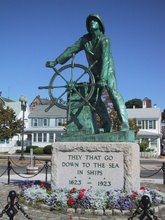
World War II started 70 years ago today, when Germany invaded Poland.
How much things have changed since then, and how little.
Tuesday, September 01, 2009


Blowing his own horn
A group of very nice letters about Ted Kennedy in today's Times, one of them by a person very close to my heart.
Monday, August 31, 2009
Give me back my Tea Party
We've been seeing and hearing a great deal about "tea parties"--gatherings of citizens who are mad as hell and not going to take it any more. With its typical lack of critical analysis, the mass media have omitted to point out that the self-described tea partiers are the antithesis of the Americans who took to the streets of Boston on the night of December 17, 1773.
Those who carried out that first Tea Party were not protesting against government, or even against taxation. They were agitating for democracy. They did not cry "No taxation!" but "No taxation without representation!" They stood for principle--representative government--not policy.
Those who are protesting now are not arguing for democracy. Indeed, they argue against the results of democracy. For these are the people who lost in 2008. Their complaint is not that they have been deprived of representative government, but that they are in the minority. They object not to a lack of freedom, but to the result of free choice. They are perfectly entitled to their anger and to protest, but they are not the true descendants of the patriots in Boston that winter night in 1773.
Health care insanity
Not enough attention has been paid to the astounding irrationalities of our healthcare system. Consider:
I read recently about a woman who, suffering from aggressive cancer, went into a clinical study for a new treatment. The trial was so successful that it was stopped before it's scheduled end. The woman in question could afford the new drug's cost, but some in the trial had to exhaust their resources to pay for treatment, and some could not afford full treatment.
Think of this: In the United State, you can die if you participate in a drug trial that is too successful.
Another example: The lovely Diane and I picked up dental insurance, even though the maximum benefit is only twice the annual premium. Why would we make such a financial commitment? Because my dentist's office manager pointed out that the dentist charges the insurance company less than he would charge me if I do not have insurance. And even if we have to pay the balance--because the insurer pays less than the amount charged--we'll pay less than we would have without insurance, and so the real value of the insurance is much greater than appears.
So, there you have it: we have a system that charges those who have too little to afford insurance more than those who are insured.
Insanity.
A place in history
In all of the weekend's remembrances of Ted Kennedy, Chris Dodd's comment stood out:
"John F. Kennedy inspired our America. Robert F. Kennedy challenged our America. Ted Kennedy changed America."
Thursday, August 27, 2009
Saying goodbye
A few minutes ago, I left my office and went down to the street outside to watch as Sen. Kennedy's cortege went by. It was a short procession and moving rather rapidly for such an event in the city's streets. Fortunately, the sidewalk in front of my building was not heavily packed, so I was able to stand at the curb and get a glimpse of the hearse, flag-draped coffin inside, and the cars and a bus holding the family that followed. The Kennedy family graciously had the windows down in the cars, so that they were able to sense the affection, even love, of those on the street. As the procession--still out of my line of sight--approached the corner of Court and Tremont Streets, the people who could see it began to applaud, and I found myself joining in. And so we said goodbye to Ted with a soft patter of hands.
They are saying on television that it is the end of Camelot, that never again will the Kennedy Compound in Hyannisport be the center of a major news event. Very likely, that is true--that this is the final act of the Kennedy family as the closest thing that we have had to royalty. Yet I prefer to think of the things that the family has done: the civil rights, immigration, labor and healthcare legislation that they were instrumental in bringing to reality, the Special Olympics, and above all the spirit of citizenship, service and friendliness that characterized, and still characterizes them.
They are saying on television that it is the end of Camelot, that never again will the Kennedy Compound in Hyannisport be the center of a major news event. Very likely, that is true--that this is the final act of the Kennedy family as the closest thing that we have had to royalty. Yet I prefer to think of the things that the family has done: the civil rights, immigration, labor and healthcare legislation that they were instrumental in bringing to reality, the Special Olympics, and above all the spirit of citizenship, service and friendliness that characterized, and still characterizes them.
Wednesday, August 26, 2009
The Brother Who Mattered Most
Richard Lacayo of Time on Ted Kennedy, "the Brother Who Mattered Most." "[A]s the Romans understood, there can be Emperors of no consequence - and Senators whose legacies are carved in stone."
Ted
For all those whose cares have been our
concern, the work goes on, the cause endures,
the hope still lives, and the dream shall never die.
I never really thought the cancer would get him. He was Ted Kennedy, after all, and it was merely cancer. I guess larger than life wasn't large enough in the end.
Perhaps other nations think of legislators the way we revere some few of our senators, but it seems unlikely. Ted Kennedy walked in the shoes of Webster, Clay and Calhoun and perhaps a few others; Hubert Humphrey comes to my mind. He did things for people--ordinary people. (I was tempted to write, "people very different from himself," but from what I know of him--and I never met the man--I don't think he saw himself as different from the rest of us.) He was great in his accomplishments and great in his heart. He started from a privileged background, but had many obstacles to overcome, some of his own making, to become the giant we think of today.
We'll miss you, Ted.
Tuesday, August 25, 2009
They just don't learn
From the NYT:
How dumb do they think we are? How dumb do they think the Afghan people--that is, the ones who haven't written off the government entirely--are?
Just yesterday we heard reports that the western military commanders in Afghanistan are preparing to ask for more troops. As regular readers will recall, this page has long supported the Afghan war as necessary or at least justified. But in the end, as everyone recognizes, the Taliban and their terrorist allies (which allies are the reason we are in this, and the only justification for putting American and other NATO troops in among the warring parties) can only be defeated by the Afghans. If the Afghan people do not reject the Taliban, the country will only be a graveyard for foreign troops.
And it should go without saying that the only way that the people of Afghanistan will back the central government is if it presents something worth supporting. That means, as a first step. making serious inroads on corruption, cronyism and incompetence.
Apparently, there is no appetite for serious reform in the Afghan government. It's time for the US to tell Karzai (whom I welcomed early in his term) some home truths: that if he and those around him are not going to get on the stick and put the welfare of the nation above their own fortunes, the US will leave him and his cronies to their just desserts. As a first step in that lesson, no more troops until government improves.
Update: According to AP, fragmentary official returns give Karzai and Abdullah Abdullah (the former foreign minister) about 40% each. Returns are to be reported over the next few days.
President Hamid Karzai seems poised to declare an overwhelming victory in Afghanistan’s hotly contested presidential election, even as allegations of fraud by his main opponent threaten to undermine the credibility of the vote.Apparently, they imported vote-counters from Iran.
The president’s finance minister, Hazrat Omar Zakhilwal, claimed Monday that Mr. Karzai had garnered 68 percent of ballots in Thursday’s election, quoting figures from election officials that he said had been provided to the cabinet.Such a showing would make a second round of voting unnecessary.
How dumb do they think we are? How dumb do they think the Afghan people--that is, the ones who haven't written off the government entirely--are?
Just yesterday we heard reports that the western military commanders in Afghanistan are preparing to ask for more troops. As regular readers will recall, this page has long supported the Afghan war as necessary or at least justified. But in the end, as everyone recognizes, the Taliban and their terrorist allies (which allies are the reason we are in this, and the only justification for putting American and other NATO troops in among the warring parties) can only be defeated by the Afghans. If the Afghan people do not reject the Taliban, the country will only be a graveyard for foreign troops.
And it should go without saying that the only way that the people of Afghanistan will back the central government is if it presents something worth supporting. That means, as a first step. making serious inroads on corruption, cronyism and incompetence.
Apparently, there is no appetite for serious reform in the Afghan government. It's time for the US to tell Karzai (whom I welcomed early in his term) some home truths: that if he and those around him are not going to get on the stick and put the welfare of the nation above their own fortunes, the US will leave him and his cronies to their just desserts. As a first step in that lesson, no more troops until government improves.
Update: According to AP, fragmentary official returns give Karzai and Abdullah Abdullah (the former foreign minister) about 40% each. Returns are to be reported over the next few days.
Monday, August 24, 2009
Keeping our eyes on the ball
I heard someone (I think it was a Republican officeholder) say that we all agree that we want everyone to have health insurance.
Isn't what we REALLY want (or ought to want) if for everyone to have health care?
Isn't what we REALLY want (or ought to want) if for everyone to have health care?
Wednesday, August 19, 2009
The surprise
It strikes me that the big surprise about the Republicans is how stubborn they are. They lost control of Congress in 2006. They lost the White House and got scalded in congressional races in 2008. Yet they maintain the same lock-step, hard-right, ideologically-driven attitude that got them where they are today. They are like Fouche's description of the Bourbon kings of France: "They have learned nothing and forgotten nothing. That can't be smart, or good politics.
Democrats, from the White House down, should remember that. Bipartisanship is fine, but it takes two to tango. If the GOPhers can't remember that they are very much in the minority, and negotiate in good faith from that position, forget them. Why hold progressive policies hostage to the troglodyte faction? Let the Grand Old Party slide further into irrelevance while the nation marches forward.
Barney Frank takes on the health care Nazis
Smackdown!
(It's been all over TV and the 'net, but I couldn't resist putting it here in case you haven't seen it.)
Friday, August 14, 2009
A disgrace
The news media report that oldsters are angry. Specifically, they are angry about healthcare reform.
Now you might think that people who have benefited from Medicare would be up in arms at the idea that people would try to deprive other Americans of the high-quality that older citizens enjoy. And I'm sure that many seniors are making that point. But, at least according to what we read, it seems that most of these angry oldsters are outraged at the idea that the benefits of government-administered health care may be extended to younger citizens.
I suppose that I should not be surprised that older Americans show the same narrowness, ignorance and selfishness that characterize much of the electorate, but it is disheartening to realize that so many of them seem to have successfully resisted learning the lessons of their experience.
The best argument
It strikes me that the best argument in favor of healthcare reform with a public option lies in the raucous town halls that we have been seeing spread across our television and computer screens. Yes, there is great ignorance and meretriciousness displayed, but think about this: if there's a problem with Medicare, you can write to your congressman/woman. If enough people feel the same way, or if the situation is egregious enough, changes will be made. That's politics: even the most entrenched representative ultimately has to listen to the voters.
Now, try writing to the president of your private health insurer and see where THAT gets you.
Friday, April 17, 2009
Ve vas only folloving orders
On the day that the Obama Administration released for memos from the Department of Justice that justified torture and read like something out of the Nazi archives, the President also announced that no CIA employee will be prosecuted for such crimes as waterboarding, repeatedly dousing prisoners with cold water, depriving detainees of sleep for up to eleven days, or other brutal and degrading acts.
Why no prosecutions? Because the interrogators were following interpretations of the law that were binding on them.
I thought we settled this issue at Nuremburg: it is no defense to say that you followed a lawful order.
And none of the Justice Department memos required the interrogators to torture; they merely offered a fig leaf for practices that the Agency voluntarily carried out.
The President was closer to the mark--although still wrong--when he said, “nothing will be gained by spending our time and energy laying blame for the past.”
This was a political decision, taken to avoid prolonging the deep divide between those who believe that what the United States does is, per se, right and those who believe that if we aspire to lead the world, we Americans must show that we really are better than our adversaries.
The Bush Administration subverted the Constitution and traduced our legal traditions. Expiation for the nation's sins is not necessary just to cleanse our consciences, but to help us regain our moral ascendancy over those who have declared themselves our mortal enemies. This, in abjuring prosecution for crimes against humanity, Mr. Obama is not merely wrong morally, he is making a serious political mistake as well. The President should have listened to Dean Acheson.
Why no prosecutions? Because the interrogators were following interpretations of the law that were binding on them.
I thought we settled this issue at Nuremburg: it is no defense to say that you followed a lawful order.
And none of the Justice Department memos required the interrogators to torture; they merely offered a fig leaf for practices that the Agency voluntarily carried out.
The President was closer to the mark--although still wrong--when he said, “nothing will be gained by spending our time and energy laying blame for the past.”
This was a political decision, taken to avoid prolonging the deep divide between those who believe that what the United States does is, per se, right and those who believe that if we aspire to lead the world, we Americans must show that we really are better than our adversaries.
The Bush Administration subverted the Constitution and traduced our legal traditions. Expiation for the nation's sins is not necessary just to cleanse our consciences, but to help us regain our moral ascendancy over those who have declared themselves our mortal enemies. This, in abjuring prosecution for crimes against humanity, Mr. Obama is not merely wrong morally, he is making a serious political mistake as well. The President should have listened to Dean Acheson.
Thursday, April 16, 2009
Not one cent for tribute
Some thoughts on curbing piracy, principally in Somalia
As in so many of our problems, the essential question is whether we have the will, not the means. We may not be able to eliminate piracy, but we can surely reduce it to a manageable annoyance if we exercise the will to do so. For instance, one idea that's been bruited about is to go in and clean out the pirate havens on the Somali coast. But whenever that is brought up, someone is sure to murmur, "Blackhawk Down." While the deaths of 18 American soldiers in
Fortunately, we can probably curb pirates around the Horn of Africa without having to go ashore. Here are a few approaches:
It's not just business: Stop permitting shipping companies and insurers (or anyone else) to pay ransom for ships and crews. The problem goes beyond the individuals and the ships involved. Misplaced feelings of sympathy, and the desire for corporate profit, only make things worse. If shipping companies, their agents or insurers pay ransom, provide that the ships in question will be forfeited and sold, with cargo, in a prize court. Shippers and insurers will try to find third-party fronts so that they can keep paying ransoms--it's cheaper and easier than resisting--so efforts will have to be made to keep them from getting away with that.
Convoys: Convoys worked in both World Wars and they would work off Somalia. True, they would be inconvenient, as ships would have to wait for the convoy to assemble and then travel at the speed of the slowest vessel. On the other hand, given the nature of the threat and today's military technology, escorts could offer almost complete protection. Fortunately, convoys through the seas off
Guards on Shipboard: We should have squads of Marines and/or sailors on board vessels traveling through the threatened areas. Think of 12 to 15 men (and possibly women) armed with a couple of machine guns, some shoulder-fired missiles and assault rifles. Pirates have threatened merchant ships with automatic rifles and RPGs. I think it's safe to say that a TOW missile would do a lot more damage to a pirate skiff than an RPG can do to a 15,000 ton ship. A recent story said that 20,000 ships pass by the Horn of Africa each year. That is a large number, but it comes down to around 55 per day. A few battalions of Marines, stationed on Amphibious Assault Ships, could rotate squad-sized units on and off ships passing through the lower end of the Red Sea, off the Horn of Africa and the southern border of Somalia. Not all ships passing through would have to be given armed guards for them to be a powerful deterrent. This kind of duty, by the way, is exactly what marines have been doing for hundreds of years. It's a lot more in the Marine tradition than slogging through Fallujah or Tora Bora. Other nations that have naval vessels patrolling of Somalia should be asked to contribute to the guard force. (I am resolutely against private armed forces on ships. If there are any core government functions, law enforcement and national defense are among them. Privatization has an even worse record in those areas than in others.)
Broaden the Military Response: The Amphibious Support Ships mentioned above can dominate a large area. They carry helicopters, Harrier aircraft and small seacraft. Unfortunately, the latter have been landing craft, which are relatively slow. For anti-pirate patrols these need to be replaced with fast, maneuverable boats that can match, or even outrun and out maneuver pirate craft. Some of the larger commercially-available RIBs can probably be outfitted with machine guns and in any event can carry sailors or Marines armed with the kind of light weapons that the pirates have. Better would be the kind of high-speed patrol boats that the Coast Guard employs.
Prosecute the Pirates: Pirates captured by US forces should be prosecuted in US courts here in the United States. The prospect of long prison terms in the States would be another strong deterrent to turning pirate, even though the food in our penitentiaries is probably more plentiful and of better quality than what a lot of the pirates are now getting. The French are already prosecuting pirates that they have captured.
Many authorities have pointed out that the real solution to piracy off the Somali coast lies in creating a working state in Somalia. True. But that could take decades. The steps that I have outlined can be taken the next few months, some in just a few weeks. They would be relatively inexpensive (by the standards of military operations), require relatively few resources (though now than we have dedicated now), and would as a side benefit provide valuable experience for the kind of small-unit actions that our military is likely to see a lot more of in the next few years.Wednesday, April 15, 2009
We always knew it
The NYT had an interesting story in its Science section yesterday, pointing out that socially-compelled sharing of resources (i.e. taxation) is not only nearly universal among humans, but also exists in many other social species. As the writer, Natalie Angier, put it, "It turns out that giving up a portion of one’s income for the sake of the tribe is such a ubiquitous feature of the human race that some researchers see it as crucial to our species’ success."
What does this mean? That Republicans are not only bad for the nation, they threaten human existence! Take that, Newt Gingrich.
What does this mean? That Republicans are not only bad for the nation, they threaten human existence! Take that, Newt Gingrich.
Tuesday, April 14, 2009
Did you spot the howler?
Our unplanned hiatus (I've been too busy and/or lazy to post) meant that we did not answer the question in "Can you spot the howler?" Time to catch up.
The passage in question, from Scott Turow's Ordinary Heroes (a book I recommend highly, despite the howler) was:
The passage in question, from Scott Turow's Ordinary Heroes (a book I recommend highly, despite the howler) was:
"The C rations are terrible," she said. "They are the best thing the American Army brought with them." She actually hugged her green pack of Luckys to her breast. "In Vichy, the women were banned from buying cigarettes altogether. Martin says that is why I had no choice but to join the resistance." She laughed at herself.The key to this is that the action takes place in October 1944. But Lucky Strikes had lost their green packaging in 1942. All Americans who had reached maturity by WWII knew that, because one of the most famous advertising campaigns of the time was, "Lucky Strike Green Has Gone to War!" By 1944, any cigarettes in a green Lucky Strike pack had long since gone stale.
Subscribe to:
Posts (Atom)