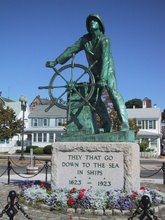
This post is occasioned by my friend Leanderthal, the Lighthouse Keeper. You can find his blog here.
Lee first came to my attention with a comment he posted about some of my thoughts on Israel. He is very concerned about war and peace in the Middle East (as we all should be), and particularly by the influence he sees in what he and others call the Israel Lobby. More particularly, he is concerned that in his view the Israel Lobby has a lock on American policy toward the region, preventing the United States from staking out any new position. That's a valid point.
What is the "Israel Lobby?" Not surprisingly, it is defined by its critics. It's centerpiece is AIPAC, the American Israel Public Affairs Committee. AIPAC doesn't make any bones about its stance: go to its website and you'll see that it bills itself as "America's Pro-Israel Lobby." Another part of what is often considered the Israel Lobby, although perhaps not so strident as AIPAC is the Conference of Presidents of Major Jewish Organizations. (I can't help but wonder if anyone has been turned down for membership, because he or she is the president of a minor Jewish organization.) Then there is a less formal network of intellectuals and pundits (the terms may be partially interchangeable) and other machers. They are, of course, allied with many members of Congress, and have had the ear of vital members of all administrations as well.
One thing that ought to be noted is that most of those who raise alarums about the Israel Lobby oppose American policy in the Middle East more than they care about those who speak for Israel; I don't place Leanderthal in that group, but it would be fallacious to deny that they exist. The real objection of such people is not so much the Israel Lobby as its effectiveness. In the end, many of them are not friends of Israel.
Let me hasten to make clear that no one need be a friend of Israel to be a responsible participant in the debate over Middle East policy, although I have trouble taking seriously those who wish for the elimination of Israel from the list of the world's nations except, perhaps, as part of a very long-range hope that someday Israelis and Palestinians will freely and peacefully choose to be part of a single state. I don't happen to think that is likely to happen, ever (the dissolution of the Netherlands into what is now that country and Belgium, in 1830, was over issues not nearly as deep as those that divide Palestinians and Israelis, and I haven't heard calls for re-unification of the Low Countries), but one could make an intellectually respectable argument for it.
I should also note that debate over the role of the Israel Lobby, and the making of American policy, are perfectly legitimate topics. Indeed, American Jews debate them fiercely. Check out the Israel Policy Forum and the writings of blogger M.J. Rosenberg, who frequently differ with and often vociferously criticize the doings of the lobby. I have also disagreed frequently with the chauvinistic and unthinking attitude of some of Israel's more vociferous supporters.
But here's the thing: Right now, how much can US policy change? Don't the realities on the ground trump the desire for a bold new direction and push a debate about how Israel tries to affect American policy into the background?
For many years, I would daydream about what I would say to Israelis and Palestinians if I were the occupant of the Oval Office. As the first Jewish president, I would have some extra weight with the Israeli prime minister, and I would use it to tell him or her a few home truths. I would say that the time for settlements in the West Bank had passed, and that the time to remove them had arrived. I would tell the prime minister that the Palestinians have to get a state that pretty much runs along the borders of the West Bank in 1967, artificial as those were. For the settlers, I would suggest cash incentives and land--to the extent that a tiny state like Israel could find some--to induce them to move. For those who refused, I would advise telling them that, from a certain date a few years hence, they could live under Palestinian rule. I would make clear that Israel has to treat its Arab citizens the same way that it treats its Jewish ones. To the Palestinian prime minister--undoubtedly suspicious of this Jew in the White House--I would offer friendship and firm support for a Palestinian state. But I would tell him (it is hardly likely to be a woman at any time in the near future) that he had to suppress the violent elements in the Palestinian polity. No peace deal will work if people are firing rockets into Israel. And those who are still refugees in Lebanon, Syria and Jordan more than sixty years after the division of the British mandate have to give up the hope of return. Perfect is the enemy of good enough. Half a loaf is better than none, and so is half a land.
Would this frank talk prove the key to peace? Questionable at any time. (You may note that my home truths did not include Jerusalem, about which I have some ideas, but which is the hardest nut of all to crack.) But now? For the present, at least, my ideas are those of a dreamer at best, or maybe a crackpot. Given what happened in Gaza when Israel abandoned it, who could expect the Israelis to give unfettered domain in the West Bank to the Palestinians. Given the actions of Israeli settlers and police in the West Bank, how long a road must be traveled be before Palestinians find enough hope, let alone trust, to live in peace with their neighbors? Yet how can we expect Israel to give up security in the hope of peace? And all that is without regard to the recent fighting in Gaza. Given the power of the rejectionists of Hamas, Hezbollah and the right wing in Israel, who can envision a stable peace?
In the Middle East today, the parties, with the U.S. as the essential intermediary, need to devise the first small steps toward an ultimate accord. That will entail a complex, difficult and probably slow process that needs ingenuity and much patience.
But beside that, debates over the Israel Lobby seem like a distraction.
Thursday, March 26, 2009


Monday, March 23, 2009
If you're so smart, why aren't we rich?
I'm no economist, but the Treasury's new plan looks like a reasonable approach to repairing the financial system. Yes, it is in many respects a re-run of the Bush administration's original proposal. And, yes, taxpayers will be subsidizing the same financial institutions that got us into this fix. But what else are we going to do? I don't see anyone proposing that we create a whole new banking system. Would nationalization--which is probably the way I would go were I in the Oval Office--really create a new group of banks? Or would it reshuffle the old ones?
What does bother me is not so much the idea of public-private partnerships or low interest loans to investors, but the administration's unwillingness to tell Wall Street that this is a new day. The AIG bonuses, tiny as they were compared to the amount that the company has received from us taxpayers, showed that the old culture remains all too intact. If we are to make basic, long-term progress, that needs to change. The people in charge of banks, hedge funds, stock brokerages and insurance companies need to learn an old truth: No one is irreplaceable.
What does bother me is not so much the idea of public-private partnerships or low interest loans to investors, but the administration's unwillingness to tell Wall Street that this is a new day. The AIG bonuses, tiny as they were compared to the amount that the company has received from us taxpayers, showed that the old culture remains all too intact. If we are to make basic, long-term progress, that needs to change. The people in charge of banks, hedge funds, stock brokerages and insurance companies need to learn an old truth: No one is irreplaceable.
Bernie's not so different from the rest of us
Thanks to Talkingpointsmemo.com for this one.
In case you haven't been to TPM, it seems that before Bernie Madoff's plea, the US Attorney's office for the Southern District of New York sent the judge a collection of emails from his victims. (Given that the US Attorney's office knew that the sentencing would not be that day, it's not clear what the purpose of forwarding the emails was.) You can find the cover letter here, with the emails attached.
Now, here's the reason for posting this: go to Page 36 of the document and read the email there.
See, Bernie really isn't all that different from you and me. Well, not in one respect, anyway.
In case you haven't been to TPM, it seems that before Bernie Madoff's plea, the US Attorney's office for the Southern District of New York sent the judge a collection of emails from his victims. (Given that the US Attorney's office knew that the sentencing would not be that day, it's not clear what the purpose of forwarding the emails was.) You can find the cover letter here, with the emails attached.
Now, here's the reason for posting this: go to Page 36 of the document and read the email there.
See, Bernie really isn't all that different from you and me. Well, not in one respect, anyway.
Sunday, March 22, 2009
Can you spot the howler?
Today, we're starting an occasional challenge: to spot the howler in a passage from a book or article. The answer will be published in a few days or perhaps a week.
Our first howler comes from Scott Turow's Ordinary Heroes. The woman referred to is a young woman in the liberate part of northern France, in October 1944. See if you can spot the howler. (Hint: this is a double howler; something Turow intended to give his work verisimilitude that was actually wrong.)
Our first howler comes from Scott Turow's Ordinary Heroes. The woman referred to is a young woman in the liberate part of northern France, in October 1944. See if you can spot the howler. (Hint: this is a double howler; something Turow intended to give his work verisimilitude that was actually wrong.)
"The C rations are terrible," she said. "They are the best thing the American Army brought with them." She actually hugged her green pack of Luckys to her breast. "In Vichy, the women were banned from buying cigarettes altogether. Martin says that is why I had no choice but to join the resistance." She laughed at herself.Can you spot the howler? If you think you have, post a comment below to tell us what it is. If your idea agrees with a prior comment, feel free to say so. There's no point in being different and wrong! All correct answers will result in a glow of satisfaction.
The President's interview
I watched President Obama's interview on 60 Minutes tonight. Nothing especially new in it, but I for one was reassured by his calm, and I wonder if that was not the main purpose of the appearance.
Mr. Obama's repeated declarations that he is the one finally responsible are heartening, given his predecessor's refusal to accept responsibility for anything, but sadly they are also made necessary by the lack of confidence that so many are expressing. In the last few weeks, Congressional Republicans seem to have found new energy; clearly, they believe they are getting traction with their negative campaign. Too little attention has been paid, as yet, to how much of that campaign, in addition to its negativity without any plan for the future, relies on the American people having such a poor collective remedy that we do not remember how much of what they now inveigh against were articles of Republican faith just a few months ago.
Regular readers will know that this page has been critical of Treasury Secretary Timothy Geithner, and has questioned whether he can survive (or should). But I'm going to go out on a limb and suggest that a year from now, while we are certainly not going to be in a time of prosperity--or even, perhaps, on the clear road back to good times--the American people will have accepted Mr. Obama's policy prescriptions and the Republicans will be seen as nothing more than a doomsday chorus.
Mr. Obama's repeated declarations that he is the one finally responsible are heartening, given his predecessor's refusal to accept responsibility for anything, but sadly they are also made necessary by the lack of confidence that so many are expressing. In the last few weeks, Congressional Republicans seem to have found new energy; clearly, they believe they are getting traction with their negative campaign. Too little attention has been paid, as yet, to how much of that campaign, in addition to its negativity without any plan for the future, relies on the American people having such a poor collective remedy that we do not remember how much of what they now inveigh against were articles of Republican faith just a few months ago.
Regular readers will know that this page has been critical of Treasury Secretary Timothy Geithner, and has questioned whether he can survive (or should). But I'm going to go out on a limb and suggest that a year from now, while we are certainly not going to be in a time of prosperity--or even, perhaps, on the clear road back to good times--the American people will have accepted Mr. Obama's policy prescriptions and the Republicans will be seen as nothing more than a doomsday chorus.
Thursday, March 19, 2009
Good news
Most of the people who routinely complain that the media concentrate on bad news will probably consider this more of the same, but in a step forward the state of New Mexico has abolished capital punishment. Gov. Bill Richardson, who has supported the death penalty in the past, signed a bill establishing life-without-parole as the state's most severe punishment.
Civilization advances slowly and with halting steps.
Civilization advances slowly and with halting steps.
Borrowed time?
The Times joins the list of those questioning whether Treasury Secretary Tim Geithner can long endure.
From the article: "Fair or not, questions about why Mr. Geithner did not know sooner about the A.I.G. bonuses and act to stop them threaten to overwhelm his achievements and undermine Mr. Obama’s overall economic agenda."
What are the Secretary's achievements? Either because they have been slim, or hard to describe, or have not yet come to fruition, or because neither Treasury or the White House have been effective in getting them out to the people, they are hard to discern. That needs to change.
The Treasury Secretary's political weight needs to be heavy if the administration is going to get us out of our plight on its terms. Remember a few months ago, when Hank Paulson (Hank Paulson!) seemed to be running the country? Yes, I know, in those days of yore the Oval Office was for all intents and purposes vacant, but even a strong President needs a strong lieutenant at the Treasury. President Obama can't afford to spend his political capital on building up Tim Geithner's credibility; the Secretary will have to do that for himself. We need leadership, and not just from the President. If Mr. Geithner is not going to be an asset, he needs to get out of the way.
(And this from someone who paled at the thought of Larry Summers as Treasury Secretary in the Obama administration.)
From the article: "Fair or not, questions about why Mr. Geithner did not know sooner about the A.I.G. bonuses and act to stop them threaten to overwhelm his achievements and undermine Mr. Obama’s overall economic agenda."
What are the Secretary's achievements? Either because they have been slim, or hard to describe, or have not yet come to fruition, or because neither Treasury or the White House have been effective in getting them out to the people, they are hard to discern. That needs to change.
The Treasury Secretary's political weight needs to be heavy if the administration is going to get us out of our plight on its terms. Remember a few months ago, when Hank Paulson (Hank Paulson!) seemed to be running the country? Yes, I know, in those days of yore the Oval Office was for all intents and purposes vacant, but even a strong President needs a strong lieutenant at the Treasury. President Obama can't afford to spend his political capital on building up Tim Geithner's credibility; the Secretary will have to do that for himself. We need leadership, and not just from the President. If Mr. Geithner is not going to be an asset, he needs to get out of the way.
(And this from someone who paled at the thought of Larry Summers as Treasury Secretary in the Obama administration.)
Wednesday, March 18, 2009
This is the Army
I don't know if President Obama reads the letters to the editor in The New York Times, but I hope that at least someone in the West Wing saw today's paper.
Wever Weed, of Long Lake, Minnesota: " Memo to A.I.G. bonus-seekers: Your prima donna days are over; you are on America’s team now, and you are expendable."
Paulette Altmeier, of Cupertino, California: "President Obama may not realize it yet, but his Katrina moment has arrived. "
The phrase "America's team," caught my eyes, and reminded me of what Irving Berlin wrote:
This is the Army Mr. Brown
You and your baby went to town.
She had you worried, but this is war,
And she won't worry you any more.
We haven't seen that spirit--the idea that this is a new day in which the old worries are recognized to be trivial, the old values will no longer serve, that we're all engaged in a national effort that will mean sacrifice from those of us who still have something left. The President has expressed something like that in his speeches, but he has not, at least so far, turned that into a philosophy that animates the response of the executive branch, much less the nation, to the economic crisis.
Perhaps we should not expect so much of a President who has been in office for only two months, but time is short. As that letter writer said, this is (at least potentially) Barack Obama's Katrina moment.
Wever Weed, of Long Lake, Minnesota: " Memo to A.I.G. bonus-seekers: Your prima donna days are over; you are on America’s team now, and you are expendable."
Paulette Altmeier, of Cupertino, California: "President Obama may not realize it yet, but his Katrina moment has arrived. "
The phrase "America's team," caught my eyes, and reminded me of what Irving Berlin wrote:
This is the Army Mr. Brown
You and your baby went to town.
She had you worried, but this is war,
And she won't worry you any more.
We haven't seen that spirit--the idea that this is a new day in which the old worries are recognized to be trivial, the old values will no longer serve, that we're all engaged in a national effort that will mean sacrifice from those of us who still have something left. The President has expressed something like that in his speeches, but he has not, at least so far, turned that into a philosophy that animates the response of the executive branch, much less the nation, to the economic crisis.
Perhaps we should not expect so much of a President who has been in office for only two months, but time is short. As that letter writer said, this is (at least potentially) Barack Obama's Katrina moment.
Tuesday, March 17, 2009
What we lose
Dan Barry, on the demise of the Seattle P0st-Intelligencer, showing us what we lose when a newspaper dies.
No Bozos
I first thought of writing this post when I saw a headline that the creator of Bozo had died. But Alan W. Livingston, who left this mortal coil on March 13th at age 91, was no Bozo.
A short sketch of his career: In 1956, he had the idea for a series of children's records that came accompanied by storybooks. One of them was Bozo at the Circus, which was the clown's start. It sold more than a million copies.
A few years later, as president of Capitol records, Livingston signed Frank Sinatra, whose career was in eclipse, and paired him with Nelson Riddle. Some of the great records of the '50's and '60's came out of that partnership. In the mid-50's he left Capitol to go to NBC, where he put together a western called Bonanza. (His brother, songwriter Jay Livingston, co-wrote the famous theme song).
Oh, and then he went back to Capitol where, in 1963, he reversed the decision of others in the company and decided to releas a record called "I Want to Hold Your Hand," by a little-known group called the Beatles.
Now that's a career!
A short sketch of his career: In 1956, he had the idea for a series of children's records that came accompanied by storybooks. One of them was Bozo at the Circus, which was the clown's start. It sold more than a million copies.
A few years later, as president of Capitol records, Livingston signed Frank Sinatra, whose career was in eclipse, and paired him with Nelson Riddle. Some of the great records of the '50's and '60's came out of that partnership. In the mid-50's he left Capitol to go to NBC, where he put together a western called Bonanza. (His brother, songwriter Jay Livingston, co-wrote the famous theme song).
Oh, and then he went back to Capitol where, in 1963, he reversed the decision of others in the company and decided to releas a record called "I Want to Hold Your Hand," by a little-known group called the Beatles.
Now that's a career!
The power to tax is the power to destroy
So wrote Justice Holmes.
Now some in Congress are talking about taxing the AIG bonuses at 100%. Unfortunately, that is almost surely unconstitutional. To begin with, it would amount to a bill of attainder--an ancient practice of punishing one or more individuals in a defined group without due process that is proscribed by the Constitution. Also the ex post facto clause, which forbids punishment for acts that were legal when committed. And there may be others as well.
Nice try. No cigar.
Now some in Congress are talking about taxing the AIG bonuses at 100%. Unfortunately, that is almost surely unconstitutional. To begin with, it would amount to a bill of attainder--an ancient practice of punishing one or more individuals in a defined group without due process that is proscribed by the Constitution. Also the ex post facto clause, which forbids punishment for acts that were legal when committed. And there may be others as well.
Nice try. No cigar.
They pushed the company over a cliff, and now...
Monday, March 16, 2009
More AIG
Robert Reich on the argument that the AIG bonuses are necessary to retain talented executives: "And any mention of the word 'talent' in the same sentence as 'AIG' or 'credit default swaps' would be laughable if laughing weren't already so expensive."
Reich also points out that the argument that the company is contractually-obligated to pay the bonuses rings false because, had the company gone into bankruptcy, as it would have without the government handout, err, bailout, claims for bonuses would have come behind those of secured creditors--which is to say they would have been wiped out--and that the people now feeding at the trough would have been out on the street.
Reich concludes:
Reich also points out that the argument that the company is contractually-obligated to pay the bonuses rings false because, had the company gone into bankruptcy, as it would have without the government handout, err, bailout, claims for bonuses would have come behind those of secured creditors--which is to say they would have been wiped out--and that the people now feeding at the trough would have been out on the street.
Reich concludes:
But if our very own Secretary of the Treasury doesn't even learn of the bonuses until months after AIG has decided to pay them, and cannot make stick his decision that they should not be paid, AIG is not even accountable to the government. That means AIG's executives -- using $170 billion of our money, so far -- are accountable to no one.
* * * *
On a related topic: Was Larry Summers' broadside at AIG on George Stephanopolous' show yesterday aimed at Tim Geithner as much as at the company? Is Summers setting himself up to be the next Treasury Secretary, when the President decides that Geithner is not ready for prime time? (He sure hasn't looked it so far.)
Actual good news
The voters of El Salvador have elected Mauricio Funes, candidate of the leftist FMLN, as their new president. Now, I don't know anything about President-Elect Funes or the details of his politics, but this is good news, because (a) the race was a close one; Funes had a big lead, but the party of the Right, ARENA, had the money and clout with the establishment, slammed Funes as a tool of Hugo Chavez and gained much ground; (b) FMLN was asserting that if the race was close, ARENA would engage in fraud and prevent Funes from winning; (c) the margin was, apparently, around 51-49 percent and (d) it sounds like no one is making noises about nullifying the election results.
In a nation like El Salvador, a peaceful change of government is an important and heartening step.
In a nation like El Salvador, a peaceful change of government is an important and heartening step.
Sunday, March 15, 2009
Just say no!
You have undoubtedly heard that AIG is taking millions of taxpayer dollars (it has none of its own) to pay millions in bonuses to executives in its Financial Products division. This relatively small part of the company is mainly responsible for the company getting into trouble (that and upper management's blindness or willingness to look the other way while the people in FP drove AIG under).
The early reports said that $100 to $170 million was to be paid, but the WSJ says a whopping $450 million.
Various sources reported that Secretary Geithner tried to stanch the bonuses with a phone call, but was unsuccessful. Worse, the CEO is the guy that Treasury put in when we (that is, the American people) took an 80% stake in the company. The excuse for this is that the bonuses are required by contract.
Let me tell you that if I had an 80% stake in a company and the guy running the place told me that he couldn't stop paying those bonuses, he'd be on the street so fast that his head would be spinning. And as for the excuse that there's no alternative, I would ask, "Can you say, 'Sue me?'"
I have a lot of clients who have very good claims of employment discrimination. Companies have no trouble in forcing us to sue to enforce those claims. Let the AIG employees sue. They won't collect more than they will be paid as the company and the government turn tail. Many of them will settle for less. Given that the reasoning behind paying these bonuses is that AIG is "contractually obligated," many of those who sue will lose: surely they cannot maintain with a straigh face that they fulfilled their contracts by being so negligent, incompetent or worse that they put the company it the state it was in last last October.
AIG's excuse is that they need to retain talent. Huh? Retain them? Why weren't they fired months ago?
(The one bright spot is that Edward Liddy, AIG's CEO, was a Bush Administration appointee. A good time to fire him.)
The early reports said that $100 to $170 million was to be paid, but the WSJ says a whopping $450 million.
Various sources reported that Secretary Geithner tried to stanch the bonuses with a phone call, but was unsuccessful. Worse, the CEO is the guy that Treasury put in when we (that is, the American people) took an 80% stake in the company. The excuse for this is that the bonuses are required by contract.
Let me tell you that if I had an 80% stake in a company and the guy running the place told me that he couldn't stop paying those bonuses, he'd be on the street so fast that his head would be spinning. And as for the excuse that there's no alternative, I would ask, "Can you say, 'Sue me?'"
I have a lot of clients who have very good claims of employment discrimination. Companies have no trouble in forcing us to sue to enforce those claims. Let the AIG employees sue. They won't collect more than they will be paid as the company and the government turn tail. Many of them will settle for less. Given that the reasoning behind paying these bonuses is that AIG is "contractually obligated," many of those who sue will lose: surely they cannot maintain with a straigh face that they fulfilled their contracts by being so negligent, incompetent or worse that they put the company it the state it was in last last October.
AIG's excuse is that they need to retain talent. Huh? Retain them? Why weren't they fired months ago?
(The one bright spot is that Edward Liddy, AIG's CEO, was a Bush Administration appointee. A good time to fire him.)
Thursday, March 12, 2009
Reckoning
"Some will rob you with a six-gun and some with a fountain pen"
Pretty Boy Floyd, Woody Guthrie
Bernie Madoff is to plead guilty this morning. A few of his victims will be in the courtroom to face him. The New York Times reported suggestions that the proceeding be held at the new Citi Field (successor to Shea Stadium), to give a reasonable fraction of those duped a chance to attend. (The Times also reported suggestions that the new stadium should be re-named Debits Field.)
I don't know if Madoff will be sentenced today; there's no plea deal, and normally the court orders a pre-sentence evaluation and report. So it could be months before we know what is going to happen.
But look at it this way: If Madoff gets just one year for every billion that he claims to have stolen, he'll be sentenced to fifty years in prison. What would you or I get if we stole a hundred dollars from a guy on the street?
I don't know if Madoff will be sentenced today; there's no plea deal, and normally the court orders a pre-sentence evaluation and report. So it could be months before we know what is going to happen.
But look at it this way: If Madoff gets just one year for every billion that he claims to have stolen, he'll be sentenced to fifty years in prison. What would you or I get if we stole a hundred dollars from a guy on the street?
Tuesday, March 10, 2009
Very good news
The BBC reports that researchers have discovered an enzyme that they say is crucial in allowing cancer to metastasize. Metastasization is responsible for 90 percent of cancer deaths, so stopping the spread of the disease would be by far the largest step to improving treatment. (The story does not state what the prognosis is for a drug that would block the enzyme in humans, although it references studies in mice, without saying whether the enzyme was effectively blocked.)
One downside: the enzyme in question is LOX. Does that mean no more bagels....?
One downside: the enzyme in question is LOX. Does that mean no more bagels....?
Monday, March 09, 2009
STOP THE INSANITY
Most of the guns used by the Mexican drug cartels are sold to traffickers by American gun dealers. A man walks into a church, goes to the pulpit and guns down the pastor, in front of his horrified congregation. It actually made the news when a committee of the Arkansas state senate killed (no pun intended) a bill that would have allowed concealed weapons in churches. (I can hear it now: if some people in that Illinois church had had guns, the pastor might be alive today. Sure. Or maybe half a dozen more would be dead.)
And how do we respond? The United States Senate attaches a rider to a bill to give the District of Columbia a voting representative in Congress that would repeal the District's requirement for trigger locks and repeal a ban on assault weapons.
Think of it: you could legally carry a .50 cal. sniper rifle in Washington, D.C. That's right, a weapon that can deliver aimed, rapid fire against targets a mile away, within easy range of the nation's leaders. (Remember the D.C. sniper of a few years ago? He and his sidekick terrorized the whole D.C. metropolitan area with an ordinary rifle.)
Oh, and there's a later development: Yesterday, the Supreme Court refused to hear a case in which New York was trying to continue its campaign against gun manufacturers who flood the state with illegal weapons.
Will we ever wake up? Will we continue to let a minority of crazies hold the nation hostage? Will someone have the courage--or clarity--to stand up and say that the leadership of the NRA and its allied organizations are the witting or unwitting allies of drug dealers, mobsters and terrorists?
And how do we respond? The United States Senate attaches a rider to a bill to give the District of Columbia a voting representative in Congress that would repeal the District's requirement for trigger locks and repeal a ban on assault weapons.
Think of it: you could legally carry a .50 cal. sniper rifle in Washington, D.C. That's right, a weapon that can deliver aimed, rapid fire against targets a mile away, within easy range of the nation's leaders. (Remember the D.C. sniper of a few years ago? He and his sidekick terrorized the whole D.C. metropolitan area with an ordinary rifle.)
Oh, and there's a later development: Yesterday, the Supreme Court refused to hear a case in which New York was trying to continue its campaign against gun manufacturers who flood the state with illegal weapons.
Will we ever wake up? Will we continue to let a minority of crazies hold the nation hostage? Will someone have the courage--or clarity--to stand up and say that the leadership of the NRA and its allied organizations are the witting or unwitting allies of drug dealers, mobsters and terrorists?
Friday, March 06, 2009
The more things change...
A couple of years ago, I noted that the Republicans, like the Bourbons of France, had learned nothing and forgotten nothing. (The phrase is from Talleyrand.)
That's even more true today, when the the once Grand Old Party has nothing to offer but the hope that Democrats will fail. They have not only ceded the initiative to President Obama (I like writing those words together!) and his allies on Capitol Hill, they have no ideas worth the name to offer as an alternative. That is sad, because for all of his energy, initiative and ability, Obama has not been perfect so far, and intellectual competition could improve the way we are governed. But the Republicans offer no creative ideas about the direction in which the nation should move, or even on the issues of the day.
Almost certainly, there will come a time when this will change, when Republicans will offer some real, if misguided, theories on what the United States should be like and how we should govern ourselves. And when that happens, we Democrats will deride the Republicans and wail if the voters seem to accept what they have to say. But in the long run, the nation will be better for it. Well, maybe. Are we really better off for having had Reagan?
That's even more true today, when the the once Grand Old Party has nothing to offer but the hope that Democrats will fail. They have not only ceded the initiative to President Obama (I like writing those words together!) and his allies on Capitol Hill, they have no ideas worth the name to offer as an alternative. That is sad, because for all of his energy, initiative and ability, Obama has not been perfect so far, and intellectual competition could improve the way we are governed. But the Republicans offer no creative ideas about the direction in which the nation should move, or even on the issues of the day.
Almost certainly, there will come a time when this will change, when Republicans will offer some real, if misguided, theories on what the United States should be like and how we should govern ourselves. And when that happens, we Democrats will deride the Republicans and wail if the voters seem to accept what they have to say. But in the long run, the nation will be better for it. Well, maybe. Are we really better off for having had Reagan?
Thursday, March 05, 2009
John Stewart gets the meltdown
I'm not a fan of The Daily Show, because there are more hits and misses. But here is a real hit, via TPM.
Friday, January 23, 2009
Two nations, separated by a common language
Sarah Lyall, NYT correspondent in Blighty, has one of the wittiest articles I've seen in years. (Warning: your editor has not grown entirely out of his sophomoric streak.)
(Have you noticed that even as newspapers struggle, the quality of writing and photography, at least in The New York Times, has grown markedly?)
(Have you noticed that even as newspapers struggle, the quality of writing and photography, at least in The New York Times, has grown markedly?)
Wednesday, January 21, 2009
And so the countdown begins
If you don't already feel a sense of urgency, think of this: The countdown on Barack Obama's time as President has already begun: Thanks to the 22nd (or XXIInd, if you prefer) Amendment, he is limited to no more than two terms. There's no time to lose!
Fortunately, there are a couple of signs of starting fast, even if they are steps that only start undoing the evils of the Bush administration. (Undoing the evils of the Bush years is a major task, on top of all the crises that face the new President.) Chief of Staff Rahm Emmanuel took time off from inaugural festivities to order that all pending regulations be stopped pending review, and the President found time to order that military prosecutors to seek 120-day continuances in all war-crimes cases at Guantanamo Bay.
And so the new age begins.
Fortunately, there are a couple of signs of starting fast, even if they are steps that only start undoing the evils of the Bush administration. (Undoing the evils of the Bush years is a major task, on top of all the crises that face the new President.) Chief of Staff Rahm Emmanuel took time off from inaugural festivities to order that all pending regulations be stopped pending review, and the President found time to order that military prosecutors to seek 120-day continuances in all war-crimes cases at Guantanamo Bay.
And so the new age begins.
Tuesday, January 20, 2009
A New Day Dawned at Noon
Something extraordinary happened today: a new day dawned at noon, when Barack Obama became the 44th President of the United States. The weather was cold, but clear and marvelously sunny; let us hope that that is an augury for the coming days. To call the sea of citizens in front of the Capitol huge would be a vast understatement; may that be a symbol of a basic unity among us--even as we furiously debate--in the challenging days ahead.
And may the new President's words inspire us, and the world:
And may the new President's words inspire us, and the world:
I stand here today humbled by the task before us, grateful for the trust you have bestowed, mindful of the sacrifices borne by our ancestors.
...Today I say to you that the challenges we face are real. They are serious and they are many. They will not be met easily or in a short span of time. But know this, America - they will be met.
On this day, we gather because we have chosen hope over fear, unity of purpose over conflict and discord.
On this day, we come to proclaim an end to the petty grievances and false promises, the recriminations and worn out dogmas, that for far too long have strangled our politics.
We remain a young nation, but in the words of Scripture, the time has come to set aside childish things. The time has come to reaffirm our enduring spirit; to choose our better history; to carry forward that precious gift, that noble idea, passed on from generation to generation: the God-given promise that all are equal, all are free, and all deserve a chance to pursue their full measure of happiness.
...
Now, there are some who question the scale of our ambitions - who suggest that our system cannot tolerate too many big plans. Their memories are short. For they have forgotten what this country has already done; what free men and women can achieve when imagination is joined to common purpose, and necessity to courage.
What the cynics fail to understand is that the ground has shifted beneath them - that the stale political arguments that have consumed us for so long no longer apply.
...
For we know that our patchwork heritage is a strength, not a weakness. We are a nation of Christians and Muslims, Jews and Hindus - and non-believers. We are shaped by every language and culture, drawn from every end of this Earth; and because we have tasted the bitter swill of civil war and segregation, and emerged from that dark chapter stronger and more united, we cannot help but believe that the old hatreds shall someday pass; that the lines of tribe shall soon dissolve; that as the world grows smaller, our common humanity shall reveal itself; and that America must play its role in ushering in a new era of peace.
...
Our challenges may be new. The instruments with which we meet them may be new. But those values upon which our success depends - hard work and honesty, courage and fair play, tolerance and curiosity, loyalty and patriotism - these things are old. These things are true. They have been the quiet force of progress throughout our history. What is demanded then is a return to these truths. What is required of us now is a new era of responsibility - a recognition, on the part of every American, that we have duties to ourselves, our nation, and the world, duties that we do not grudgingly accept but rather seize gladly, firm in the knowledge that there is nothing so satisfying to the spirit, so defining of our character, than giving our all to a difficult task.
...So let us mark this day with remembrance, of who we are and how far we have traveled. In the year of America’s birth, in the coldest of months, a small band of patriots huddled by dying campfires on the shores of an icy river. The capital was abandoned. The enemy was advancing. The snow was stained with blood. At a moment when the outcome of our revolution was most in doubt, the father of our nation ordered these words be read to the people:
“Let it be told to the future world…that in the depth of winter, when nothing but hope and virtue could survive…that the city and the country, alarmed at one common danger, came forth to meet [it].“
America. In the face of our common dangers, in this winter of our hardship, let us remember these timeless words. With hope and virtue, let us brave once more the icy currents, and endure what storms may come. Let it be said by our children’s children that when we were tested we refused to let this journey end, that we did not turn back nor did we falter; and with eyes fixed on the horizon and God’s grace upon us, we carried forth that great gift of freedom and delivered it safely to future generations.
Now, the work begins.
Monday, January 19, 2009
Transition trivia
It is the clock, not the oath, that will make Barack Obama President tomorrow. Under the Twentieth Amendment (or the XXth, if you prefer), the term of the outgoing president ends at noon on January 20th. As there can be no vacancy in the office, Barack Obama will then succeed to the office whether or not he has been sworn in.
One day!
As I write this, there are fewer than 24 hours until Barack Obama becomes the 44th President of the United States. And less than 24 hours until George W. Bush leaves office!
The horizon is stormy and fog surrounds us, but truly a new day is dawning!
The horizon is stormy and fog surrounds us, but truly a new day is dawning!
This Land is Your Land
If I were the producer, yesterday's concert would have closed with This Land is Your Land. Yet I never expected that; I know how out of touch I am with popular taste. How perfect for me, then, that Obama's remarks should be followed with that anthem to the American people; even better that it brought us Pete Seeger--even if he was only speaking the verses--and Bruce Springstein. And how suprising--perhaps shocking--to hear them sing the verse that goes:
As I was walkin'  -  I saw a sign there
And that sign said - no tress passin'
But on the other side  .... it didn't say nothin!
Now that side was made for you and me!

I confess that there were tears in my eyes, and some of them
escaped down my cheeks.  This Land is not merely Woody
Guthrie's great anthem,  a remembrance of the folk music revival
of the 1960's, it was also the theme song of Fred Harri's New
Populist campaign in 1976--a time when we true believers
thought we would change the world.  The song represents the
best of my past, and a hope for the future.
A thought
Barack Obama's brief remarks at yesterday's concert at the Lincoln Memorial were better than anything George W. Bush said in eight years in office.
National day of service
As you probably know, President-Elect Obama has designated today as a National Day of Service, and asked Americans to volunteer at a local community-service agency for the day. This is a good and noble idea, more for the intent it shows and the possibility that some of us will find today a springboard into serving our fellows than for useful work that will be done.
Having said that, I am at my office today. Why? For one thing, I am working on Martin Luther King Day so that I may take tomorrow off to celebrate the fruition of his dream. Also, most of my law practice is devoted to furthering the civil rights of employees, so I think it is fair to say that in some sense most of my work is devoted to serving the community. I am reminded of the story of the French knight who implored a Spaniard to go on crusade to the Holy Land. Thinking of the constant struggle against the Moors, the Spaniard replied, "We are always on crusade; we do our part."
(For those who take issue with the idea of equating a crusade for a particular religion with equal rights for all, as Lincoln said, we know what is right only "as God gives us to see the right.")
Having said that, I am at my office today. Why? For one thing, I am working on Martin Luther King Day so that I may take tomorrow off to celebrate the fruition of his dream. Also, most of my law practice is devoted to furthering the civil rights of employees, so I think it is fair to say that in some sense most of my work is devoted to serving the community. I am reminded of the story of the French knight who implored a Spaniard to go on crusade to the Holy Land. Thinking of the constant struggle against the Moors, the Spaniard replied, "We are always on crusade; we do our part."
(For those who take issue with the idea of equating a crusade for a particular religion with equal rights for all, as Lincoln said, we know what is right only "as God gives us to see the right.")
Friday, January 16, 2009

A righteous war
“It is a very righteous war and has the full support of public opinion," said the chief rabbi if Israel's military, quoted in today's New York Times.
No, rabbi, it isn't. Not even for those of us who support the necessity of the Israeli offensive. There are no righteous wars. There are necessary wars, even just wars and, as Americans well know, there are unnecessary wars. But let us never confuse the killing of human beings in armed conflicts with righteousness.
(For an incisive analysis of Israeli policy and goals, see Tom Friedman's piece in the Times from a few days ago.)
No, rabbi, it isn't. Not even for those of us who support the necessity of the Israeli offensive. There are no righteous wars. There are necessary wars, even just wars and, as Americans well know, there are unnecessary wars. But let us never confuse the killing of human beings in armed conflicts with righteousness.
(For an incisive analysis of Israeli policy and goals, see Tom Friedman's piece in the Times from a few days ago.)
Wednesday, January 14, 2009

Profiles in courage
From today's NYT:
Some people have said that I showed courage years ago when I started my own law practice, and for taking on large companies in court and the US government in representing a couple of Guantanamo detainees. Nothing I have done is worth a fig compared to the daily bravery of those school girls and their families in a remote Afghan village--and of thousands of others prepared to resist the forces of ignorance and hate.
This page has criticized President-elect Obama's announced policy on Afghanistan, but let's all be clear that the goal of helping Afghans to move their nation out of the twelfth century--not to our vision of the twenty-first, but to theirs--remains worthwhile, even necessary. The debate ought to be about how we can do it.
One morning two months ago, Shamsia Husseini and her sister were walking through the muddy streets to the local girls school when a man pulled alongside them on a motorcycle and posed what seemed like an ordinary question.
“Are you going to school?”Read the rest of the story, which includes a photograph of Shamsia.Then the man pulled Shamsia’s burqa from her head and sprayed her face with burning acid. Scars, jagged and discolored, now spread across Shamsia’s eyelids and most of her left cheek. These days, her vision goes blurry, making it hard for her to read.
But if the acid attack against Shamsia and 14 others — students and teachers — was meant to terrorize the girls into staying home, it appears to have completely failed.
Today, nearly all of the wounded girls are back at the Mirwais School for Girls, including even Shamsia, whose face was so badly burned that she had to be sent abroad for treatment. Perhaps even more remarkable, nearly every other female student in this deeply conservative community has returned as well — about 1,300 in all.
Some people have said that I showed courage years ago when I started my own law practice, and for taking on large companies in court and the US government in representing a couple of Guantanamo detainees. Nothing I have done is worth a fig compared to the daily bravery of those school girls and their families in a remote Afghan village--and of thousands of others prepared to resist the forces of ignorance and hate.
This page has criticized President-elect Obama's announced policy on Afghanistan, but let's all be clear that the goal of helping Afghans to move their nation out of the twelfth century--not to our vision of the twenty-first, but to theirs--remains worthwhile, even necessary. The debate ought to be about how we can do it.
Monday, January 12, 2009
Justice takes another hit
The judge has declined to revoke Bernie Madoff's bail.
One law for the rich (or the formerly rich) and socially prominent, one law for the poor and obscure.
One law for the rich (or the formerly rich) and socially prominent, one law for the poor and obscure.
Just a thought
If someone offers a bribe to the President for a pardon, and the President issues the pardon, is the briber home free?
(Now, why would this thought come to me now? I wonder.)
(Now, why would this thought come to me now? I wonder.)
Is this really necessary?
AP is reporting that the Army's general in charge of the Army Recruiting Command wants to set up a fat farm for overweight recruits to slim down to Army standards.
Excuse me, but Huh?!? Isn't the function of basic training to get recruits into shape? If they arrive overweight, assign them to more marches. If a recruit comes in overweight, maybe add and extra week to basic so he (or she) can do some more hoofing across open ground. Adding a few more pounds to the pack will also help.
Excuse me, but Huh?!? Isn't the function of basic training to get recruits into shape? If they arrive overweight, assign them to more marches. If a recruit comes in overweight, maybe add and extra week to basic so he (or she) can do some more hoofing across open ground. Adding a few more pounds to the pack will also help.
Wednesday, January 07, 2009
Another take
Over the weekend, I suggested that the Senate should seat Roland Burris as the junior senator from Illinois. Yesterday, a friend pointed me to an article in Slate by Akhil Reed Amar and Josh Chafetz, from Yale and Cornell Law Schools respectively, making the case for the Senate's right to keep Burris out.
I'm not sure that I'm convinced that the Senate should keep Burris out, but I find the following reasoning in the article to be persuasive (although perhaps not completely) of the power to do so:
I'm not sure that I'm convinced that the Senate should keep Burris out, but I find the following reasoning in the article to be persuasive (although perhaps not completely) of the power to do so:
But imagine if Burris had won election only because other candidates were wrongly and corruptly kept off the ballot. Surely the Senate could properly deem this an invalid election. Similarly, it now seems apparent that there were candidates that Blagojevich refused to consider for improper reasons—because one refused to "pay to play" early on, or because another is at the center of the impending criminal case against the governor. With the appointments process so inherently and irremediably tainted, the Senate may properly decide that nothing good can come from a Blagojevich appointment.(Etymological question: Should we say that an article appears in and online publication like Slate, or on it?)
And now for something completely different.
The most beautiful automobile ever built: the Bugatti Type 57sc Atlantique coupe:

For more, check out Jay Leno's fascinating description of his Type 57sc.

For more, check out Jay Leno's fascinating description of his Type 57sc.
Tuesday, January 06, 2009
Ave atque vale
Obituaries of people you might not know, who made a difference and lived lives that provide lessons for the rest of us:
Victor Krulak, Marine's marine (all 5'4" of him), whose intelligence and persistence led to the landing craft that made victory in WWII possible. He also had a formula that might actually have defeated the Communists in Vietnam.
Nick Scandone, winner of a gold medal in sailing at the Beijing paralympics just a few months ago, even as he was in the last stages of ALS. All I know about him is in his obituary, but from that I would say that he deserves to rank with the great deep-water sailors (Joshua Slocum, Dennis Connor) that we celebrate.
Victor Krulak, Marine's marine (all 5'4" of him), whose intelligence and persistence led to the landing craft that made victory in WWII possible. He also had a formula that might actually have defeated the Communists in Vietnam.
Nick Scandone, winner of a gold medal in sailing at the Beijing paralympics just a few months ago, even as he was in the last stages of ALS. All I know about him is in his obituary, but from that I would say that he deserves to rank with the great deep-water sailors (Joshua Slocum, Dennis Connor) that we celebrate.
The limits of bipartisanship
All very well to speak about moving beyond partisanship, but there are costs to doing so, and they are becoming apparent in the debate over an economic stimulus package, oops, the American Reinvestment and Recovery Plan.
Republicans are applauding the President-Elect's tax-cutting proposals (which fit in with the anti-government mantra that still paralyzes the GOP), but in a posture that gives new meaning to the term chutzpah, are already carping at the size of the overall package. This from the people who kept all that spending on the Iraq rat-hole "off-budget," so they could pretend it didn't exist.
If, for the sake of bipartisanship, the new administration trims the size of the stimulus, uh ARRP, package, that will be a serious mistake. (Paul Krugman had a very good take on this yesterday.) And to what purpose would Obama do this? If the economy continues to go downhill--which too small a stimulus will make much more likely--will Republicans take any part of the blame? Do I have to answer that one for you?
If the minority party is not willing to stand up and support steps necessary to save the nation from economic calamity, then it should be left in the dust.
(In practical terms the Democratic majority is large enough so that Obama and the House and Senate leadership need not pay much mind to the Republican leadership. I do not suggest openly dissing McConnell, Boehner and the others--although the impulse to do so on general principles is almost overwhelming--but they well know that some of the rank-and-file will support almost any plan that the new President puts forward. In the Senate, in particular, it is hard to see every "moderate" Republican supporting a filibuster over the stimulus package, which is what would be needed to block it.)
Republicans are applauding the President-Elect's tax-cutting proposals (which fit in with the anti-government mantra that still paralyzes the GOP), but in a posture that gives new meaning to the term chutzpah, are already carping at the size of the overall package. This from the people who kept all that spending on the Iraq rat-hole "off-budget," so they could pretend it didn't exist.
If, for the sake of bipartisanship, the new administration trims the size of the stimulus, uh ARRP, package, that will be a serious mistake. (Paul Krugman had a very good take on this yesterday.) And to what purpose would Obama do this? If the economy continues to go downhill--which too small a stimulus will make much more likely--will Republicans take any part of the blame? Do I have to answer that one for you?
If the minority party is not willing to stand up and support steps necessary to save the nation from economic calamity, then it should be left in the dust.
(In practical terms the Democratic majority is large enough so that Obama and the House and Senate leadership need not pay much mind to the Republican leadership. I do not suggest openly dissing McConnell, Boehner and the others--although the impulse to do so on general principles is almost overwhelming--but they well know that some of the rank-and-file will support almost any plan that the new President puts forward. In the Senate, in particular, it is hard to see every "moderate" Republican supporting a filibuster over the stimulus package, which is what would be needed to block it.)
Spooky stuff
The about-to-be-official appointment of Leon Panetta as CIA Director has surprised almost everyone in Washington. Josh Marshall has an excellent post on the appointment, with contributions from a couple of his readers, one a retired intelligence professional with a (to me, at least) surprising take.
One concern about Panetta: According to the Times, he's 70 years old.
One concern about Panetta: According to the Times, he's 70 years old.
Monday, January 05, 2009
Clear thinking, military style
One way to deal with shrinking in recruits: Accept heavier enlistees.
Stimulating
The latest figures of the Obama stimulus plan (we're not supposed to call it that, it's now the American Reinvestment and Recovery Plan--ARRP; don't confuse it with AARP) suggest that it will be less than $750 billion. A lot of money--inconceivable before the recent giveaway of a cool trillion to the bankers and brokers. I'm not economist, but from what I've heard, the great danger is not that we shall spend too much on priming the pump, but not enough. This is a time to think big, and I hope that the size of the program will grow, not shrink. This will be the first test of Obama's presidential (not political) acumen.

Last week I heard a debate over the stimulus on NPR. One economist took the Keynesian position that we need government to step in, because no one else is spending or investing. The other espoused the view that private decisions about spending are better than choices made by government.
Generally, the second view is correct, but that is like saying that generally people like sunny weather more than rainy days; we all know that we need the rain. Surely the present crisis was caused by private decisions. And we know something about how to use government dollars to promote economic growth.
But the real fallacy in the free-market approach lies in the question of timing. If they are honest, enthusiasts of laissez-faire economics tell us that the market will right thing over time. True, but time is the problem. People are suffering now. As John Maynard Keynes noted, in perhaps his most brilliant pronouncement, "In the long run, we are all dead."
Last week I heard a debate over the stimulus on NPR. One economist took the Keynesian position that we need government to step in, because no one else is spending or investing. The other espoused the view that private decisions about spending are better than choices made by government.
Generally, the second view is correct, but that is like saying that generally people like sunny weather more than rainy days; we all know that we need the rain. Surely the present crisis was caused by private decisions. And we know something about how to use government dollars to promote economic growth.
But the real fallacy in the free-market approach lies in the question of timing. If they are honest, enthusiasts of laissez-faire economics tell us that the market will right thing over time. True, but time is the problem. People are suffering now. As John Maynard Keynes noted, in perhaps his most brilliant pronouncement, "In the long run, we are all dead."
The toll rises
The Times contains a news analysis suggesting that the Israeli attack on Gaza was timed because of the imminent (not imminent enough) departure of President Bush, a very, very staunch ally. While President-elect Obama has said good things about Israel and many of his advisers have solid records on Middle East issues, the Israelis were, according to Scott Shane, not willing to wait for the reaction of the new administration.
I can well understand such reasoning. What I fear is that political considerations arising from next month's Israeli elections may also be at work. More specifically, I worry that the need to be tough (Polls have had the Likud party of Benyamin Natanyahu--Israel's answer to George W. Bush--leading) will lead the current government to prolong military action beyond the point where it is worthwhile. If a political leader has any sensitivity, the calculation of when the benefits of war justify the human cost is always hellish, but when politics puts the thumb of self-interest on the scale, the computation becomes even more grotesque and, in most cases, less humane.
A final thought, generated by the protests against Israel's actions: "War is war and not popularity seeking." Thus William Tecumseh Sherman, who had reason to know. Sherman, widely accounted the greatest general of a war known for superb commanders, was right. Hamas and other intransigent enemies of Israel wanted war. Now they have it. As the Bible tells us, "For they sow the wind And they reap the whirlwind."
What is the answer? Peace. Not an armed truce, except as a bridge to a permanent arrangement. And until Hamas and its allies accept that they need to work toward a true peace, they will bring forth upon themselves and those whom they control all the evils of which Sherman spoke when he said, "War is all hell."
I can well understand such reasoning. What I fear is that political considerations arising from next month's Israeli elections may also be at work. More specifically, I worry that the need to be tough (Polls have had the Likud party of Benyamin Natanyahu--Israel's answer to George W. Bush--leading) will lead the current government to prolong military action beyond the point where it is worthwhile. If a political leader has any sensitivity, the calculation of when the benefits of war justify the human cost is always hellish, but when politics puts the thumb of self-interest on the scale, the computation becomes even more grotesque and, in most cases, less humane.
A final thought, generated by the protests against Israel's actions: "War is war and not popularity seeking." Thus William Tecumseh Sherman, who had reason to know. Sherman, widely accounted the greatest general of a war known for superb commanders, was right. Hamas and other intransigent enemies of Israel wanted war. Now they have it. As the Bible tells us, "For they sow the wind And they reap the whirlwind."
What is the answer? Peace. Not an armed truce, except as a bridge to a permanent arrangement. And until Hamas and its allies accept that they need to work toward a true peace, they will bring forth upon themselves and those whom they control all the evils of which Sherman spoke when he said, "War is all hell."
Saturday, January 03, 2009
Senatorial musings
Some thoughts on the three as-yet undecided Senate seats:
Democrats should reverse course and seat Roland Burris as the senator from Illinois; Burris should announce that he will not run for reelection in 2010. For all the apparent strength of the case against Illinois governor Ron Balagojevich (D), he has not been convicted of anything (indeed, there is some chance that he will not be, given the difficulty of proving cases involving political favor-trading). There is, as far as I know, no suspicion of anything untoward in Burris' background, his relationship with the governor or his appointment. Despite the unsavory atmosphere surrounding the appointment, if he is willing to serve under a cloud (and he certainly appears to be), he should be seated.
Democrats should not attempt to seat Al Franken until the process of law has worked its way out in Minnesota. Although Franken has "surged" to a lead of more than 200 votes, that is still and infinitesimal margin. Norm Coleman (R.MN--although his term expires tomorrow) has said he will go to court, as is his right. The Senate--that is, the Democratic caucus--should stand aside and let Minnesota decide the race, as it is entitled to do under the Constitution.
In New York, the candidacy of Caroline Kennedy has been talked up and talked down and, as of the past twenty-four hours, talked up again. Attractive as she is, picking her could engender not only talk of elitism among Democrats (the GOP is desperate for ANY point of leverage), but conflict between Gov. David Paterson (D) and many powerful political figures in New York, in all likelihood without gaining him a reputation for independence that he could use when he has to run in 2010. New York has many qualified candidates. One of them is Rep. Carolyn Maloney (D.NY). A lifelong Republican until her husband was killed in a massacre on the Long Island Railroad, she became a Democrat when Republicans would not support gun control. She has been an effective legislator, she knows her way around Washington, she is not one of the state's powerful political families, she's a woman, and she's not from New York City--all points in her favor. Paterson could do a lot worse--for the nation, the state, the Democratic Party and himself--than to pick her.
Democrats should reverse course and seat Roland Burris as the senator from Illinois; Burris should announce that he will not run for reelection in 2010. For all the apparent strength of the case against Illinois governor Ron Balagojevich (D), he has not been convicted of anything (indeed, there is some chance that he will not be, given the difficulty of proving cases involving political favor-trading). There is, as far as I know, no suspicion of anything untoward in Burris' background, his relationship with the governor or his appointment. Despite the unsavory atmosphere surrounding the appointment, if he is willing to serve under a cloud (and he certainly appears to be), he should be seated.
Democrats should not attempt to seat Al Franken until the process of law has worked its way out in Minnesota. Although Franken has "surged" to a lead of more than 200 votes, that is still and infinitesimal margin. Norm Coleman (R.MN--although his term expires tomorrow) has said he will go to court, as is his right. The Senate--that is, the Democratic caucus--should stand aside and let Minnesota decide the race, as it is entitled to do under the Constitution.
In New York, the candidacy of Caroline Kennedy has been talked up and talked down and, as of the past twenty-four hours, talked up again. Attractive as she is, picking her could engender not only talk of elitism among Democrats (the GOP is desperate for ANY point of leverage), but conflict between Gov. David Paterson (D) and many powerful political figures in New York, in all likelihood without gaining him a reputation for independence that he could use when he has to run in 2010. New York has many qualified candidates. One of them is Rep. Carolyn Maloney (D.NY). A lifelong Republican until her husband was killed in a massacre on the Long Island Railroad, she became a Democrat when Republicans would not support gun control. She has been an effective legislator, she knows her way around Washington, she is not one of the state's powerful political families, she's a woman, and she's not from New York City--all points in her favor. Paterson could do a lot worse--for the nation, the state, the Democratic Party and himself--than to pick her.
Thursday, January 01, 2009
Happy new year
With so much bad news, it may be hard to view the coming year with optimism, but at least we have something from last year to cheer you up:
Tuesday, December 30, 2008
Presidential precedent
Not since James Buchanan, in 1861, has a president slunk into a well-deserved ignominy with the passivity (not to mention incompetence) of George W. Bush.
Great expectations
In the 210 years of the American presidency, only two new presidents have arguably faced challenges of the magnitude that confronts Barack Obama: Lincoln and FDR. Yet Obama may be subject to higher expectations than either of those legendary predecessors. When Lincoln acceded to the presidency as the union threatened to dissolve, he did so largely thanks to a schism among the Democrats. The Great Emancipator was thought by many to be a lucky beneficiary of the crisis that did in his opponents; few gave him credit for a masterful campaign. For many months after he entered the White House, the weight of "informed" opinion continued to underestimate him.
FDR was the subject of great hopes, but no one could have expected him to perform as he did, not least because no government in the history of the world had ever acted on such a scale or with so much sustained energy as America (and the world) saw during Roosevelt's four terms. Notably, Roosevelt in office was far more innovative and energetic than FDR the candidate had suggested he would be.
Obama suffers--yes, suffers--because he has predecessors such as Roosevelt and Lincoln. I have suggested, only half in jest, that every 150 years or so the nation needs a tall, skinny guy from Illinois. The challenges that we must meet now are easily analogized to those of 1933. But unlike FDR and Lincoln, we have the example of those great forebears with which to compare Barack Obama. (I am not aware that FDR was widely compared with Lincoln in 1932 or 1933; the crises that contronted the two men were almost entirely different.)
The presidency is a crushing burden. The expectations that confront Obama can only make it more so. Let's hope and even pray (even if you are not religious, dear reader, what could it hurt?) that our forty-fourth President can stand up and ever excel, under the pressure.
FDR was the subject of great hopes, but no one could have expected him to perform as he did, not least because no government in the history of the world had ever acted on such a scale or with so much sustained energy as America (and the world) saw during Roosevelt's four terms. Notably, Roosevelt in office was far more innovative and energetic than FDR the candidate had suggested he would be.
Obama suffers--yes, suffers--because he has predecessors such as Roosevelt and Lincoln. I have suggested, only half in jest, that every 150 years or so the nation needs a tall, skinny guy from Illinois. The challenges that we must meet now are easily analogized to those of 1933. But unlike FDR and Lincoln, we have the example of those great forebears with which to compare Barack Obama. (I am not aware that FDR was widely compared with Lincoln in 1932 or 1933; the crises that contronted the two men were almost entirely different.)
The presidency is a crushing burden. The expectations that confront Obama can only make it more so. Let's hope and even pray (even if you are not religious, dear reader, what could it hurt?) that our forty-fourth President can stand up and ever excel, under the pressure.
Clean coal
The New York Times reports that the power plant that used the coal-ash reservoir that collapsed in Tennessee last week deposited more than 2.2 million pounds of toxic material in a single year, including "45,000 pounds of arsenic, 49,000 pounds of lead, 1.4 million pounds of barium, 91,000 pounds of chromium and 140,000 pounds of manganese." The Times notes that, "Those metals can cause cancer, liver damage and neurological complications, among other health problems."
The story also points out that the reservoir contained many decades' worth of such poisons.
Now, what was that about coal being clean energy?
The story also points out that the reservoir contained many decades' worth of such poisons.
Now, what was that about coal being clean energy?
Three weeks
Three weeks from now, at noon on January 20th, Barack Obama will become President. (Under the Twentieth Amendment, it is the clock, not the oath of office, and makes a President.)
Is it just me, or do the days seem to be crawling by?
Is it just me, or do the days seem to be crawling by?
Sunday, December 28, 2008
In proportion
In The American President, Michael Douglas' character is advised that a military response to a Libyan attack on an American military mission to Israel is "proportional." He replies something along the lines of, "Someday, someone is going to have to tell me the value of a proportional response."
Israel's response to rocket attacks from the Gaza Strip has been notably disproportionate. I suggest that that is the right course for Israel to take.
Palestinian rocket attacks were renewed after a 6-month cease-fire between Israel and Hamas expired last week. While a number of authorities have suggested that both sides need a renewed cessation of hostilities, Palestinian forces opened a renewed fusillade within days.
This writer favored the unconditional Israeli evacuation of Gaza. I did not foresee--as the Israelis did not--that Hamas would monopolize Gaza, and that it would continue its unconditional refusal to recognize Israeli existence.
Many would suggest that Israel react to the renewal of Palestinian rocket fire--notably ineffective, given its volume--through limited responses aimed mainly at those who set off the missiles, with occasional strikes at specific leaders among Hamas and its allies. The trouble with that approach is that it does not work and, worse, that the "collateral damage" from such attacks arouses hostility among Palestinians and across the Arab world.
What to do? Should Israel ignore the attacks from Gaza? It is tempting to say yes, that the cost--a life here, damaged businesses there, some thousands of civilians suffering from PTSD or something like it--is not so great as to require response. Such thinking lacks intellectual discipline.
Hamas and its ilk do not simply oppose Israeli policy--they seek the destruction of the State of Israel. Perhaps they do not desire the extinction of Israelis (at least Jewish Israelis), but perhaps they do. In any event, it is clear that if Israel were to collapse many thousands--and perhaps many tens of thousands--of its citizens would die, and that the rest would be rendered destitute refugees in a diaspora that would dwarf the one in the Bible.
A "proportionate" response would do nothing to discourage further attacks on Israel. It would do nothing to keep Hamas and its allies from developing more deadly weapons, as they have already begun to do.
There is no guaranty that Israel's massive attack (which has continued today) will change Hamas' mind about its ultimate aims, or even its tactics. But nothing else has worked, and by bringing disproportionate damage to its enemies, Israel might--just might--begin to convince ordinary Gazans that Hamas' methods, if not its ultimate ambitions, are not worth the cost. Hamas is anything but democratic, but eventually even it must listen to those it seeks to govern.
Is it tragic that innocent people will die? Yes. But it is no more tragic if they are Palestinians than Israelis and, given that, tactics most likely (even if "most likely" is still considerably less than probably) to change Hamas' behavior are the right ones to use.
Israel's response to rocket attacks from the Gaza Strip has been notably disproportionate. I suggest that that is the right course for Israel to take.
Palestinian rocket attacks were renewed after a 6-month cease-fire between Israel and Hamas expired last week. While a number of authorities have suggested that both sides need a renewed cessation of hostilities, Palestinian forces opened a renewed fusillade within days.
This writer favored the unconditional Israeli evacuation of Gaza. I did not foresee--as the Israelis did not--that Hamas would monopolize Gaza, and that it would continue its unconditional refusal to recognize Israeli existence.
Many would suggest that Israel react to the renewal of Palestinian rocket fire--notably ineffective, given its volume--through limited responses aimed mainly at those who set off the missiles, with occasional strikes at specific leaders among Hamas and its allies. The trouble with that approach is that it does not work and, worse, that the "collateral damage" from such attacks arouses hostility among Palestinians and across the Arab world.
What to do? Should Israel ignore the attacks from Gaza? It is tempting to say yes, that the cost--a life here, damaged businesses there, some thousands of civilians suffering from PTSD or something like it--is not so great as to require response. Such thinking lacks intellectual discipline.
Hamas and its ilk do not simply oppose Israeli policy--they seek the destruction of the State of Israel. Perhaps they do not desire the extinction of Israelis (at least Jewish Israelis), but perhaps they do. In any event, it is clear that if Israel were to collapse many thousands--and perhaps many tens of thousands--of its citizens would die, and that the rest would be rendered destitute refugees in a diaspora that would dwarf the one in the Bible.
A "proportionate" response would do nothing to discourage further attacks on Israel. It would do nothing to keep Hamas and its allies from developing more deadly weapons, as they have already begun to do.
There is no guaranty that Israel's massive attack (which has continued today) will change Hamas' mind about its ultimate aims, or even its tactics. But nothing else has worked, and by bringing disproportionate damage to its enemies, Israel might--just might--begin to convince ordinary Gazans that Hamas' methods, if not its ultimate ambitions, are not worth the cost. Hamas is anything but democratic, but eventually even it must listen to those it seeks to govern.
Is it tragic that innocent people will die? Yes. But it is no more tragic if they are Palestinians than Israelis and, given that, tactics most likely (even if "most likely" is still considerably less than probably) to change Hamas' behavior are the right ones to use.
Thursday, December 18, 2008
Obama's first mistake?
In choosing evangelical pastor Rick Warren to provide the invocation at his Inauguration, President-Elect Obama (we need to keep saying "President-Elect Obama" to make it easier to get used to saying "President Obama") made a real mistake. Is it his first? Given the way the team he has assembled so far looks, it might well be, although the proof of that pudding will be in the eating.
The mistake in picking Warren is not in angering part of the President-Elect's base. That may even be politically wise. The error lies in giving a place of honor at a major public event to a man who espouses bigotry against a substantial group of Americans, and a group that has suffered and still suffers from prejudice. As more than one observer has noted, if Warren preached anti-Semitism or anti-Catholicism with the virulence that he shows toward gays and non-believers, having him appear at the Inauguration would not even been considered. Indeed, he wouldn't even be invited.
The mistake in picking Warren is not in angering part of the President-Elect's base. That may even be politically wise. The error lies in giving a place of honor at a major public event to a man who espouses bigotry against a substantial group of Americans, and a group that has suffered and still suffers from prejudice. As more than one observer has noted, if Warren preached anti-Semitism or anti-Catholicism with the virulence that he shows toward gays and non-believers, having him appear at the Inauguration would not even been considered. Indeed, he wouldn't even be invited.
Franken on the verge of victory?
As the Minnesota Canvassing Board reviews challenged ballots, Norm Coleman's (R.MN) lead has dropped in 24 hours from 358 votes to a mere 5.
Is this the end of the road for Democratic turncoat Coleman? Probably not, although things look a lot better for Franken than they did last week. To be frank, the whole process is mystifying to TONE (who hasn't followed it the way he did the hanging chads of Florida), but we understand that the race is probably going to be decided in court.
I said from the beginning that Franken's slogan should have been, "Send a real comedian to the Senate."
Is this the end of the road for Democratic turncoat Coleman? Probably not, although things look a lot better for Franken than they did last week. To be frank, the whole process is mystifying to TONE (who hasn't followed it the way he did the hanging chads of Florida), but we understand that the race is probably going to be decided in court.
I said from the beginning that Franken's slogan should have been, "Send a real comedian to the Senate."
Wednesday, December 17, 2008
The schnorrer
The present economic malaise has led me to remember an old story about a schnorrer. A schnorrer (the word, being transliterated from Yiddish, is usually spelled "sch," but pronounced with a soft "sh" sound, like "shoe") was a beggar in the world of Eastern European Jews. Unlike mendicants of other cultures, however, the schnorrer was not an abject figure. No, he had pride, even chutzpah.
In Judaism, tzedakah, charity, is one of the greatest mitzvot (blessings) that Jew can perform.
Because of this, the schnorrer and his more prosperous co-religionists in the ghettos and the shtetl (the villages of the Pale, the part of the Russian Empire where Jews were allowed to live legally) developed a symbiotic relationship. The schnorrer depended on the generosity of those who could afford to give, while he made it convenient for them to perform tzedakah, often by making regular calls.
The story is told of the schnorrer who makes his weekly visit to the home of a merchant. Knocking at the back door, he is handed a coin. "Five kopecks? Last week you gave me ten kopecks."
"I'm sorry," says the merchant. "I had a bad week"
"Nu? You had a bad week, I should suffer?"
In Judaism, tzedakah, charity, is one of the greatest mitzvot (blessings) that Jew can perform.
Because of this, the schnorrer and his more prosperous co-religionists in the ghettos and the shtetl (the villages of the Pale, the part of the Russian Empire where Jews were allowed to live legally) developed a symbiotic relationship. The schnorrer depended on the generosity of those who could afford to give, while he made it convenient for them to perform tzedakah, often by making regular calls.
The story is told of the schnorrer who makes his weekly visit to the home of a merchant. Knocking at the back door, he is handed a coin. "Five kopecks? Last week you gave me ten kopecks."
"I'm sorry," says the merchant. "I had a bad week"
"Nu? You had a bad week, I should suffer?"
The financial crisis in a nutshell
So I got some checks mixed up, and put one intended for a bank account in the envelope to my health insurer. And the health-insurance payment? You guessed it, it went into the bank
So, what happened? Neither my bank or the insurer (or its bank) caught the errors. The checks were processed and paid even though the money went into accounts unrelated to the payees on them.
And you wonder why banks are in trouble?
So, what happened? Neither my bank or the insurer (or its bank) caught the errors. The checks were processed and paid even though the money went into accounts unrelated to the payees on them.
And you wonder why banks are in trouble?
Back
The demands of work and a lack of energy has led to an unanticipated vacation, but TONE is back, although we can't promise to post as frequently as in the past.
Monday, December 01, 2008
"Seven nays, one aye....
...the ayes have it." So Abraham Lincoln is reported to have counted the votes at a cabinet meeting. His, of course, was the only "aye."
This story came to mind as I heard about the Obama supporters who complain that he has been appointing old Clinton hands to his economic team. Now he has announced a Clinton and a couple of Republicans among his national-security appointments.
President-Elect Obama knows his history. He knows that the cabinet and White House staff carry out the President's directive. And he is strong enough to know that he can dismiss those who go off on their own. Is there risk that President Obama's policy will be undermined? Yes. But given the challenges that we face as the new administration takes office, experience seems like a better bet than ideological purity.
This story came to mind as I heard about the Obama supporters who complain that he has been appointing old Clinton hands to his economic team. Now he has announced a Clinton and a couple of Republicans among his national-security appointments.
President-Elect Obama knows his history. He knows that the cabinet and White House staff carry out the President's directive. And he is strong enough to know that he can dismiss those who go off on their own. Is there risk that President Obama's policy will be undermined? Yes. But given the challenges that we face as the new administration takes office, experience seems like a better bet than ideological purity.
Sunday, November 30, 2008
Where Obama is wrong
Although I could not be happier with what I've seen from the incoming Obama administration, there is one notable area where I believe Obama to be wrong. His announced policy is to increase American troop strength in Afghanistan. In the short run, that may be indicated, but troop reinforcements can be at most a stop-gap.
Rory Stewart, a former British foreign service officer, had a piece in The Times pointing out that security in the country has deteriorated as the western military presence has grown. By itself, those facts do not prove much; the need for more troops could represent the reaction to a deteriorating security situation. What caught me about Stewart's argument, however, was this:
To prevail in Afghanistan, we need a much more broad-front strategy than we have seen to date. We need much more reconstruction: the building of roads and schools and hospitals, as well as programs to encourage economic development controlled by Afghans. We also need to deal with the production of opium poppies in a more creative way--although reports indicate that the production of poppies is way down in some areas under government control. For those parts of the country that are not in safe hands, we need ways at least to reduce the flow of drug cash into the hands of the enemy.
Why, for instance, have we not considered buying the crop, in the fields (to keep farmers from delivering adulterated product and selling to both sides)? This would not be a voluntary program; farmers who refuse to cooperate would suffer serious penalties--perhaps the destruction of their crop. But it should be accompanied by measures to induce the growers to switch to other crops; the farmers must know that they are selling poison; the opportunity to grow a profitable foodstuff should be attractive.
We must also be more politically adept. We must look for opportunities to split off and co-opt some of the Taliban's allies. Indeed, according to the BBC, the refer to the Taliban as if the insurgency were a unified force is to commit a major blunder.
And, finally, we must realize that while western force might--might--keep our enemies from taking Kabul, we "win" the war (which means reducing the Taliban and its allies to a minor factor) only through the efforts of the Afghans themselves. They are the ones who will have to construct an answer to fundamentalist Islam. That is not impossible--Afghans have a history of moderation in their religion. But it will require a change in political culture--patriotism or some other motive that can banish the incompetence, cupidity and corruption that afflict the Karzai regime. That will be a tall order, and results from other countries--Vietnam comes to mind--does not inspire confidence. But a Western strategy that is not premised mainly on local political leadership is bound to fail.
Rory Stewart, a former British foreign service officer, had a piece in The Times pointing out that security in the country has deteriorated as the western military presence has grown. By itself, those facts do not prove much; the need for more troops could represent the reaction to a deteriorating security situation. What caught me about Stewart's argument, however, was this:
By 2004, Afghanistan had a stable currency, millions more children in school, a better health system, an elected Parliament, no Al Qaeda and almost no Taliban. All this was achieved with only 20,000 troops and a relatively small international aid budget.This still does not work as proof that the resurgence of the Taliban has been related to the increase in NATO forces, but it does underscore some important and, I believe, undisputed facts. One is that insurgencies such as that faced in Afghanistan are not defeated by military means. The second is that Afghans traditionally resent--deeply--the presence of foreign troops. Indeed, this writer was one of the few who worried aloud at the wisdom of invading Afghanistan in 2001, for that very reason. While I have seen indications that some Afghans are willing to accept a foreign presence for a limited time, we should not read too much into that. There have always been those willing to cooperate--or collaborate--with invaders. We cannot count on such allies to win the day.
To prevail in Afghanistan, we need a much more broad-front strategy than we have seen to date. We need much more reconstruction: the building of roads and schools and hospitals, as well as programs to encourage economic development controlled by Afghans. We also need to deal with the production of opium poppies in a more creative way--although reports indicate that the production of poppies is way down in some areas under government control. For those parts of the country that are not in safe hands, we need ways at least to reduce the flow of drug cash into the hands of the enemy.
Why, for instance, have we not considered buying the crop, in the fields (to keep farmers from delivering adulterated product and selling to both sides)? This would not be a voluntary program; farmers who refuse to cooperate would suffer serious penalties--perhaps the destruction of their crop. But it should be accompanied by measures to induce the growers to switch to other crops; the farmers must know that they are selling poison; the opportunity to grow a profitable foodstuff should be attractive.
We must also be more politically adept. We must look for opportunities to split off and co-opt some of the Taliban's allies. Indeed, according to the BBC, the refer to the Taliban as if the insurgency were a unified force is to commit a major blunder.
And, finally, we must realize that while western force might--might--keep our enemies from taking Kabul, we "win" the war (which means reducing the Taliban and its allies to a minor factor) only through the efforts of the Afghans themselves. They are the ones who will have to construct an answer to fundamentalist Islam. That is not impossible--Afghans have a history of moderation in their religion. But it will require a change in political culture--patriotism or some other motive that can banish the incompetence, cupidity and corruption that afflict the Karzai regime. That will be a tall order, and results from other countries--Vietnam comes to mind--does not inspire confidence. But a Western strategy that is not premised mainly on local political leadership is bound to fail.
Better late than never
Although Bush and Cheney are on their way out, I had to smile at this sticker on the back window of a pick-up:
I never thought I'd miss Nixon
Monday, November 24, 2008
Obvious choice
New York is abuzz with speculation about whom Gov. David Paterson will appoint to fill Hillary Clinton's spot in the Senate when she sashays over to Foggy Bottom.
The choice seems simple to me: Bill.
The choice seems simple to me: Bill.
Forgotten but not gone
George W. Bush.
Over the weekend, Gail Collins suggested that Bush and Cheney resign and let Nancy Pelosi become the interim President, figuring that she would, in essence, commence the Obama administration.
More simply and more practically, Tom Friedman suggested Sunday that W appoint Timothy Geithner Treasury Secretary immediately, so that the Obama team can start managing the economy at once.
Both sensible, if drastic, suggestions. Neither of them will be tried, of course.
Over the weekend, Gail Collins suggested that Bush and Cheney resign and let Nancy Pelosi become the interim President, figuring that she would, in essence, commence the Obama administration.
More simply and more practically, Tom Friedman suggested Sunday that W appoint Timothy Geithner Treasury Secretary immediately, so that the Obama team can start managing the economy at once.
Both sensible, if drastic, suggestions. Neither of them will be tried, of course.
Saturday, November 22, 2008
Quiet down
You may have seen the reports last week that Hamid Karzai, the President of Afghanistan, had offered Mullah Omar, leader of the Taliban, safe-conduct to discuss peace in Kabul. That seemed like a good idea to me--without, I admit, a lot of analysis--but what really interested me was that a spokesman for the National Security Council threw cold water on the idea.
If I had Barack Obama's ear, one of the ideas I would whisper into it is that the National Security Council should not have a spokesman. For one thing, what the NSC does should remain secret. For another, it's functions cross those of the Departments of State, Defense, DHS and Commerce, all of which have more than enough flacks. Not to mention the CIA and NSC, two agencies that have spokesmen but shouldn't.
WAPO reports that the President-elect is soon to appoint retired Marine General James Jones as his National Security Advisor. A former Commandant of the Corps and NATO commander, Jones would bring much credibility and clout to a job that has already acquired a great deal of the latter in the past few decades. Nonetheless, if he takes up the job, Gen. Jones should button his lip. To have someone in the White House speaking at cross-purposes with expected Secretary of State Clinton would be a seed for disunity in the government at a time when we can ill-afford it.
Barack Obama has promised us an open administration. Very good. But a first step toward that would be to shut up the proliferation of self-serving spokesmen for government agencies that are too secret, too small or too awkwardly placed (viz, NSC) to deserve one.
Friday, November 21, 2008
The not-so-big three
For the past few days, I've been thinking about Eddie Rickenbacker. For anyone who doesn't remember him, Rickenbacker was the most successful American ace of WWI, and he survived the war, which most of them didn't. He was one of the most popular American heroes of the War to End Wars.
Rickenbacker had actually been famous as a racing-car driver before the war, and was for a time General Pershing's chauffeur. After the war, he decided to enter the automobile industry. Capitalizing on his name, the started manufacturing a car called the Rickenbacker (a name that's no stranger than Chrysler and less so than Chevrolet, which is not pronounced the way it's spelled). The advanced feature for which the Rickenbacker was remembered was--get this--four-wheel brakes. That's right--brakes on all four wheels. Up to this time, most American cars had had brakes only on the rear wheels.
Although there were a number of other independent manufacturers, with its founder's heroic reputation the Rickenbacker presented a particular threaten the dominance of Ford and GM in the American market. (Chrysler wasn't formed until a couple of years after Rickenbacker started making cars.) What did they do? Did they put their engineers to work to leapfrog the competitor's technology? Did they at least match that technology and offer lower prices to meet the competition? No, and no. They started a smear campaign, centering around allegations that four-wheel brakes were dangerous. The Rickenbacker lasted only a few years.
This story is all too emblematic of the way in which the US automobile industry has operated for the past hundred years. While American manufacturers have often trumpeted this or that new device, their products have been technologically inferior to European and later Japanese vehicles.
For more than a decade we have heard that American buyers want big, gas-guzzling trucks and SUVs. There has been some truth to this, but little recognition that a large part of that desire was created by marketing. If Detroit had wanted to sell smaller and more efficient automobiles, more of them would have been sold.
So, what to do with an industry that has had a death wish for decades and is now in extremis? I opposed the Chrysler bailout on ideological grounds; as a matter of economics, it worked out well. Now the economic argument is much stronger than it was when only one American company--and the smallest--was in trouble.
Although I'm not comfortable agreeing with the leaders of GM, Ford and Chrysler, I must concede that their argument that no one will buy a car from a bankrupt company has a lot of force. Yet it's anything but clear that Congress will pass a bailout bill for American car-makers, even if they last through January 20th.
Something else is needed. I suggest a federal receivership, which would be like a bankruptcy, except that it would be funded by the federal government and would be intended to a reconstruction--indeed, reinvention--of the industry.
As part of this reinvention the companies' management should be decapitated. To make the radical change in direction that the industry needs, the top 50 no, make that 100 executives should be shown the door. Replacements should be brought in from Toyota, Honda, VW, etc., and from other industries such as solar and wind power. (Part of the plan should be to diversify the companies into new technologies.)
In true crisis mode, a rescue of the auto industry will have to be made up on the fly. Even if Congress adopts a receivership, getting the companies back to financial stability, much less prosperity. But the cost of letting the companies be liquidated makes the risk worth it.
Rickenbacker had actually been famous as a racing-car driver before the war, and was for a time General Pershing's chauffeur. After the war, he decided to enter the automobile industry. Capitalizing on his name, the started manufacturing a car called the Rickenbacker (a name that's no stranger than Chrysler and less so than Chevrolet, which is not pronounced the way it's spelled). The advanced feature for which the Rickenbacker was remembered was--get this--four-wheel brakes. That's right--brakes on all four wheels. Up to this time, most American cars had had brakes only on the rear wheels.
Although there were a number of other independent manufacturers, with its founder's heroic reputation the Rickenbacker presented a particular threaten the dominance of Ford and GM in the American market. (Chrysler wasn't formed until a couple of years after Rickenbacker started making cars.) What did they do? Did they put their engineers to work to leapfrog the competitor's technology? Did they at least match that technology and offer lower prices to meet the competition? No, and no. They started a smear campaign, centering around allegations that four-wheel brakes were dangerous. The Rickenbacker lasted only a few years.
This story is all too emblematic of the way in which the US automobile industry has operated for the past hundred years. While American manufacturers have often trumpeted this or that new device, their products have been technologically inferior to European and later Japanese vehicles.
For more than a decade we have heard that American buyers want big, gas-guzzling trucks and SUVs. There has been some truth to this, but little recognition that a large part of that desire was created by marketing. If Detroit had wanted to sell smaller and more efficient automobiles, more of them would have been sold.
So, what to do with an industry that has had a death wish for decades and is now in extremis? I opposed the Chrysler bailout on ideological grounds; as a matter of economics, it worked out well. Now the economic argument is much stronger than it was when only one American company--and the smallest--was in trouble.
Although I'm not comfortable agreeing with the leaders of GM, Ford and Chrysler, I must concede that their argument that no one will buy a car from a bankrupt company has a lot of force. Yet it's anything but clear that Congress will pass a bailout bill for American car-makers, even if they last through January 20th.
Something else is needed. I suggest a federal receivership, which would be like a bankruptcy, except that it would be funded by the federal government and would be intended to a reconstruction--indeed, reinvention--of the industry.
As part of this reinvention the companies' management should be decapitated. To make the radical change in direction that the industry needs, the top 50 no, make that 100 executives should be shown the door. Replacements should be brought in from Toyota, Honda, VW, etc., and from other industries such as solar and wind power. (Part of the plan should be to diversify the companies into new technologies.)
In true crisis mode, a rescue of the auto industry will have to be made up on the fly. Even if Congress adopts a receivership, getting the companies back to financial stability, much less prosperity. But the cost of letting the companies be liquidated makes the risk worth it.
Monday, November 10, 2008
Truth
The New York Times published the following photograph today:

Take a few moments to look at it closely. The colors. The look on the face of the soldier you can see (how young he is!); the posture of the soldier whose face is hidden. This shot tells you all about war without showing violence or gore. Robert Capa--almost certainly the greatest war photographer ever--would have been proud to have taken it.
(Capa said, "I am a war photographer. My ambition is to be a retired war photographer." That was not an ambition that he was to fulfill. In Indochina, in 1954, he stepped on a landmine and was killed.)

Take a few moments to look at it closely. The colors. The look on the face of the soldier you can see (how young he is!); the posture of the soldier whose face is hidden. This shot tells you all about war without showing violence or gore. Robert Capa--almost certainly the greatest war photographer ever--would have been proud to have taken it.
(Capa said, "I am a war photographer. My ambition is to be a retired war photographer." That was not an ambition that he was to fulfill. In Indochina, in 1954, he stepped on a landmine and was killed.)
Sunday, November 09, 2008
Opportunities
JFK said that the Chinese characters for crisis mean danger and opportunity. Apparently, he was wrong about that, but the present economic crisis provides a fine opportunity to do something that I did not expect would happen without a huge struggle: rebuild the nation's infrastructure. As Robert Reich points out, spending government money--despite the huge deficit already in prospect--is by far the best way to pull ourselves out of what he calls a mini depression. Indeed, even conservative economists like Martin Feldstein are calling for using infrastructure spending to stimulate the economy. If the Obama administration plays the cards right, it might be able to get a major commitment to rebuilding the nation's physical assets through Congress before next summer. That would be a major achievement even in four years. If passed quickly, it could be the cornerstone of the most effective effort to use government as a way to make the nation stronger since the 1930's. (I am excluding WWII from my calculus intentionally, as military strength is necessarily narrow in focus.)
Here's an idea
Headline and sub-head from today's Boston Globe:
Wish lists piling up for ObamaCould it be that ideas will actually have to be considered on their merits? Now that's a novel idea!
But grass-roots strategy leaves few debts to interest groups.
Thank you, Dan Schorr
I was listening to Daniel Schorr on NPR yesterday. He noted that on Wednesday morning, we woke up and everything had changed. A pretty amazing comment for a man who's 92.
I say, "thank you," to him, because on Wednesday I did not feel as if the world had changed. Perhaps it was because I had been working so hard on the voter protection that last week, or maybe because having paid such close attention to the campaign I was not surprised (though gratified) by the results. Whatever the cause, on Wednesday, I felt as if the result was something of an anti-climax. That did not especially surprise or dishearten me; I have learned almost to expect such reactions at the end of a long effort.
But as the days have passed since last Tuesday, I have shared the feeling of excitement that has swept the nation, indeed, the world. Yes, it does seem like a new era.
This will pass soon. Already, people are starting to talk about how Obama will actually govern. We may expect debate, frustration and anger. But for now we can bask in the moment.
I say, "thank you," to him, because on Wednesday I did not feel as if the world had changed. Perhaps it was because I had been working so hard on the voter protection that last week, or maybe because having paid such close attention to the campaign I was not surprised (though gratified) by the results. Whatever the cause, on Wednesday, I felt as if the result was something of an anti-climax. That did not especially surprise or dishearten me; I have learned almost to expect such reactions at the end of a long effort.
But as the days have passed since last Tuesday, I have shared the feeling of excitement that has swept the nation, indeed, the world. Yes, it does seem like a new era.
This will pass soon. Already, people are starting to talk about how Obama will actually govern. We may expect debate, frustration and anger. But for now we can bask in the moment.
Friday, November 07, 2008
Due process?
A federal judge in Washington has opened the first habeas corpus hearing for prisoners at Guantanamo Bay. But lest you think that the detainees are finally receiving the benefits of American justice, consider this:
In the case that began Thursday, government lawyers appear to be taking few chances that the men will be freed.
They have filed a sealed envelope of evidence with Judge Leon, which the detainees’ lawyers have not been permitted to see. In court filings the government lawyers said that if the evidence in the closed hearings was not enough to justify the detention, then the judge should open the envelope.
Judge Leon, the filing said, “may very well ultimately face the circumstance where the information justifying detention is too sensitive” to share not only with the detainees but also with their lawyers.
A long road
As you may have heard, exit polls suggest that 70 percent of black voters in California supported the noxious Proposition 8. As part of a long-term strategy to reverse that decision, it should be suggested to black voters that:
You may think that homosexuality is immoral, and you are entitled to believe that.
You may think that the Bible forbids homosexuality, and you are entitled to believe that.
But remember that there were people who believed that the Bible justified racial segregation and even slavery.
You may think that homosexuality is immoral, and you are entitled to believe that.
You may think that the Bible forbids homosexuality, and you are entitled to believe that.
But remember that there were people who believed that the Bible justified racial segregation and even slavery.
I wish
As I was sitting in the airport yesterday, reading The New York Times' election coverage while waiting for my flight, I found myself reflecting on how nice it would have been if my mother had lived to see Barack Obama elected President.
When I was very young, before Brown v. Board of Education, I remember my mother fulminating--I can think of no better word--at the idea that people were treated differently because of the color of their skin. And when Brown was decided, and I as a nine-year-old said that now everything would be all right, my mother was wise and honest enough to say that, no, it would take a very long time.
I can only imagine what Mother would have thought on Tuesday night.
When I was very young, before Brown v. Board of Education, I remember my mother fulminating--I can think of no better word--at the idea that people were treated differently because of the color of their skin. And when Brown was decided, and I as a nine-year-old said that now everything would be all right, my mother was wise and honest enough to say that, no, it would take a very long time.
I can only imagine what Mother would have thought on Tuesday night.
Thursday, November 06, 2008
Speaking of reaching out
Apparently, John Kerry (D.MA) is campaigning actively for the Secretary of State's job. Wouldn't a better choice be Richard Lugar, former Republican Senator from Indiana? (If he has the energy, that is.) For one thing, Lugar would seem to be a better diplomat than Kerry. For another, Obama has talked about having Republicans in his cabinet, and Lugar has a reputation for being a moderate and pragmatic figure. Then, too, given the way our politics is focused now--i.e., on the economy and the wars in Iraq and Afghanistan--the Secretary of State's job is one that would be a good fit for a member of the opposition.
Change we can believe in?
Can it really be true that Larry Summers is on the short list for Treasury Secretary? Larry Summers, alumnus of the Clinton administration? Larry Summers, who suggested that maybe girls' brains didn't work as well as boys' brains when it comes to things like math and science? Larry Summers, who can't get along with anybody? That Larry Summers?
Reach out
If I had had the ear of Barack Obama on Tuesday night, I would have suggested that he tell John McCain that he'd like to sit down with the erstwhile Republican candidate, one-on-one in the next couple of weeks. Yes, I know that McCain does not like the President-elect and that he did not even give the man who beat him soundly much respect, but the new President should reach out.
Obama should reach out to Republican Congressional leaders as well.
Democrats should remember what happened to the Republicans: Hubris.
To make this a truly transformational election, Democrats need to behave differently from those they have defeated.
Obama should reach out to Republican Congressional leaders as well.
Democrats should remember what happened to the Republicans: Hubris.
To make this a truly transformational election, Democrats need to behave differently from those they have defeated.
Sick at heart
Even as we celebrate Barack Obama's triumph, I am sick at heart over California's adoption of Proposition 8, turning back the clock on same-sex marriage, not to mention similar measures in Florida and Arizona.
I hope that those who support rights for gay, lesbian and transgendered citizens--that is, all those who believe in equality--will start the long road to reversing these benighted decisions.
I hope that those who support rights for gay, lesbian and transgendered citizens--that is, all those who believe in equality--will start the long road to reversing these benighted decisions.
Art imitates life
or is it the other way 'round?
Obama Win Causes Obsessive Supporters To Realize How Empty Their Lives Are
Obama Win Causes Obsessive Supporters To Realize How Empty Their Lives Are
Wednesday, November 05, 2008
What it was about
I heard this on NPR while I was in Florida last week. Sorry, I did not hear the name of the person who said it, nor that of the person who wrote it; if you know, please tell us.
Rosa sat so Martin could march.
Martin marched so Barack could run.
Barack is running so our children can fly.
(Update: See this attribution.)
Rosa sat so Martin could march.
Martin marched so Barack could run.
Barack is running so our children can fly.
(Update: See this attribution.)
Sunday, November 02, 2008
From the trail
It's been a long time since I've been able to post. As regular readers will know, I am in Florida, working with the Obama campaign's Voter Protection project. The chaos of getting ready to come down here (which I did on Tuesday), long hours and a dodgy Internet connection have prevented posting until now.
About the long hours. The day I got here, Gov. Charlie Crist (R) ordered that the early voting hours be extended, so from Wednesday through Friday they were open 7 to 7, and in Miami-Dade, where I am, they were open 9-5 yesterday. Today, those us working get a break--only 1-5. But voters will be lined up by 11 AM today, if what I heard from people yesterday is any guide.
The location that I have been working at, in South Dade, is a mixture of black, Hispanic and white voters, heavily but not entirely Democratic. There is a great deal of enthusiasm for Obama among all three groups. (Hispanic South Florida is no longer dominated by Cuban-Americans, and many younger members of that group are Democrats. Indeed, Joe Garcia, a Cuban-American who turned around the politics of the Cuban American National Foundation, stands a good, or maybe better than good, chance of ousting Republican Mario Diaz-Balart and being elected to Congress.)
I'd like to pay tribute to the people from the Miami-Dade Supervisor of Elections office who have been handling the polls, and from other county employees who have been handling the long lines of voters. They have been working amazingly long hours without complaint. Many of them worked from 6 AM to after 9 PM on Wednesday, Thursday and Friday, and they had been working long ours before that. They are public servants in the best sense.
And credit to the voters who are willing to stand in line for hours in order to exercise their right to vote. Yesterday, a voter said, "After eight years, four hours are nothing." She's right, but while it is a tribute to the patriotism of people willing to make such an effort to choose their leaders, it is a disgrace that they have to do so.
About the long hours. The day I got here, Gov. Charlie Crist (R) ordered that the early voting hours be extended, so from Wednesday through Friday they were open 7 to 7, and in Miami-Dade, where I am, they were open 9-5 yesterday. Today, those us working get a break--only 1-5. But voters will be lined up by 11 AM today, if what I heard from people yesterday is any guide.
The location that I have been working at, in South Dade, is a mixture of black, Hispanic and white voters, heavily but not entirely Democratic. There is a great deal of enthusiasm for Obama among all three groups. (Hispanic South Florida is no longer dominated by Cuban-Americans, and many younger members of that group are Democrats. Indeed, Joe Garcia, a Cuban-American who turned around the politics of the Cuban American National Foundation, stands a good, or maybe better than good, chance of ousting Republican Mario Diaz-Balart and being elected to Congress.)
I'd like to pay tribute to the people from the Miami-Dade Supervisor of Elections office who have been handling the polls, and from other county employees who have been handling the long lines of voters. They have been working amazingly long hours without complaint. Many of them worked from 6 AM to after 9 PM on Wednesday, Thursday and Friday, and they had been working long ours before that. They are public servants in the best sense.
And credit to the voters who are willing to stand in line for hours in order to exercise their right to vote. Yesterday, a voter said, "After eight years, four hours are nothing." She's right, but while it is a tribute to the patriotism of people willing to make such an effort to choose their leaders, it is a disgrace that they have to do so.
Subscribe to:
Posts (Atom)